You are using an out of date browser. It may not display this or other websites correctly.
You should upgrade or use an alternative browser.
You should upgrade or use an alternative browser.
Chinese semiconductor thread II
- Thread starter vincent
- Start date

Three years ago, when Samsung Electronics was barely holding on by borrowing funds from its affiliates, the reduction in production lines has now returned as a boomerang in the form of the current "surge in DRAM prices."The Koreans want to boost sk hynix stock price as sk hynix IPO in the US, so that they can profit as much as possible.
The price increase is not due to increased demand, but rather a temporary supply shortage caused by artificial production cuts by Korean companies. Amidst this, even though experts like Dr. Lee Ju-wan warned on television that "this price rise is merely an illusion and will soon plummet," public opinion did not listen.
Since unit prices are rising while volume itself has drastically decreased, people are under the illusion that South Korea's semiconductor exports are experiencing a massive boom.
What is truly frightening is that latecomers like China's CXMT have seized the opportunity to frantically increase production, surging their market share to 8% this year (2026).
Last edited:
The sixth electron beam equipment of the 48th Research Institute of China Electronics Technology Group Corporation was successfully launched.
China Electronics Technology Group Corporation (CEC) Institute 48 has successfully completed the shipment of its sixth domestically developed Electron Beam Lithography (EBL) machine, marking the official delivery to a customer. With the previous two machines delivered just weeks apart, this rapid pace signifies a transformative leap in supply capabilities for CEC Institute 48. The institute has moved away from a small-batch production model that previously resulted in only one machine per year, establishing instead a stable mass-production capacity capable of delivering one unit every month. This new operational framework enables immediate production upon signing an order and swift delivery upon placing a purchase order.

This surge in efficiency underscores the maturity of CEC Institute 48's integrated "Research — Prototyping — Verification — Iteration — Mass Production" supply chain, which is now fully aligned with industrialization needs. The institute has entered a new phase characterized by widespread implementation and standardized, rapid deliveries. As EBL equipment is a critical necessity in the field of nanoscale graphics processing, it serves key frontier industries such as compound semiconductors, quantum computing, and AI chips. Leveraging deep expertise in its core "Three Beams" technology, CEC Institute 48's self-developed 100kV mass-production EBL system offers stable and reliable nanoscale precision processing capabilities that fully meet the standards for customer production lines at scale.
By bridging cutting-edge R&D, standardized mass manufacturing, and full-lifecycle maintenance services, CEC Institute 48 has created an integrated assurance link spanning from technological breakthroughs to bulk supply. This complete industrial ecosystem ensures a continuous provision of high-end, domestically sourced equipment that is both secure and reliable for China's semiconductor industry chain.
Moving forward, CEC Institute 48 will continue to consolidate its capability of "Delivery upon Order Signing" and immediate production readiness. The institute aims to generate benefits and added value for customers while empowering research and mass production in strategic sectors such as artificial intelligence, quantum information, and optical communications. It remains steadfast on the path toward self-reliant advanced semiconductor equipment development.
Kunshan Xingkai Semiconductor Materials Intelligent Factory Unveiled and Commissioned in Anhui
Recently, the unveiling ceremony for Fuyao Material's subsidiary, Kunshan Xingkai Semiconductor Materials Intelligent Factory, was successfully held. The event also hosted the "Xingqi Xincheng · Kaichuang Future" Forum on Advanced Packaging and Materials Innovation in Anqing, Anhui.
The commissioning of this new factory represents a significant step for Fuyao Material in optimizing its capacity layout and manufacturing capabilities. As a key investment project promoted by the Anqing municipal government, the facility has a total investment of 100 million yuan ($14 million). It focuses on the R&D and production of high-end epoxy molding compounds (EMC), meeting demanding application requirements for storage stacking packaging, intelligent chips, and automotive power devices.
Once fully operational, the factory will achieve an annual production capacity of 10,000 tons, significantly enhancing Fuyao Material's ability to secure supply in the high-end encapsulation material sector.
The new facility is constructed according to full-automation intelligent factory standards. It integrates automated production lines and a digital management system to achieve comprehensive smart management throughout the entire process—from raw material loading and production control to final product inspection. This approach not only boosts production efficiency but also effectively enhances product consistency and quality stability.
The establishment of the Anqing plant will further refine Fuyao Material's capacity layout in semiconductor packaging materials, strengthening its scaled supply and delivery capabilities for high-end epoxy molding compounds. It aims to build a complete industrial portfolio covering mid-to-high-end packaging demands, laying a solid foundation for handling larger volumes and higher standards orders.
Looking ahead, the company plans to leverage this new facility to continue driving technological innovation in semiconductor packaging materials, improve product performance and stability, enhance global competitiveness, and contribute significantly to supply chain security and sustainable high-quality development of the advanced packaging industry.
Yungsi Electronics Launches 10-Billion RMB Expansion Plan: Targeting Advanced Packaging in the Post-Moore Era
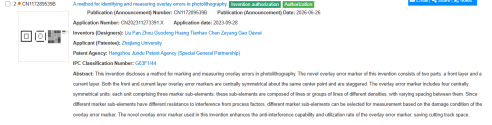
Yungsi Electronics a leading packaging and testing enterprise on the STAR Market, announced an investment project for its "Microelectronics High-End Integrated Circuit IC Packaging and Testing Phase III." Located in the Nantong International Ecological Park in Yuyao, Zhejiang Province, the project is planned to have a total investment of 10.3 billion RMB. This marks another major capacity expansion for the company following its completion of Phase II.
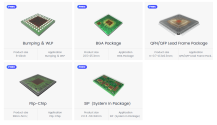
The project spans 96 months (8 years), with construction progressing in phases and capacity released gradually to match market demand. The facility will focus on cutting-edge advanced packaging technologies, specifically laying out production lines for BUMP ( bumps), 2.5D/3D heterogeneous integration, FC (Fan-Out) underfill/bumping, and high-end Wire Bonding (WB). These are critical processes in the industry's shift towards higher-performance chips.
As chip manufacturing processes approach physical limits, advanced packaging has become the core path for boosting chip performance and computing power. Demand from downstream sectors like AI (Artificial Intelligence) and High-Performance Computing is surging, creating a clear strategic window for domestic companies. The company noted that this investment follows a trend of heavy capital expenditure by industry leaders in 2026. Competitors such as JCET Technology (planning a 7.8 billion RMB project), Infineum (raising funds for storage and auto electronics packaging), and Win Smart Tech are also aggressively expanding their advanced packaging capacity, reflecting the long-term scarcity of high-end testing resources driven by computing power needs. Yungsi has already built an "FH-BSAP" modular advanced packaging platform. Their 2.5D packaging line successfully went live in Q4 2024, providing a solid technical base for the Phase III industrialization.
Yungsi Electronics stated that this investment will not significantly impact the current year's operating performance in the short term. However, upon full commissioning, the new advanced packaging capacity is expected to drive long-term core growth, strengthening the company's competitive position in the domestic high-end packaging market.
The project spans 96 months (8 years), with construction progressing in phases and capacity released gradually to match market demand. The facility will focus on cutting-edge advanced packaging technologies, specifically laying out production lines for BUMP ( bumps), 2.5D/3D heterogeneous integration, FC (Fan-Out) underfill/bumping, and high-end Wire Bonding (WB). These are critical processes in the industry's shift towards higher-performance chips.
As chip manufacturing processes approach physical limits, advanced packaging has become the core path for boosting chip performance and computing power. Demand from downstream sectors like AI (Artificial Intelligence) and High-Performance Computing is surging, creating a clear strategic window for domestic companies. The company noted that this investment follows a trend of heavy capital expenditure by industry leaders in 2026. Competitors such as JCET Technology (planning a 7.8 billion RMB project), Infineum (raising funds for storage and auto electronics packaging), and Win Smart Tech are also aggressively expanding their advanced packaging capacity, reflecting the long-term scarcity of high-end testing resources driven by computing power needs. Yungsi has already built an "FH-BSAP" modular advanced packaging platform. Their 2.5D packaging line successfully went live in Q4 2024, providing a solid technical base for the Phase III industrialization.
Yungsi Electronics stated that this investment will not significantly impact the current year's operating performance in the short term. However, upon full commissioning, the new advanced packaging capacity is expected to drive long-term core growth, strengthening the company's competitive position in the domestic high-end packaging market.
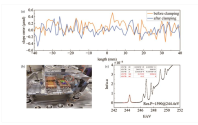
Real-time active droplet synchronization via long-baseline dual-beam detection in LPP-EUV sources
Abstract
In laser-produced plasma (LPP) extreme ultraviolet (EUV) light sources, precise synchronization between high-energy laser pulses and micrometer-sized tin droplets is a crucial prerequisite for achieving stable radiation output. However, droplets are highly susceptible to random perturbations during generation, leading to non-periodic velocity jitter and positional drift. Consequently, conventional triggering strategies based on fixed frequencies or fixed delays struggle to maintain a stable hit rate, resulting in off-center hits or misses. To address this issue, we propose and develop a real-time active compensation synchronization system based on long-baseline dual-beam detection. The system employs a dual-channel photoelectric detection architecture to capture the flight status of the droplets. A field-programmable gate array (FPGA) calculates the instantaneous velocity of individual droplets at the hardware level, dynamically generating a feed-forward compensated trigger signal. Furthermore, the trigger logic is designed with excellent engineering robustness, effectively mitigating system errors introduced by discrepancies between the two detection beam spots and signal fluctuations. Performance tests demonstrate that the total electrical timing delay error of the system is controlled within ± 2.2 ns. Targeting experiments demonstrate that the system effectively mitigates longitudinal droplet jitter. As a result, off-center hits and misses are significantly reduced, ensuring stable laser irradiation on the droplets. The average intensity of the plasma radiation signal is enhanced from 14.89 mV (without compensation) to 46.78 mV. With its compact structure and reliable operation, this system provides an effective engineering reference for the long-term stable operation of high-frequency, high-power LPP-EUV light sources.
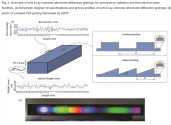
Diffraction gratings for synchrotron radiation and free-electron lasers
Abstract
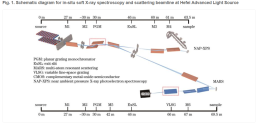
Accelerator light sources, represented by synchrotron radiation and free-electron lasers, have become important multidisciplinary platforms supporting cutting-edge scientific research. Diffraction gratings, as key dispersive elements, play an irreplaceable role, and their manufacturing quality directly determines the overall performance of optical systems such as monochromators and spectrometers. With the continuous improvement of light source brightness and coherence, the fabrication technology of soft X-ray and extreme ultraviolet diffraction gratings faces significant challenges, especially in the precise control of linear density distribution in variable-pitch gratings, the nanoscale groove structure of blazed gratings (such as small blaze angle control), and the requirements for substrate roughness and surface accuracy. Currently, significant progress has been made in the fabrication technology of such gratings: grating lengths can exceed 300 mm; the linear density control precision of variable-pitch gratings can reach the order of 10⁻⁵ , with a resolution exceeding 50,000; and in small blaze angle gratings with linear densities of hundreds of lines/mm, the blaze angle can be controlled below 1°, with the lowest currently reaching 0.11°. This article briefly introduces the characteristics of relevant gratings, and systematically reviews the research progress and development trends in cutting-edge areas such as the control of linear density distribution of variable-pitch gratings and the fabrication of small blaze angle gratings in recent years, in order to provide a reference for the design, fabrication and application of gratings, focusing on the development needs of synchrotron radiation and free-electron laser devices.
A rapid modeling method for random effects in extreme ultraviolet (EUV) photoresist
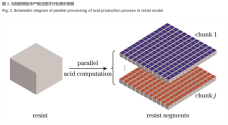
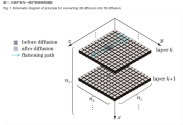
Compared to deep ultraviolet (DUV) light sources, extreme ultraviolet (EUV) light sources have higher photon energies, and their random photon fluctuations have a greater impact on photoresist morphology. To address the need for rapid modeling of random effects during the EUV photoresist exposure-baking process, a fast discrete event modeling method for the post-baking (PEB) process is proposed based on the Gillespie algorithm of the master chemical equation. The innovation of this method lies in: first, separating and modeling four types of reactions—deprotection, neutralization, acid diffusion, and alkali diffusion; second, constructing an accumulation array through one-dimensional mapping of three-dimensional coordinates and employing a binary search algorithm to accurately locate reaction units; and finally, combining a batch delayed update mechanism with a one-dimensional diffusion optimization strategy to achieve efficient simulation of the PEB process. Simulation data shows that, while maintaining essentially the same simulation accuracy, this method achieves a 2.15–3.75-fold improvement in computational efficiency. The proposed method not only provides an efficient numerical solution for modeling random effects in EUV photoresists, but its methodological framework also has significant reference value for simulating complex reaction systems.
KAG Precision Machinery Makes its Debut at CFCF2026.
Artificial intelligence and big data are driving exponential growth in global computing power. From cloud computing to edge computing, every leap in data is inseparable from the innovation of underlying optical interconnect technology. With the exponential increase in speed, the production capacity of optical modules and the demand for automation are beginning to surge. Every process presents a challenge to automated equipment.
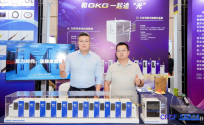
From June 25th to 27th, 2026, the 11th China Optical Connectivity Conference (CFCF2026) was held at the Suzhou Longemont Convention Center. KEG Precision Machinery made its debut at an optical communication industry conference, showcasing its automated optical module assembly line, fully automated pulse heating eutectic generator, and high-precision contact dispensing system. Leveraging its years of accumulated fundamental common technologies and equipment matrix covering optical module manufacturing, KEG Precision Machinery engaged in in-depth exchanges with industry peers on cutting-edge processes and jointly explored new paths for mass production in optical communication.
Kaige Precision Machinery's Flexible Automated Manufacturing System (FMS) is based on a standardized equipment platform. Through flexible configuration of different execution modules, it enables rapid function switching, thus adapting to diverse industry application scenarios. The automated optical module production line solution covers multiple optical module scenarios, adopting a gantry dual-drive linear motor architecture. Optimized through CAE simulation, it deeply integrates the FMS modular standard design concept with a unified software framework, ultimately achieving full automation of the optical module assembly process. Maximum capacity (UPH) reaches 400pcs ; supports non-stop material changeover and modular switching of execution units; repeatability accuracy ±5μm, assembly accuracy ±25μm; complies with CE safety standards ; process capability index CPK≥1.67; and supports intelligent full-process control and remote operation and maintenance .