Top AI conference reverses ban on papers from US-sanctioned entities after Chinese boycott

You are using an out of date browser. It may not display this or other websites correctly.
You should upgrade or use an alternative browser.
You should upgrade or use an alternative browser.
News on China's scientific and technological development.
- Thread starter Quickie
- Start date

“科创中国”公众号消息,我国首台商用 2x6MV(IT之家注:12 兆伏)串列加速器日前在江西瑞昌核物理应用研究院加速器研发中心完成组装、冷调试,关键性能指标达到设计要求,正式完成生产下线,标志着国产高端科研装备取得阶段性进展。
China's first commercial 2x6MV (12-megavolt) tandem accelerator recently completed assembly and "cold commissioning" at the Accelerator R&D Center of the Ruichang Institute of Applied Nuclear Physics in Jiangxi Province. With its key performance indicators meeting design specifications, the unit has officially rolled off the production line, marking a significant milestone in the development of domestically produced, high-end scientific research equipment.

supercat
Colonel
Another one goes to China.
Huawei poaches top German scientist, as scholars blame academic system
Lawmakers call for tighter rules over fears of Chinese tech know-how theft, sabotage
Huawei Technologies has poached a prominent German scientist from a leading public institution, highlighting the difficulty that the country faces in keeping staff from joining well-resourced and fast-moving Chinese tech giants.
Shanghai Institute of Optics and Fine Mechanics has made new progress in laser welding process monitoring.
Recently, the team led by Professor Yang Shanglu of the Laser Intelligent Manufacturing Technology R&D Center of the High-end Optoelectronic Equipment Department of the Shanghai Institute of Optics and Fine Mechanics, Chinese Academy of Sciences, has made progress in laser welding process monitoring. The relevant results, entitled " An explainable multi-modality fusion framework for laser weld penetration classification of Al–Si coated PHS 22MnB5" , were published in Optics & Laser Technology .
As high-end manufacturing demands increasingly higher welding quality and reliability, monitoring the weld penetration during laser welding has become a crucial aspect of ensuring structural safety and service performance. However, traditional methods relying on single sensor signals and manual feature engineering are insufficient to fully characterize the complex physical behavior of the welding process, thus limiting the improvement of online precision identification capabilities.
To address these challenges, the research team constructed a multi-sensor fusion monitoring platform that simultaneously acquires acoustic signals, plasma spectral signals, and molten pool image signals during the welding process, establishing a multimodal dataset covering four types of weld depth states. Based on this, they innovatively proposed a hybrid model framework (Fusion-XGBNet) combining a neural network ( NN ) and extreme gradient boosting ( XGBoost ) . This model utilizes neural networks to achieve automatic feature extraction and deep fusion of raw multi-source data, and introduces XGBoost for efficient discrimination of fused features. Finally, an adaptive strategy enables collaborative decision-making between the two model outputs, overcoming the reliance on manual feature engineering in traditional methods.
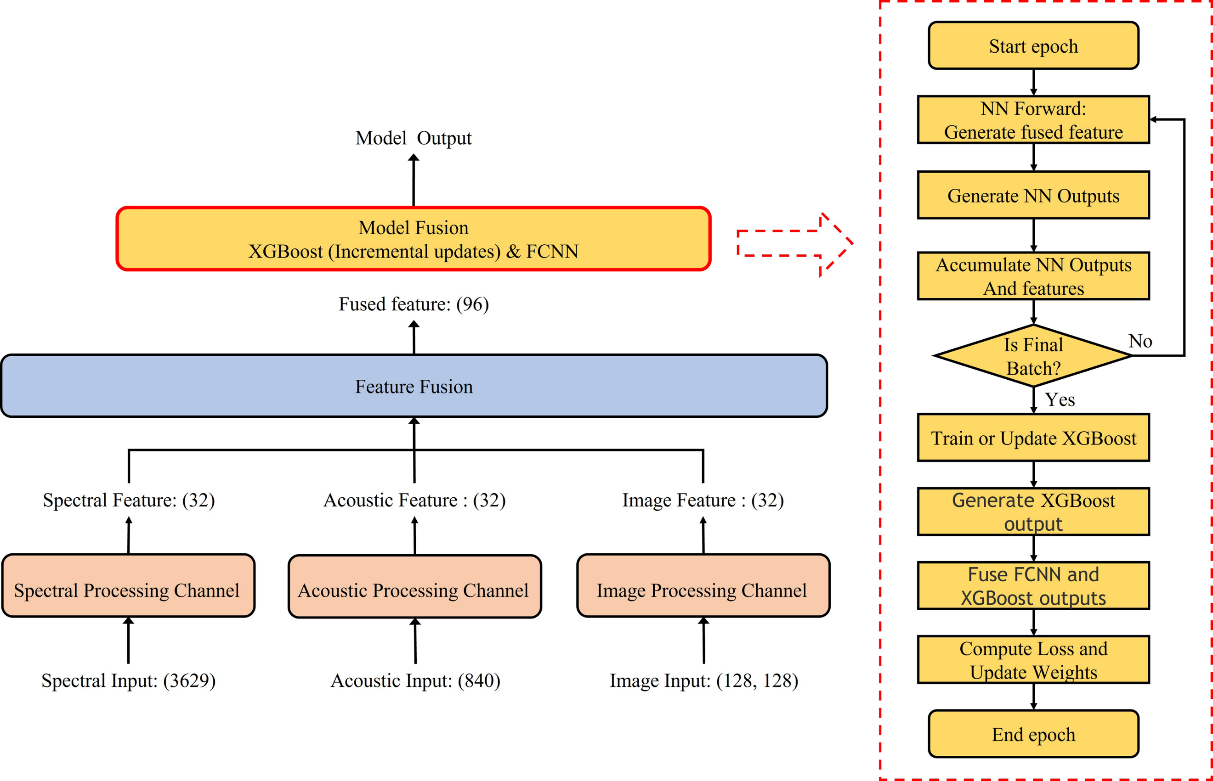
A multimodal machine learning framework for fusion state classification (Fusion-XGBNet)
Experimental results show that the fusion model achieved an average recognition accuracy of 95.29% on the test set. Furthermore, using Grad-CAM++ visualization analysis, it was clearly identified that the molten pool contour region and the characteristic spectra near 367 nm , 437 nm , 580 nm , and 622 nm make crucial contributions to the model's decision-making, significantly enhancing the model's interpretability and reliability for engineering applications.
google translated:
The LPPHT micro/nano diamond production line of Zhongke Powder Research (Henan) Superhard Materials Co., Ltd. was officially launched at the pilot plant in Zhengzhou High-tech Zone. This is the world's first LPPHT micro/nano diamond production line, marking a new journey in the industrialization of micro/nano diamonds in my country and holding great significance for Zhengzhou's development as a city of computing power, a city of diamonds (superhard materials), and a city of quantum computing.
supercat
Colonel
Huawei's net profit grew 8.6% in 2025.

Another paper on the well-documented-by-now trend of shifting global publications.
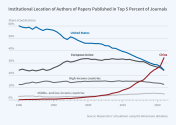
Although Western nations have dominated global scientific research since the nineteenth century, recent decades have witnessed profound shifts in where research is conducted, what topics it addresses, and how widely its findings spread across borders. In (NBER Working Paper 34694), and provide a comprehensive analysis of the evolution of global science between 1980 and 2022. Using data on 44 million publications from nearly 12,000 journals, they track where science is produced, based on author affiliations, what science studies, based on geographic references in titles and abstracts, and where science is consumed, based on citation patterns.
The US share of global publications declined from 40 percent in 1980 to 15 percent in 2022, while China's share rose from near zero to 32 percent. In 2022, China produced over 35 percent of the publications in top-tier journals, more than either the US or the EU. Other middle- and low-income countries collectively account for 21 percent of global publications, comparable to high-income EU countries combined.

‘Impossible for Chinese’: Yale scientist Zhang Kai leaves US to break racial ceiling
Pioneering work involves observing proteins inside the body during exercise, effectively capturing their activity in a natural state