Food & Resource Security

lcloo

Major
Chinese consumers have been changing their preference for other meat proteins than pork, and the trend has cause oversupply of pork and resulted in cheap pork prices.

Imported soybean are almost exclusively used as farmed animal feed for pigs. Lesser demand for pork resulted in less demand for imported soybean. Compare to previous decades in China, more beef, mutton, chicken and seafood are in greater demand over pork.

Thus it is inevitable that China's soybean imported will be reduced in the future.
 

Wrought

Captain
Registered Member
Paper on the evolving strategy towards food security and its long-term trajectory over the next few decades.

This consultation paper synthesises the available evidence into a central hypothesis: that China has begun to apply to food and agriculture some of the same system-level tools it has previously used in sectors such as energy and transport. It considers what that could mean for domestic production, global trade flows and the future of protein supply. The purpose of this paper is to invite discussion on the assumptions, signals and scenarios presented and to use this to collectively shape more sustainable outcomes for all stakeholders involved.

Early signals indicate that China has entered “Year 0” of food system transformation. New and emerging government policies centre food security, with a central pillar in reshaping protein supply through technological innovation, including alternative protein pathways. Domestic innovation clusters around alternative proteins, fermentation-derived ingredients and agricultural biotechnology are emerging.11 State-aligned capital is flowing into infrastructure, and policy and regulations are signalling coordinated action, notably the approval of commercialised genetically engineered maize and soya varieties.12 While demand-side mechanisms are still somewhat limited, this is consistent with the sequencing observed in prior transitions, where supplyside capacity was built and demand activation reinforced it.

Please, Log in or Register to view URLs content!
 

Wrought

Captain
Registered Member
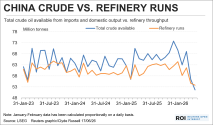
Counterintuitively, it seems that crude inventories continued to rise in April. Imports dropped sharply, but so too did refinery runs. There will eventually be a tipping point, of course, but apparently not yet.

China's surplus crude amounted to about 430,000 barrels per day in April as the 20% drop in imports was outweighed by refinery processing sliding to the lowest since August 2022. The ongoing building of inventories by the world's biggest crude importer underlines that China is in quite a different ‌situation to the rest of the world, which is burning through oil stockpiles in order to compensate for the loss of about 12 million bpd of supply to the effective closure of the Strait of Hormuz.

Please, Log in or Register to view URLs content!
 

lcloo

Major
Another surprise to many who are unaware.

....."China has issued the first batch of fuel export quotas for the new year, at a total of 19 million tons, Reuters
Please, Log in or Register to view URLs content!
today, citing unnamed sources. The volumes were relatively unchanged on the first fuel export quota batch for this year.


The quotas include gasoline, diesel, and jet fuel. In addition to those, Beijing also issued export quotas for 8 million tons of low-sulfur bunkering fuel. The bulk of the quotas, at over 70%, are going to state-owned energy majors Sinopec and CNPC. The two together received fuel export quotas for a total of 13.76 million tons of gasoline, diesel, and jet fuel.".....

Please, Log in or Register to view URLs content!
 
Top