
You are using an out of date browser. It may not display this or other websites correctly.
You should upgrade or use an alternative browser.
You should upgrade or use an alternative browser.
Food & Resource Security
- Thread starter Maikeru
- Start date

Article on natural gas storage, a difficult technical problem which was resolved only recently.
The row of enormous storage tanks in Yancheng holds liquefied natural gas at a temperature of minus 260 degrees Fahrenheit, or minus 162 degrees Celsius. When the gas is allowed to warm gradually to room temperature through a system of pipes, it expands 600-fold. The tanks in Yancheng are connected to a long pier into the Yellow Sea to unload L.N.G. from ships.
Papers published in Chinese engineering journals reveal the design breakthroughs involved in holding enormous quantities of supercooled natural gas, which can be explosive if ignited or warmed too quickly. Each storage tank has an outer concrete frame to provide rigidity. Inside the concrete walls is a second layer of flexible plates made from a special steel alloy with a lot of manganese and nickel. Sophisticated robots weld the plates.

supercat
Colonel
After 20 years of research, Chinese scientists finally elucidated the genetic mechanism behind some rice variety's resistance to bacteria blight. Bacteria blight is one of the world’s most devastating plant diseases, as it can cause yield loss of over 70 percent. China's research provides a basis for breeding both disease-resistant and high-yield rice variety.
Contrary to global trends, Chinese oil stockpiles continued to rise in March.
However, the time-lag effect means the picture will probably change from April onwards.
LAUNCESTON, Australia, April 16 (Reuters) - China continued to build the world's largest stockpile of crude oil in March even as the rest of the world started to draw on inventories to compensate for the loss of millions of barrels from the effective closure of the Strait of Hormuz. China, the world's biggest crude importer, had surplus oil of 1.74 million barrels per day (bpd) in March, according to calculations based on official data. For the first quarter China's excess crude was 1.41 million bpd, down from the record high of 2.67 million bpd in December but up from the average of 1.13 million bpd for the whole of 2025.
However, the time-lag effect means the picture will probably change from April onwards.
The continuing building of China's crude stockpiles in March came as imports were largely unaffected by the conflict in the Middle East, which started on February 28 when the United States and Israel launched an aerial campaign against Iran. The oil delivered to China in March would have exited the Strait of Hormuz prior to the conflict's start, but imports from April onwards are likely to be affected.
A Russian paper analysing Chinese mobilisation towards food and resource security.
Abstract
This article examines China’s comprehensive mobilization policies undertaken since the early 2020s. Analysis reveals that they span multiple domains. First, China is developing a protected inland reserve of critical industrial capacity. Second, it is strengthening emergency supply mechanisms and accelerating the accumulation of food and raw-material reserves. Third, it is enhancing civil defense and urban infrastructure resilience, including the expansion of the ‘people’s air defense’ system. Fourth, recently amended legislation now regulates military service and the government’s obligations towards fallen servicemen’s families. The scope and pace of these measures indicate that Beijing anticipates a severe military-political crisis in the coming decade. This partly explains Chinese foreign policy’s apparent contradictions, with stated global ambitions coexisting alongside strategic caution and risk aversion.
supercat
Colonel
Luanshya Copper Mine to Restart Production After 2 Decade Hiatus
China Nonferrous Metals owns 80% whilst Zambia owns the rest. Despite its potential, the mine flooded and production was halted for years. Reuters says that production will be 100 000 tons per annum by 2030.
The CNMC news release has great pictures and details of the engineering done to restart the mine and pump the water out if anyone is interested. They mention that the mine will have a total production of 2 million tonnes, though that would be for other minerals incl. the copper.
China Nonferrous Metals owns 80% whilst Zambia owns the rest. Despite its potential, the mine flooded and production was halted for years. Reuters says that production will be 100 000 tons per annum by 2030.
The CNMC news release has great pictures and details of the engineering done to restart the mine and pump the water out if anyone is interested. They mention that the mine will have a total production of 2 million tonnes, though that would be for other minerals incl. the copper.
supercat
Colonel
China is not only the world's top refiners of many minerals. It also has the world's largest reserves of 14 minerals, including rare earths, tungsten, molybdenum, antimony, and gallium.
Adam Tooze writing on the intensifying efforts w.r.t. food security. He published a piece in FT.
He also elaborated further on the subject in his substack.
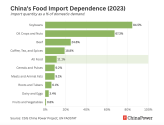
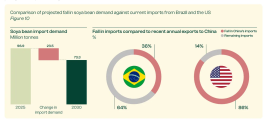
Beijing is coordinating central and provincial government, state-owned enterprises and financial institutions around . It has licensed the commercialisation of genetically modified maize and soya. Research clusters are forming around , fermentation-derived ingredients, feed additives and agricultural biotechnology. State banks are on hand to provide cheap finance. To channel demand, Beijing is tightening food and feed standards and tweaking procurement requirements.
This is the kind of whole-system policy that has given China a commanding lead in the new energy sectors. With all the levers in play, we may, by as early as 2030, see a significant fall in soyabean demand, slashing imports from the US dramatically. By 2040, innovation and efficiency gains could plausibly turn China into a net exporter of poultry, dairy, eggs, fish and seafood. If agriculture follows the industrial policy timeline, by 2050 we should expect to see China emerging as a major source of ”.
He also elaborated further on the subject in his substack.