The Institute of Microelectronics has made significant progress in 4H/3C-SiC single-crystal composite substrates and devices.
In a groundbreaking advancement in power electronics, researchers from the Institute of Microelectronics, Chinese Academy of Sciences, led by Dr. Liu Xinyu, in collaboration with institutions including the University of Hong Kong, Qinghe Epistar, Wuhan University, and the Institute of Physics, CAS, have successfully developed a large-size 4H/3C-SiC single-crystal composite substrate — a novel engineered platform that overcomes longstanding limitations of silicon carbide (SiC) in low-voltage (<600V) applications.
- Problem Addressed: Traditional 4H-SiC substrates have high resistivity (15–20 mΩ·cm), causing excessive substrate resistance that limits device efficiency and current capability in low-voltage power devices. Substrate thinning, a current workaround, increases cost and brittleness.
- Innovative Solution: The team pioneered a heterogeneous integration of a high-quality 4H-SiC epilayer (for high breakdown field and crystallinity) bonded to a low-resistivity 3C-SiC substrate (resistivity <0.5 mΩ·cm, doping up to 10²⁰ cm⁻³).
- Record-Low Resistivity: The composite substrate achieved a record-low resistivity of 0.39 mΩ·cm — 45× lower than conventional 4H-SiC.
- Advanced Bonding Technology: Using hydrogen ion implantation, ion beam surface activation, and precise thermal processing, the team achieved:
- 87% bonding yield
- World’s lowest thermal boundary resistance (1±0.7/-0.6 m²·K/GW)
- Ultra-low interface potential barrier (<30.4 mV), enabling efficient electron tunneling
- High-Quality Surface: Post-bonding processes (annealing, CMP, atomic etching) produced a surface suitable for epitaxial growth.
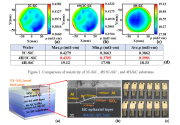
Performance:
- A 200V Schottky barrier diodefabricated on the composite substrate achieved:
- Specific on-resistance of 0.50 mΩ·cm² — 47% lower than standard 4H-SiC devices
- Surge current capability of 312A, demonstrating superior electrothermal robustness
- Within the 100–600V range, the engineered substrate reduces on-resistance by 3–6× compared to conventional 4H-SiC, surpassing the theoretical performance limits of pure 4H-SiC devices.
This innovation breaks the “dilemma” that has hindered SiC adoption in low-voltage markets (e.g., EV auxiliaries, consumer electronics, data centers), where silicon still dominates due to cost and efficiency. The 4H/3C-SiC composite enables high-performance, high-efficiency, and cost-effective SiC devices for the next generation of power electronics.