

You are using an out of date browser. It may not display this or other websites correctly.
You should upgrade or use an alternative browser.
You should upgrade or use an alternative browser.
Chinese semiconductor thread II
- Thread starter vincent
- Start date
i heard that SMEE's DUV business will eventually spin off to YuLiangSheng.
A reporter from the Science and Technology Innovation Board Daily noted that Shanghai Microelectronics is currently in a crucial stage of asset restructuring. According to public information, its core assets have been split into multiple segments: the front-end lithography machine business has been injected into Shanghai Yuliangsheng Technology Co., Ltd., the back-end packaging lithography equipment has been separated into Chip-on-Micro, and Shanghai Microelectronics has retained the research and development of next-generation technologies such as extreme ultraviolet (EUV).
Fudou New Materials received investment from SDIC Venture Capital, focusing on the electronic specialty gases and precursors sector.
According to SDIC Venture Capital, the company recently completed an investment in Fujian Fudou New Materials Co., Ltd., a company specializing in the research and development and production of electronic specialty gases and precursors. The funds will be mainly used for the research and development iteration, capacity expansion and market channel development of electronic specialty gases and precursors for advanced processes, accelerating the mass application of the company's products in leading customers of advanced integrated circuit processes.
Established in December 2020, Fudou New Materials focuses on the R&D, production, and industrial application of electronic specialty gases and precursors, providing one-stop key material solutions for high-end manufacturing industries such as ultra-large-scale integrated circuits, display panels, and photovoltaics. The company's core team has over 20 years of experience in the electronic specialty gases industry, bringing together professionals from leading domestic research institutions and manufacturing enterprises. They have independently mastered core technologies in four high-barrier areas: synthesis and preparation, separation and purification, analysis and testing, and packaging treatment. Fudou New Materials is one of the few professional teams in China possessing the technology to produce electronic specialty gases for ultra-large-scale integrated circuit manufacturing.
According to reports, Fudou New Materials is a national high-tech enterprise, a science and technology-based SME, a Fujian Province specialized and innovative SME, an innovative SME, and a gazelle enterprise. It has also received honors such as Outstanding Enterprise in New Materials at the National Innovation and Entrepreneurship Competition. With its profound technological foundation, Fudou New Materials has built a rich product portfolio, covering more than 30 kinds of electronic specialty gases, including hydrogen bromide (HBr), ethylene (C₂H₄), diiodosilane (DIS), and tungsten pentachloride (WCl₅), as well as more than 10 kinds of precursors. These are widely used in key processes such as integrated circuit etching, film formation, doping, and cleaning.
The Avip Semiconductor Equipment R&D and Production Project has been established in Qingdao West Coast New Area.
According to the Qingdao West Coast New Area International Investment Promotion Bureau, at the beginning of 2026, the Aivip Semiconductor Equipment R&D and Production Project was established in the Qingdao West Coast New Area.
The Aivip Semiconductor Equipment R&D and Production Project is a joint investment of Zhejiang Aivip Technology Co., Ltd. and Haichuang Intelligent Equipment (Yantai) Co., Ltd., with a total investment of 100 million yuan. Focusing on semiconductor, MEMS, and new energy device manufacturing, as well as AR/VR fields , the project will prioritize the R&D and production of core equipment such as physical vapor deposition/magnetron sputtering equipment, ion beam etching machines, and reactive ion etching machines, helping the New Area achieve new breakthroughs in the high-end integrated circuit equipment segment.
Zhejiang Aivip Technology Co., Ltd., established in 2019, is a holding subsidiary of Haichuang Intelligent Equipment (Yantai) Co., Ltd. Its founder, Dr. Tang Yunjun, is a Chinese-American and a national high-level talent with over 20 years of experience in physics and materials science research. The company has a core technical team of over 30 people and has achieved local production of semiconductor thin film deposition and etching equipment, successfully becoming a supplier to well-known domestic semiconductor and MEMS customers. Its core product—thin film deposition and etching equipment—is a key process equipment in integrated circuit manufacturing , with high technological barriers and a long-term reliance on imports.
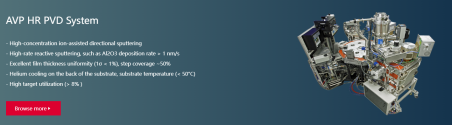
According to an international investment promotion announcement from Qingdao West Coast New Area, Aivip Technology's independent R&D and industrialization capabilities in this field are of positive significance for enhancing the self-control level of key links in my country's semiconductor industry chain and breaking international technological monopolies.
Its too singular. Need to cluster all the tools together.
The Avip Semiconductor Equipment R&D and Production Project has been established in Qingdao West Coast New Area.
According to the Qingdao West Coast New Area International Investment Promotion Bureau, at the beginning of 2026, the Aivip Semiconductor Equipment R&D and Production Project was established in the Qingdao West Coast New Area.
The Aivip Semiconductor Equipment R&D and Production Project is a joint investment of Zhejiang Aivip Technology Co., Ltd. and Haichuang Intelligent Equipment (Yantai) Co., Ltd., with a total investment of 100 million yuan. Focusing on semiconductor, MEMS, and new energy device manufacturing, as well as AR/VR fields , the project will prioritize the R&D and production of core equipment such as physical vapor deposition/magnetron sputtering equipment, ion beam etching machines, and reactive ion etching machines, helping the New Area achieve new breakthroughs in the high-end integrated circuit equipment segment.
Zhejiang Aivip Technology Co., Ltd., established in 2019, is a holding subsidiary of Haichuang Intelligent Equipment (Yantai) Co., Ltd. Its founder, Dr. Tang Yunjun, is a Chinese-American and a national high-level talent with over 20 years of experience in physics and materials science research. The company has a core technical team of over 30 people and has achieved local production of semiconductor thin film deposition and etching equipment, successfully becoming a supplier to well-known domestic semiconductor and MEMS customers. Its core product—thin film deposition and etching equipment—is a key process equipment in integrated circuit manufacturing , with high technological barriers and a long-term reliance on imports.
View attachment 167657
According to an international investment promotion announcement from Qingdao West Coast New Area, Aivip Technology's independent R&D and industrialization capabilities in this field are of positive significance for enhancing the self-control level of key links in my country's semiconductor industry chain and breaking international technological monopolies.

Shanghai Microelectronics makes a new move in asset restructuring!
Shanghai Microelectronics has made a key move in its asset restructuring by withdrawing as a shareholder from Weiyao Industrial Co., Ltd., transferring full ownership to Xinshang Micro-equipment Technology Co., Ltd., which now holds a subscribed capital of RMB 228.5 million.
This change marks part of a broader strategic reorganization, where Shanghai Microelectronics is splitting its business into distinct segments:
- Front-end lithography assets are being transferred to Shanghai Yuliangsheng Technology Co., Ltd.
- Back-end packaging and testing equipment have been spun off to Chip-on-Micro, which has already delivered 500 stepper lithography machines and showcased advanced equipment like laser annealing, optical metrology, and inspection tools. The first independently developed 350nm stepper lithography machine (AST6200) was successfully shipped in November 2025 for applications in power, RF, MEMs, optoelectronics, and Micro LED.
Weiyao Industrial, originally established in 2003 as a wholly-owned subsidiary of Shanghai Microelectronics, operates in metal processing, materials sales, equipment maintenance, and related services. Its close ties to Shanghai Microelectronics—especially through shared management, technology, and personnel—make this transfer significant.
Industry analysts interpret the move as a deliberate effort to separate R&D from industrialization, enabling:
Industry analysts interpret the move as a deliberate effort to separate R&D from industrialization, enabling:
- Chip-on-Micro to become a standalone, market-driven platform for commercializing mature technologies.
- Shanghai Microelectronics to focus exclusively on next-generation research, such as extreme ultraviolet (EUV) lithography.
Sichuan: Focusing on key areas such as dedicated chips, large-scale models, and intelligent terminals, Sichuan is making every effort to achieve breakthroughs in key core technologies in advanced computing, embodied intelligence, low-altitude intelligence, and brain-like intelligence.
On January 5, the General Office of the Sichuan Provincial People's Government issued the "Construction Plan for the Sichuan Provincial National Digital Economy Innovation and Development Pilot Zone," accelerating breakthroughs in key core digital technologies. The plan includes implementing major science and technology projects such as artificial intelligence, focusing on key areas such as dedicated chips, large-scale models, and intelligent terminals (robots, low-altitude intelligent products, brain-computer interface products, etc.), striving to achieve breakthroughs in key core technologies in advanced computing, embodied intelligence, low-altitude intelligence, and brain-like intelligence, and conducting research on key basic materials, core components and devices, and terminal products. The plan also supports the establishment of digital economy innovation consortia among provincial industry enterprises, exploring new models for the transformation of digital technology achievements and a long-term cooperation mechanism that leverages the strengths of multiple parties, shares benefits, and shares risks.
Phase defects classification in extreme ultraviolet mask blanks via ResNet-50 with an attention mechanism
Abstract
In extreme ultraviolet (EUV) mask blanks, understanding defect characteristics, such as the defect type, is crucial for achieving defect-free masks or implementing defect mitigation strategies. In this paper, we propose a transfer learning approach based on ResNet-50, enhanced by incorporating a convolutional block attention module (CBAM), to distinguish between bump and pit defects from reflected field-intensity images. These images were generated through simulations using the rigorous finite-difference time-domain (FDTD). By leveraging ResNet-50′s strong feature extraction capabilities and CBAM's ability to emphasize important regions while suppressing irrelevant ones, the proposed approach achieved 100% classification accuracy, making it a cost-effective alternative to manual and non-destructive defect classification methods.
The national standard "Chip-to-Interconnect Interface Specification" has been officially released.
China has officially released the first batch of national standards in integrated circuit interconnect interfaces—Interconnect Interface Specifications (GB/T 46280.1–2025 to GB/T 46280.5–2025)—set to take effect on March 1, 2026. These standards, developed by the Zhongguancun High-Performance Chip Interconnect Technology Alliance (HiPi Alliance), China Electronics Technology Standardization Institute, Tsinghua University, and over ten industry leaders, establish a unified framework for chip-to-chip interconnects.
The Chip-to-Interconnect Interface Specification defines layered architecture, functional requirements, and interface protocols, supporting diverse packaging, bus types, and process nodes while achieving internationally advanced performance. It enhances interoperability between chips from different suppliers and drives innovation in packaging, system design, and manufacturing.
HiPi Alliance, founded in 2022 with 33 founding members including Tsinghua University, SMIC, HiSilicon, and others, now includes 191 organizations (80% enterprises), covering the full IC industry chain. Beyond this standard, it is also advancing a 3D packaging-compatible interconnect specification. This marks a major milestone in China’s self-reliant semiconductor ecosystem.
The Chip-to-Interconnect Interface Specification defines layered architecture, functional requirements, and interface protocols, supporting diverse packaging, bus types, and process nodes while achieving internationally advanced performance. It enhances interoperability between chips from different suppliers and drives innovation in packaging, system design, and manufacturing.
HiPi Alliance, founded in 2022 with 33 founding members including Tsinghua University, SMIC, HiSilicon, and others, now includes 191 organizations (80% enterprises), covering the full IC industry chain. Beyond this standard, it is also advancing a 3D packaging-compatible interconnect specification. This marks a major milestone in China’s self-reliant semiconductor ecosystem.
not sure if that is a competitor to this or not:
The national standard "Chip-to-Interconnect Interface Specification" has been officially released.China has officially released the first batch of national standards in integrated circuit interconnect interfaces—Interconnect Interface Specifications (GB/T 46280.1–2025 to GB/T 46280.5–2025)—set to take effect on March 1, 2026. These standards, developed by the Zhongguancun High-Performance Chip Interconnect Technology Alliance (HiPi Alliance), China Electronics Technology Standardization Institute, Tsinghua University, and over ten industry leaders, establish a unified framework for chip-to-chip interconnects.
The Chip-to-Interconnect Interface Specification defines layered architecture, functional requirements, and interface protocols, supporting diverse packaging, bus types, and process nodes while achieving internationally advanced performance. It enhances interoperability between chips from different suppliers and drives innovation in packaging, system design, and manufacturing.
HiPi Alliance, founded in 2022 with 33 founding members including Tsinghua University, SMIC, HiSilicon, and others, now includes 191 organizations (80% enterprises), covering the full IC industry chain. Beyond this standard, it is also advancing a 3D packaging-compatible interconnect specification. This marks a major milestone in China’s self-reliant semiconductor ecosystem.