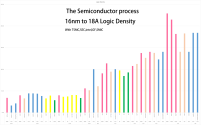
Anyone has access to the Techinsights report on N+3 feature sizes and transistor density?

You are using an out of date browser. It may not display this or other websites correctly.
You should upgrade or use an alternative browser.
You should upgrade or use an alternative browser.
Chinese semiconductor thread II
- Thread starter vincent
- Start date
On Xiangshan project, I hope some Chinese vendor will produce SBCs using Xiangshan cores, as they're quite competitive against their peers. For example, Tenstorrent plans to sell its Ascalon cores likely Q2 next year; Tenstorrent has reported performance for Ascalon around ~22 SPECint2006/GHz. Kunminghu V3 also targets roughly 22 SPECint2006/GHz. It puzzles me that so few companies are adopting these cores in SBCs; even the older one, Kunminghu V2 is 15/GHz, which is about Zen2 performance (10.5/GHz at boost, 9/GHz at base).Chipsys' GalaxSim emulator has been ranked among the top-rated domestic EDA tools.
Chipsys' GalaxSim emulator has been ranked among the top domestic EDA tools in China’s first user-driven "Domestic EDA Tool Reputation Ranking" campaign by China Electronics News. The recognition is based on real-user feedback and highlights GalaxSim's strong reputation for being easy to use, user-friendly, and high-performing.
Since its launch in 2021, GalaxSim has been adopted by leading institutions including the Chinese Academy of Sciences Semiconductor, ZTE Microelectronics, Nuclei Technology, and Black Sesame Technologies. Its latest version, GalaxSim Turbo 3.0, boosts verification efficiency for RISC-V processors (e.g., OpenChip "Xiangshan" Kunming Lake architecture) by nearly three times, thanks to its dual-event and cycle-driven simulation engines.
Key advantages over traditional tools like Verilator include:
This move supports China’s goal of achieving independent control and sustainable advancement in semiconductor technology.
SMIC N+3 :
Some metal pitches are smaller than corresponding Intel 18A. The minimum metal pitch is close to TSMC N5.
Dec 12, 2025 · 10:41 AM UTC
I have some details from the author.
Dec 12, 2025 · 9:17 AM UTC
1
64
can I ask you about the actual transistor density ?
1
33
I have the number but for now I think I can only give the rough hint. It could be out soon
Some metal pitches are smaller than corresponding Intel 18A. The minimum metal pitch is close to TSMC N5.
Dec 12, 2025 · 10:41 AM UTC
I have some details from the author.
Dec 12, 2025 · 9:17 AM UTC
1
64
can I ask you about the actual transistor density ?
1
33
I have the number but for now I think I can only give the rough hint. It could be out soon
Intel A18 metal pitches.SMIC N+3 :
Some metal pitches are smaller than corresponding Intel 18A. The minimum metal pitch is close to TSMC N5.
Dec 12, 2025 · 10:41 AM UTC
I have some details from the author.
Dec 12, 2025 · 9:17 AM UTC
1
64
can I ask you about the actual transistor density ?
1
33
I have the number but for now I think I can only give the rough hint. It could be out soon
Attachments
-
 IMG_0106.png76.3 KB · Views: 101
SMIC N+3 :
Some metal pitches are smaller than corresponding Intel 18A. The minimum metal pitch is close to TSMC N5.
Dec 12, 2025 · 10:41 AM UTC
I have some details from the author.
Dec 12, 2025 · 9:17 AM UTC
1
64
can I ask you about the actual transistor density ?
1
33
I have the number but for now I think I can only give the rough hint. It could be out soon
TSMC N5 and N5P Minimum Metal Pitch is 28nm
State the pitches, it's definitely in the same league as the others' 5nm.
I think it will be in between a true TSMC N5 (5nm) and N6 (6nm), so we could equate it to TSMC N6E.TSMC N5 and N5P Minimum Metal Pitch is 28nm
State the pitches, it's definitely in the same league as the others' 5nm.
The N+3 Transistor Density would be same as a true Samsung 5nm if not surpassing it altogether (125-130 MTr/mm2)

Yeah it’s very good for competition but bad for establishing global brands to compete against foreign giants who dominate a marketChinese in general have very strong entrepreneurial sprit. Rather being a manager of Huawei or BYD, they will rather be a boss in their own companies no matter how small, even if it is just a food store.
For reference...