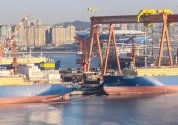
View attachment 168805
Another paper says 125.6K ton displacement with a BP length of 333.3m (WL length should be close to this value as well) and a LOA of 349m.
But how likely is this indeed the true 004?

View attachment 168805
Another paper says 125.6K ton displacement with a BP length of 333.3m (WL length should be close to this value as well) and a LOA of 349m.

Equally likely as the previous paper given the specs lines up with the current ship in the drydock as of right now.But how likely is this indeed the true 004?
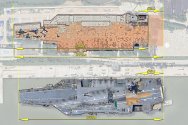
Well, that ought to embarass those who were having a hissy fit whenever someone (who either had inside info or just good at calculating based on available info) was saying this is something like 110-120,000 tons. Just like even if from day one people in the know said this is 004 and certain people kept harassing those saying that on various forums. A lesson for us about who has credibility and who has not.View attachment 168805
Another paper says 125.6K ton displacement with a BP length of 333.3m (WL length should be close to this value as well) and a LOA of 349m.

The J-15 takes up less space than an F/A-18 when folded(and you have monsters like the A-5), and the issue becomes one of height, if anything. Its probably the other way around and can be argued that american aircraft carriers haven't been able to grow because the shipyards, associated handling facilities and logistics haven't gotten big enough to handle anything too different from the existing Nimitz hulls.Chinese carrier fixed wing aircrafts (especially J-15) are marginally bigger in wingspan and length compared to F/A-18 and F-35C. Could that be one of the many reasons why 004’s waterline and deck width would likely be marginally wider compared to the Ford?

Yup, this video may argue the 100k tons is the goldilocks state, but read between the lines, the limits are really the things you mentioned.The J-15 takes up less space than an F/A-18 when folded(and you have monsters like the A-5), and the issue becomes one of height, if anything. Its probably the other way around and can be argued that american aircraft carriers haven't been able to grow because the shipyards, associated handling facilities and logistics haven't gotten big enough to handle anything too different from the existing Nimitz hulls.
In that regard, there is far more potential for more (r)evolutionary designs from Chinese shipyards when it comes to aircraft carriers in the future.

Yes that is very true. US aircraft carriers have to be built to be compatible with legacy infrastructure like existing dry docks, canals (especially Panama canals) and other infrastructure.The J-15 takes up less space than an F/A-18 when folded(and you have monsters like the A-5), and the issue becomes one of height, if anything. Its probably the other way around and can be argued that american aircraft carriers haven't been able to grow because the shipyards, associated handling facilities and logistics haven't gotten big enough to handle anything too different from the existing Nimitz hulls.
In that regard, there is far more potential for more (r)evolutionary designs from Chinese shipyards when it comes to aircraft carriers in the future.

Apologize if this has been asked before but has anyone measured the drydock at Sanya's dimensions yet?While it is the other way around for China. They are building new infrastructure that are designed to accommodate future bigger ships of wider beams. i.e. They are building new infrastructure to be compatible with future large size ships.