New Energy Vehicles (NEVs) in China

tphuang

General
Staff member
Super Moderator
VIP Professional
Registered Member
I’m just sticking to the facts. You should take another look at my previous replies. In my opinion, BYD’s current offerings—whether the basic DiLink-100 or the upgraded DiLink-150—leave far too little room for future upgrades and user customization. If you continue to discuss which cars or configurations people might choose when buying a vehicle, or how much other forum users care about this issue, I will no longer respond to these topics.
you wrote
. This year, BYD’s infotainment systems generally come with a 778G chip and 12GB RAM plus 128GB storage—a configuration that’s far too underpowered for an electric vehicle expected to last 8 to 12 years.
I just showed you that by Antutu rating (which is basically the golden rating), most of the new BYD models in China this year have the leading cockpit SoC rather than "778G chip".

So, where is your facts?
 

Nevermore

Junior Member
Registered Member
you wrote

I just showed you that by Antutu rating (which is basically the golden rating), most of the new BYD models in China this year have the leading cockpit SoC rather than "778G chip".

So, where is your facts?
Tang DM

Qin L. DM-i

Qin PLUS DM-i

Song L DM-i

Song Pro DM-i

Seal 05 DM-i

Seal 06 DM-i

Seal 07 DM-i

The default infotainment system for the models listed above is the DiLink 100, which is equipped with a 778G chip. For some of these models, you can purchase the Intelligent Driving Hardware Package to upgrade to the DiLink 150; however, you will still face the issues of insufficient reserved memory and storage space that I mentioned earlier.
 

supersnoop

Colonel
Registered Member
Well, I'm not sure Canada is a great example. I often thought of the country as an appendage to the US, even more so than Europe. What is clear is that legacy Western automakers are facing a crossroads.

The detroit legacy automakers seem to be content with just going for petrolcars and lobbying the US govt to prevent any Chinese competition. Europe's approach is better, although I would have preferred no tariffs at all.

I still think some legacy OEMs will make it. Toyota seems to be doing best of them all. VW actually does ok in terms of sales but their profits are collapsing. Tesla seems to have just given up and instead is starting to focus on robotics.

The one company I keep an eye on is Togg. Which is Turkey's attempt at creating an EV "national champion". They have a JV with a Chinese company which supplies them the batteries. Will be interesting if something comes out of it. Outside of Tesla and the Chinese EV start-ups, I have seen very few real attempts at creating new companies.

I guess VinFast is still alive? I haven't tracked them for some time now.
I used Canada as the example because they partnered with mostly non American HQ’d companies like Stellantis, VW, Northvolt, and Honda. They had a government firmly committed to a green strategy. The subsidies they provided were generous in line with what China did (west needs to stop whining about that, it’s embarrassing).

All the major brands are going through a transition right now. Financially speaking, I have not been following closely, so I can’t speak to that. However, on a technical level, I’m interested to see how the Neue Klasse BMW does in China. It is a far more modern platform. VW has conceded that MEB is done in China. They are moving forward with the CMP developed with XPeng. Will they use it in Europe? They were supposed to move to SSP based cars by 2027, but latest news has the ID4 marching on to maybe even 2028, please no…

It is funny to always see random people online who aren't in the Chinese EV industry come up with conclusive answers on why xyz doesn't sell well and are so confident about it.

Why don't you go talk to Stella and Wang and teach them how to run our company?
Of course they are successful, but does they cannot do anything wrong? OP is reposting a tweet from Tycho de Feijter who was writing about the Chinese automotive market for a long time even before the EV boom (which actually revived his news site).

This analysis is not particularly groundbreaking either. We’ve seen it time and time again in the automotive market. GM used to sell the Impala/Grand Prix/Intrigue/Regal as their under Chevy/Pontiac/Olsmobile/Buick brands. 4 cars all the same underneath. Now they’ve cut down to 2 brands per platform.

The Japanese DM dealer network was a total mess in the 80’s/90’s as the companies tried new ideas to grow sales in the recession. Honda had 3 dealer lines Clio, Verno, Primo. Mazda had Mazda, Elfini, Eunos, Autozam. Toyota had Toyota, Toyopet, Netz, Corolla (dealer line, not the car). Toyota maintained this setup until recently, but the others had long abandoned the strategy.

BYD has the Ocean line vs. Dynasty. As a large manufacturer, they can probably sustain these two mainstream lines, but what is the differentiation? I think you would struggle with this even as a BYD fan, I’m not talking about the corporate speak version. Maybe over a longer period of time, they can find a better direction.
 

Nevermore

Junior Member
Registered Member
BYD’s Ocean and Dynasty series are often planned with a one-to-one correspondence or similar positioning, but there are still significant differences in the details.

Vehicles in the same class often share the same underlying platform, with similar chassis architectures, overall lengths, and wheelbases. The main differences lie in their exterior and interior designs, as well as a few specific features.

The models in the Ocean Series feature a sporty, cute, and youthful design, while those in the Dynasty Series have a more business-oriented, understated, and dignified appearance.

For example, take this year’s latest models, the BYD Sealion EV and the BYD Song Ultra EV. These two models share the same underlying platform and have similar overall lengths and wheelbases, making them true sister models.

In terms of appearance, the Sealion 06 EV has a more youthful and distinctive look, while the Song Ultra EV gives off a more dignified and understated vibe. When it comes to specific features, the Sealion 06 EV includes electronic child locks and cornering lights, whereas the Song Ultra EV lacks these features but offers a front-row "bed mode" instead.

In terms of pricing, the Sealion 06 EV adopts a more youth-oriented two-tier structure, offering standard and high-spec versions with a 605-km range, as well as standard and high-spec versions with a 710-km range. The Song Ultra EV, on the other hand, follows the traditional pricing model of established automakers, where a higher price corresponds to a consistent increase in overall specifications.
 

Wrought

Captain
Registered Member
Familiar story by now, a US reviewer raving about banned cars.

DETROIT, April 3 (Reuters) - Popular car-shopping website Edmunds put a Chinese vehicle through a series of rigorous tests for the first time, and Editor-in-Chief Alistair Weaver came away with a notable impression: U.S. automakers have good reason for concern. While ‌Chinese cars are effectively banned in the United States, Edmunds wanted to test one because of growing U.S. consumer interest in the affordable, feature-packed vehicles. It got its hands on a Geely Galaxy M9 - an extended-range SUV hybrid starting at about $25,000 in China - and put the vehicle through its full battery of testing to measure driving range, acceleration, braking and other performance characteristics. Many of the M9's features are "ahead of the vehicles that we're driving in the U.S.," Weaver said after driving the vehicle around Edmunds' Los Angeles-based test track. "The technology is terrific."

Please, Log in or Register to view URLs content!
 

Rank Amateur

Junior Member
Registered Member
BYD’s Ocean and Dynasty series are often planned with a one-to-one correspondence or similar positioning, but there are still significant differences in the details.

Vehicles in the same class often share the same underlying platform, with similar chassis architectures, overall lengths, and wheelbases. The main differences lie in their exterior and interior designs, as well as a few specific features.

The models in the Ocean Series feature a sporty, cute, and youthful design, while those in the Dynasty Series have a more business-oriented, understated, and dignified appearance.

For example, take this year’s latest models, the BYD Sealion EV and the BYD Song Ultra EV. These two models share the same underlying platform and have similar overall lengths and wheelbases, making them true sister models.

In terms of appearance, the Sealion 06 EV has a more youthful and distinctive look, while the Song Ultra EV gives off a more dignified and understated vibe. When it comes to specific features, the Sealion 06 EV includes electronic child locks and cornering lights, whereas the Song Ultra EV lacks these features but offers a front-row "bed mode" instead.

In terms of pricing, the Sealion 06 EV adopts a more youth-oriented two-tier structure, offering standard and high-spec versions with a 605-km range, as well as standard and high-spec versions with a 710-km range. The Song Ultra EV, on the other hand, follows the traditional pricing model of established automakers, where a higher price corresponds to a consistent increase in overall specifications.

Your description of Ocean and Dynasty reminds me a lot of the relationship/differentiation between Hyundai and Kia in the U.S.
 

tphuang

General
Staff member
Super Moderator
VIP Professional
Registered Member
Tang DM

Qin L. DM-i

Qin PLUS DM-i

Song L DM-i

Song Pro DM-i

Seal 05 DM-i

Seal 06 DM-i

Seal 07 DM-i

The default infotainment system for the models listed above is the DiLink 100, which is equipped with a 778G chip. For some of these models, you can purchase the Intelligent Driving Hardware Package to upgrade to the DiLink 150; however, you will still face the issues of insufficient reserved memory and storage space that I mentioned earlier.
ADAS package doesn't get you to DiLink-150. I haven't seen any evidence that's the case and it doesn't make any sense for it to be the case since those are separate platforms.

For infotainment, if you chose cheap old models, you are going to get SoC that's lower end. Again, DiLink-100 as a platform is still superior to SD8155 if you look at the Antutu scores.

Now BYD is in the process of rolling out new models as we speak due to support for blade 2.0. If you want to get one with better infotainment system hardware, you can get a model with DiLink-150. Or you can get a competitor model with SD-8295. Those systems will be supported for a long time. But don't look for sub-160k RMB models and expect top notch infotainment hardware.


Of course they are successful, but does they cannot do anything wrong? OP is reposting a tweet from Tycho de Feijter who was writing about the Chinese automotive market for a long time even before the EV boom (which actually revived his news site).

This analysis is not particularly groundbreaking either. We’ve seen it time and time again in the automotive market. GM used to sell the Impala/Grand Prix/Intrigue/Regal as their under Chevy/Pontiac/Olsmobile/Buick brands. 4 cars all the same underneath. Now they’ve cut down to 2 brands per platform.

The Japanese DM dealer network was a total mess in the 80’s/90’s as the companies tried new ideas to grow sales in the recession. Honda had 3 dealer lines Clio, Verno, Primo. Mazda had Mazda, Elfini, Eunos, Autozam. Toyota had Toyota, Toyopet, Netz, Corolla (dealer line, not the car). Toyota maintained this setup until recently, but the others had long abandoned the strategy.

BYD has the Ocean line vs. Dynasty. As a large manufacturer, they can probably sustain these two mainstream lines, but what is the differentiation? I think you would struggle with this even as a BYD fan, I’m not talking about the corporate speak version. Maybe over a longer period of time, they can find a better direction.
again, there are many reasons why BYD has seen sales decline in the past 6 months. I hate watching people that follow Chinese EV industries from afar and then suddenly have a singular explanation why BYD has stopped growing 20% a year.

For one, have people looked at NEV sales in China in March of 2025 vs March of 2026? If you start with a baseline of market size, that alone saw a pretty big drop. And we can have a discussion about why China's NEV market size shrunk significantly in Q1 2026 vs 2025, but that is the reality.

There are obviously other reasons for BYD sales declines.

Having Oceans line compete with Dynasty may be helpful or it may not be helpful. I'm not sure. I'm not informed enough to answer that. But even if it is a net negative, it's only one of the many reasons its sales has gone down YoY.

BYD will figure it out. Same with Geely and Chery and Leapmotor. China market is full of cut throat competition. Let them battle it out.
 

Nevermore

Junior Member
Registered Member
If you insist on me getting hung up on these details, then I’ll have to break each one down and explain it clearly.

BYD’s popular models this year, the Sea Lion 06 EV and Song Ultra EV, are both priced between 160,000 and 190,000 RMB (the Song Ultra EV has an ultra-low entry-level price of 151,900 RMB, which we’ll ignore). These models come standard with the DiLink-100 infotainment system, which uses the 778G chip and features 12GB of RAM and 128GB of storage. Meanwhile, last year’s models—including the BYD Han, Seal 07, Tang, Song L, and Sea Lion 07—which are positioned as premium vehicles, are equipped with the D100 (It is essentially a customized version of the 778G chip for in-vehicle systems).

For certain vehicle models that come standard with the DiLink-100 infotainment system, an advanced driver-assistance system (ADAS) option is available, specifically the "Eye of the Sky B" system. Selecting this configuration will result in the installation of an additional LiDAR sensor on your vehicle, along with an upgrade of the infotainment system from DiLink-100 to DiLink-150. This upgrade includes a professional NVIDIA Orin-X ADAS chip, and the infotainment system chip will be replaced with a D9000 chip modified from a MediaTek chip. The memory configuration is upgraded to 4 GB RAM + 4 GB virtual RAM + 64 GB storage, with an additional 8+64 GB system.

What I mean is that while the 778G chip currently offers sufficient computing power, it severely lacks the potential for OTA updates. Meanwhile, although the D9000 chip in the DiLink-150 system is very powerful, the in-car unit has only 64GB of base storage, which means it is likely to be left without OTA updates in the future. Please note that the storage space used for installing software on the in-car unit does not support external expansion.

Due to the AI infrastructure bubble this year, which has caused prices for memory and storage chips to skyrocket, BYD has downgraded the storage capacity on most of its models from 256GB to 128GB. Typically, the infotainment system alone occupies 70–95GB of storage (the DiLink-150 system takes up approximately 33GB), leaving very little remaining space.

 

RTB74

New Member
Registered Member
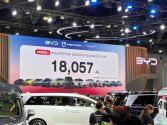
Summary of Motor Show 2026 bookings in Thailand from every booth's display: This year, "Chinese cars" have swept the Top 7 of the leaderboard! BYD remains the champion, followed by OMODA & JAECOO, which are gaining massive momentum. Meanwhile, MG and CHANGAN remain strong, successfully securing bookings in the tens of thousands.

1. BYD | DENZA: 18,057 China (No.1 Champion)
2. OMODA | JAECOO: 15,088 China (Rising new brand)
3. MG: 10,537 China
4. CHANGAN: 10,008 China (Total bookings for Deepal, AVATR, LUMIN)
5. GEELY: 7,811 China
6. CHERY: 7,509 China
7. GWM: 6,819 China
8. GAC AION: 6,287 China
9. MAZDA: 4,889 Japan (MAZDA6e accounts for 3,062 units)
10. RIDDARA: 2,569 China
11. ZEEKR: 2,339 China
12. MERCEDES-BENZ: 2,111 Europe
13. XPENG: 2,089 China
14. FORTHING: 520 China
Total Bookings: 96,633

Summary of booking proportions by country group:

China: 89,633 units (92.76%)
Japan: 4,889 units (5.06%)
Europe: 2,111 units (2.18%)

FB_IMG_1775405966884.jpg
 
Top