You are using an out of date browser. It may not display this or other websites correctly.
You should upgrade or use an alternative browser.
You should upgrade or use an alternative browser.
CV-18 Fujian/003 CATOBAR carrier thread
- Thread starter Jeff Head
- Start date

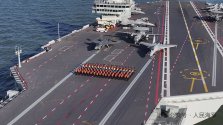
This could end up being their normal operating procedure because you can store a lot of aircraft along the C1 space.View attachment 169773
Interestingly from this picture likely before service shows that C2 and C3 are heavily used during testing while C1 do not appear to be used much.
I bet they could launch a lot of planes pretty fast if using just C2 and C3 as each cat would have a dedicated elevator and a large area of deck space.

Which begs to question as to why from the two videos we have so far of catapult takeoff/landings (from September and first training session in November post-commissioning) didn't show takeoffs from that C3 position if they've been used. Maybe we will in the next published video from its second session.View attachment 169773
Interestingly from this picture likely before service shows that C2 and C3 are heavily used during testing while C1 do not appear to be used much.

View attachment 169773
Interestingly from this picture likely before service shows that C2 and C3 are heavily used during testing while C1 do not appear to be used much.
Takeoffs from C2 and C3 predominantly does make sense from an aircraft spotting/flight cycle pov as well.
The C1 position during a launch cycle would tend to be occupied with aircraft spotted on top while C2 and C3 are active, and then as most of the aircraft are launched, only later in the launch cycle would C1 then get some use.
Interestingly, this photo is not from before service, but rather it looks from the second training session given one of the Chinese New Year videos the PLAN posted. Which then begs the question as to why all the airframes on deck appear to be prototypes? But in the first training session seen, they didn't use any prototypes, but seemingly serial production airframes. I'm assuming this second session up in Bohai had more to do with carrier takeoff/landing trials with pilots, given how the PLAN has no currently operational carrier-based CATOBAR trainer yet, and these all seem to be prototypes.View attachment 169773
Interestingly from this picture likely before service shows that C2 and C3 are heavily used during testing while C1 do not appear to be used much.
But then what was the first training session then without prototype airframes? Maybe integration/testing with actual production airframes? From what I can see, all the J-15T's on deck are prototypes, as are two KJ-600s (unsure about the one on C3). I can't say for the J-35s but it doesn't appear the J-35 at C1 has any official PLAN markings, and given that numerous prototypes airframes are seen on deck, I assume that all the airframes on deck here are prototypes.

That would be my guess too , C1 is parking , it would be used mainly for maximum takeoff .But for about 80% of time, a carrier is in a flexiable recovery and takeoff configuration.This could end up being their normal operating procedure because you can store a lot of aircraft along the C1 space.
I bet they could launch a lot of planes pretty fast if using just C2 and C3 as each cat would have a dedicated elevator and a large area of deck space.
In anyway the relatively late inclusion of EM catapult in the 003 construction makes C2 lenth a problem that a landing can't happen while a C2 lunch is happening which is suboptimal.
What surprise me is the 003 went into service like this , cause for the industrial base of China delay the 003 about half a year could mean solving this problem , since maximum take off and landing is a mission critical for a carrier, I would have thought that a delay is worth it to fix this problem but obviusly navy thought that having a flat top at all sooner was more important.
Simultaneous launch and recovery is not something that is practiced by anyone in the first place so this isn't an issue. It's extremely rare and the circumstances in which it is practiced as generally due to other factors (e.g. carrier quals/training, emergencies, etc.) rather than it being performed in combat. Everything is cyclical operations. @Blitzo made a post about this in here I believe but can't remember where it is.That would be my guess too , C1 is parking , it would be used mainly for maximum takeoff .But for about 80% of time, a carrier is in a flexiable recovery and takeoff configuration.
In anyway the relatively late inclusion of EM catapult in the 003 construction makes C2 lenth a problem that a landing can't happen while a C2 lunch is happening which is suboptimal.
What surprise me is the 003 went into service like this , cause for the industrial base of China delay the 003 about half a year could mean solving this problem , since maximum take off and landing is a mission critical for a carrier, I would have thought that a delay is worth it to fix this problem but obviusly navy thought that having a flat top at all sooner was more important.

Engineer
Major
If you haven't done so already, check out the very first post of this thread, posted back in 2016. C2 (the then C1) extends into the landing zone in the early design. Simultaneously launch and recovery is not one of 003's design criteria to begin with. It is a nice-to-have feature, hardly mission critical.That would be my guess too , C1 is parking , it would be used mainly for maximum takeoff .But for about 80% of time, a carrier is in a flexiable recovery and takeoff configuration.
In anyway the relatively late inclusion of EM catapult in the 003 construction makes C2 lenth a problem that a landing can't happen while a C2 lunch is happening which is suboptimal.
What surprise me is the 003 went into service like this , cause for the industrial base of China delay the 003 about half a year could mean solving this problem , since maximum take off and landing is a mission critical for a carrier, I would have thought that a delay is worth it to fix this problem but obviusly navy thought that having a flat top at all sooner was more important.