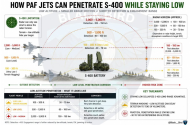
I found an article worth reading that discusses the 10th may'25 episode involving JF-17 employment of the CM-400AKG, highlighting how low-altitude penetration & stand-off tactics are used against layered S-400-style air defense networks.
Low-Altitude SEAD/DEAD Tactics Against an Integrated S-400 Air Defense Network
A modern high-intensity air warfare scenario envisions a layered air defense network built around the S-400 Triumf protecting strategic targets deep inside defended airspace. While such systems are designed with long-range detection & multi-layered interception, their effectiveness is highly dependent on detection geometry, reaction time & network cohesion rather than theoretical maximum ranges.
Before any strike element enters contested airspace, Pakistan Air Force (Pakistan Air Force) employs AEW&C, electronic intelligence & passive surveillance assets to map radar coverage, identify gaps, and assess response timelines. This creates a real-time picture of the air defense environment rather than relying on static assumptions.
Once corridors are identified, low-altitude penetration becomes central. Aircraft such as the JF-17 Thunder use terrain masking and low-level ingress to reduce radar detection ranges from hundreds of kilometers to significantly shorter engagement windows, limiting reaction time for the defender.
In parallel, a network-centric approach allows supporting sensors and AEW&C platforms to continue feeding situational awareness through secure data links, reducing the need for continuous radar emissions from strike aircraft.
When within effective stand-off range, the strike platform can employ precision weapons such as the CM-400AKG to target radar nodes, command centers & engagement systems tied to the air defense network. A previous reported PAF JF-17 CM-400AKG employment profile is often referenced in this context.
The objective in such operations is not the physical destruction of every launcher, but disruption of the integrated “kill chain”—detection, tracking, communication & engagement coordination. Once these links are degraded, even advanced systems experience reduced effectiveness under compressed decision timelines.
Overall, the scenario highlights how modern SEAD/DEAD concepts rely on synchronization of electronic warfare, low-altitude penetration & stand-off precision strikes to stress advanced integrated air defense systems rather than directly confronting them head-on.
View attachment 174920