The Kashmir conflict 2025.

_killuminati_

Captain
Registered Member
Speaking strictly of AEW&C aircraft - It is always better to have more eyes in the sky as redundancies than the opposite, especially when considering the electromagnetic spectrum domains that are only going to make things increasingly messy and challenging to deal with going forward, if not also to hedge against potential wartime losses.

Taking the 500-kilometer radius circles and plotting on the map, here's what is obtained:
View attachment 174699

Of course, the introduction of 5th-gens in the Indian Air Force in the future (whether that is expected to occur in the late-2020s or the 2030s) certainly will reduce their detectability radius for the AEW&C aircraft, which would only make the number of AEW&C assets a more important factor than ever before.
This is almost the same graphic that was shown in the report. I wouldn't be surprised if this actually occurred.
 

phrozenflame

Junior Member
Registered Member
No — there were unconfirmed reports suggesting that the DF-20s underwent extensive MLU, with the work reportedly carried out at PAC Kamra.


Seems likely, but as I mentioned in my post #4893, the PAF tends to keep such matters quite under wraps.

There were also unconfirmed reports that the original 4 DF-20s went through MLU, while at the same time PAF may have inducted an additional 3–4 units which were also reportedly brought up to standard with assistance from CETC.
Agree that PAF is quite secretive about the whole EW and network stuff.

Link-17 for e.g has years of investment behind it and the amount of $$$ behind is mind boggling for the kind of money Pakistan generally has. I cant unfortunately talk much about it. So take it as you may, but these things are highly highly prioritized.
 

siegecrossbow

Field Marshall
Staff member
Super Moderator
Agree that PAF is quite secretive about the whole EW and network stuff.

Link-17 for e.g has years and the amount of investment $$$ behind it is mind boggling for the kind of money Pakistan generally has. I cant unfortunately talk much about it. So take it as you may, but these things are highly highly prioritized.
You want to use the money on the force multipliers.
 

Black Wolf

Junior Member
Registered Member
Agree that PAF is quite secretive about the whole EW and network stuff.

Link-17 for e.g has years of investment behind it and the amount of $$$ behind is mind boggling for the kind of money Pakistan generally has. I cant unfortunately talk much about it. So take it as you may, but these things are highly highly prioritized.
You want to use the money on the force multipliers.
Agreed, and Im not even talking about EW aircrafts / AWACS, just the nodes and networks and the protocols, the ~relatively 'softer' side of things.


And let’s not forget that another project is also reportedly in the works — the ASOJ program in collaboration with Turkey. Reports suggest that 2 aircraft (Bombardier - 6000) have already been acquired & are currently in Turkey, although their latest status remains unclear.

There is also ongoing chatter that the PAF may eventually be looking at a fleet of around 4 such aircraft.

If all of this materializes, just imagine the level of airborne surveillance, electronic warfare, stand-off jamming & network-centric warfare capability this would bring to the PAF. The current AEW&C & EW assets are already integrated through Link-17 & it is widely expected that the upcoming platforms would also be incorporated into the same network-centric architecture.

For a country the size of Pakistan, a combined fleet of 12 Erieyes alongside 8 Blinders, plus the upcoming 4 ASOJ platforms & potentially 4–6 KJ-500s, would represent a very significant airborne support & force-multiplication capability — arguably unmatched in the region in terms of the overall mix of AEW&C, EW, stand-off jamming & network-centric integration. And this is before even factoring in the Navy’s upcoming fleet of 12 LRMPAs (Sea-Sultan) which would further strengthen the overall ISR and maritime domain awareness architecture.
 
Last edited:

Black Wolf

Junior Member
Registered Member
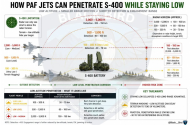
I found an article worth reading that discusses the 10th may'25 episode involving JF-17 employment of the CM-400AKG, highlighting how low-altitude penetration & stand-off tactics are used against layered S-400-style air defense networks.


Low-Altitude SEAD/DEAD Tactics Against an Integrated S-400 Air Defense Network

A modern high-intensity air warfare scenario envisions a layered air defense network built around the S-400 Triumf protecting strategic targets deep inside defended airspace. While such systems are designed with long-range detection & multi-layered interception, their effectiveness is highly dependent on detection geometry, reaction time & network cohesion rather than theoretical maximum ranges.

Before any strike element enters contested airspace, Pakistan Air Force (Pakistan Air Force) employs AEW&C, electronic intelligence & passive surveillance assets to map radar coverage, identify gaps, and assess response timelines. This creates a real-time picture of the air defense environment rather than relying on static assumptions.

Once corridors are identified, low-altitude penetration becomes central. Aircraft such as the JF-17 Thunder use terrain masking and low-level ingress to reduce radar detection ranges from hundreds of kilometers to significantly shorter engagement windows, limiting reaction time for the defender.

In parallel, a network-centric approach allows supporting sensors and AEW&C platforms to continue feeding situational awareness through secure data links, reducing the need for continuous radar emissions from strike aircraft.

When within effective stand-off range, the strike platform can employ precision weapons such as the CM-400AKG to target radar nodes, command centers & engagement systems tied to the air defense network. A previous reported PAF JF-17 CM-400AKG employment profile is often referenced in this context.

The objective in such operations is not the physical destruction of every launcher, but disruption of the integrated “kill chain”—detection, tracking, communication & engagement coordination. Once these links are degraded, even advanced systems experience reduced effectiveness under compressed decision timelines.

Overall, the scenario highlights how modern SEAD/DEAD concepts rely on synchronization of electronic warfare, low-altitude penetration & stand-off precision strikes to stress advanced integrated air defense systems rather than directly confronting them head-on.

1778680580054.png
 

siegecrossbow

Field Marshall
Staff member
Super Moderator
I found an article worth reading that discusses the 10th may'25 episode involving JF-17 employment of the CM-400AKG, highlighting how low-altitude penetration & stand-off tactics are used against layered S-400-style air defense networks.


Low-Altitude SEAD/DEAD Tactics Against an Integrated S-400 Air Defense Network

A modern high-intensity air warfare scenario envisions a layered air defense network built around the S-400 Triumf protecting strategic targets deep inside defended airspace. While such systems are designed with long-range detection & multi-layered interception, their effectiveness is highly dependent on detection geometry, reaction time & network cohesion rather than theoretical maximum ranges.

Before any strike element enters contested airspace, Pakistan Air Force (Pakistan Air Force) employs AEW&C, electronic intelligence & passive surveillance assets to map radar coverage, identify gaps, and assess response timelines. This creates a real-time picture of the air defense environment rather than relying on static assumptions.

Once corridors are identified, low-altitude penetration becomes central. Aircraft such as the JF-17 Thunder use terrain masking and low-level ingress to reduce radar detection ranges from hundreds of kilometers to significantly shorter engagement windows, limiting reaction time for the defender.

In parallel, a network-centric approach allows supporting sensors and AEW&C platforms to continue feeding situational awareness through secure data links, reducing the need for continuous radar emissions from strike aircraft.

When within effective stand-off range, the strike platform can employ precision weapons such as the CM-400AKG to target radar nodes, command centers & engagement systems tied to the air defense network. A previous reported PAF JF-17 CM-400AKG employment profile is often referenced in this context.

The objective in such operations is not the physical destruction of every launcher, but disruption of the integrated “kill chain”—detection, tracking, communication & engagement coordination. Once these links are degraded, even advanced systems experience reduced effectiveness under compressed decision timelines.

Overall, the scenario highlights how modern SEAD/DEAD concepts rely on synchronization of electronic warfare, low-altitude penetration & stand-off precision strikes to stress advanced integrated air defense systems rather than directly confronting them head-on.

View attachment 174920

One benefit for getting J-35 is that the plane no longer needs to stay low for this sort of thing.
 

_killuminati_

Captain
Registered Member
I found an article worth reading that discusses the 10th may'25 episode involving JF-17 employment of the CM-400AKG, highlighting how low-altitude penetration & stand-off tactics are used against layered S-400-style air defense networks.


Low-Altitude SEAD/DEAD Tactics Against an Integrated S-400 Air Defense Network

A modern high-intensity air warfare scenario envisions a layered air defense network built around the S-400 Triumf protecting strategic targets deep inside defended airspace. While such systems are designed with long-range detection & multi-layered interception, their effectiveness is highly dependent on detection geometry, reaction time & network cohesion rather than theoretical maximum ranges.

Before any strike element enters contested airspace, Pakistan Air Force (Pakistan Air Force) employs AEW&C, electronic intelligence & passive surveillance assets to map radar coverage, identify gaps, and assess response timelines. This creates a real-time picture of the air defense environment rather than relying on static assumptions.

Once corridors are identified, low-altitude penetration becomes central. Aircraft such as the JF-17 Thunder use terrain masking and low-level ingress to reduce radar detection ranges from hundreds of kilometers to significantly shorter engagement windows, limiting reaction time for the defender.

In parallel, a network-centric approach allows supporting sensors and AEW&C platforms to continue feeding situational awareness through secure data links, reducing the need for continuous radar emissions from strike aircraft.

When within effective stand-off range, the strike platform can employ precision weapons such as the CM-400AKG to target radar nodes, command centers & engagement systems tied to the air defense network. A previous reported PAF JF-17 CM-400AKG employment profile is often referenced in this context.

The objective in such operations is not the physical destruction of every launcher, but disruption of the integrated “kill chain”—detection, tracking, communication & engagement coordination. Once these links are degraded, even advanced systems experience reduced effectiveness under compressed decision timelines.

Overall, the scenario highlights how modern SEAD/DEAD concepts rely on synchronization of electronic warfare, low-altitude penetration & stand-off precision strikes to stress advanced integrated air defense systems rather than directly confronting them head-on.

View attachment 174920
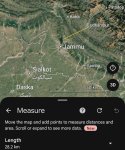
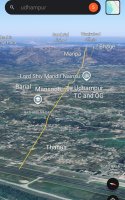
S-400 @ Udhampur facing west towards Pakistan's Sialkot sector already has restricted vision due to the hills in between.
Screenshot_20260515_222955_Google Earth.jpg

The first set of hills are just 10km away from the airbase.
Screenshot_20260515_223302_Google Earth.jpg

The 2nd set, 30km away, are 1,200-1,500ft. Image below shows the opposite view towards Udhampur on the other end.
Screenshot_20260515_223207_Google Earth.jpg
And, Jammu itself is ~1,000ft higher than the adjacent Sialkot sector of Pakistan.

That's about 2,200 - 2,500ft total.

With this terrain, S-400 can be avoided up until very close if flying low, closer than 30km.

Jammu sector and nearby areas received very intense shelling; non-stop artillery strikes every day.
 
Top