According to the official manual, what can keep the reset to zero is the Picatinny rail on the side.Holy losing Zero batman

You are using an out of date browser. It may not display this or other websites correctly.
You should upgrade or use an alternative browser.
You should upgrade or use an alternative browser.
QBZ-191 service rifle family
- Thread starter Blitzo
- Start date

given that their primary adversary has a penchant for abusing night fighting does this seems like a decision of doubtful wisdom?an acceptance that the fielding of helmet mounted NODs (needed for night navigation as well as the fighting part of a night operation) just isn't going to be widely fielded to the PLA to begin with in the near future. And if NODs are a scarce resource, why bother with a serious implementation for IR lasers?
though perhaps lasers are not a good path to pursue outside of punching down on lowtech adversaries who can't see them.

given that their primary adversary has a penchant for abusing night fighting does this seems like a decision of doubtful wisdom?
though perhaps lasers are not a good path to pursue outside of punching down on lowtech adversaries who can't see them.
As discussed in the past, it would be rare where they'd have to deal with infantry night fighting from their primary adversary in the most likely conflict scenarios they are concerned about.
Guys, I'm not well versed in military realities.
Since China's opponents are mainly wealthy like the USA, wouldn't thermals be a better option?
The Ukraine war is mostly thermal Scopes to spot drones and enemies at a distance. Night vision isn't that useful when your opponents can get night vision too, and see your infrared.
Hence why the ak-12 handguard not fully holding zero wasn't a big deal for the common grunts fighting in combined arms.
I see parallelism in how both China and Russia cheapened out in the handguard because most of the troops don't need lasers, and the extra weight and cost from a better handguard.
Since China's opponents are mainly wealthy like the USA, wouldn't thermals be a better option?
The Ukraine war is mostly thermal Scopes to spot drones and enemies at a distance. Night vision isn't that useful when your opponents can get night vision too, and see your infrared.
Hence why the ak-12 handguard not fully holding zero wasn't a big deal for the common grunts fighting in combined arms.
I see parallelism in how both China and Russia cheapened out in the handguard because most of the troops don't need lasers, and the extra weight and cost from a better handguard.

TerraN_EmpirE
Tyrant King
The problem for the AK12 wasn’t just that flimsy handguard it was also the wobbly Top cover. Remember the AK 12 is still an AK based design in its assembly making the top cover just a cover rather than an upper receiver As it is just a cover meant to keep debris out of the track of the BCG it wasn’t meant to mount sights or hold zero. The sights were as such mounted to the trunnion making the AK12 or less a world war 2 design with rails slapped on.
This isn’t an insolvable design problem. The IWI Ace is also based on the AK structure but its top cover is forced to be rigid by means of a Rubber biscuit spacer that tensioned the cover. Older Soviet versions of the AK design used a side mount system to mount optics but this off set them.
If you’re not mounting a clip on night and or thermal scope after the day sight or using a laser or a bipod mounted to the rail then the top rail of the handguard doesn’t need to be super rigid. However the top rail over the receiver does if you intend to mount any sights there.
The AK12 gen 1 had easily 3-4moa shift on the top rail making it more an area of effect spray weapon as that’s where the iron sights were mounted or the rare red dot or Acog class sight.
Now AK12 underwent two major revisions since with the Gen 2 AK12 they moved to a cross pinned dust cover as opposed to the leaver system on the early version.
The Type 19 family uses a two piece receiver assembly similar to the AR15 family so it didn’t have this issue.
This isn’t an insolvable design problem. The IWI Ace is also based on the AK structure but its top cover is forced to be rigid by means of a Rubber biscuit spacer that tensioned the cover. Older Soviet versions of the AK design used a side mount system to mount optics but this off set them.
If you’re not mounting a clip on night and or thermal scope after the day sight or using a laser or a bipod mounted to the rail then the top rail of the handguard doesn’t need to be super rigid. However the top rail over the receiver does if you intend to mount any sights there.
The AK12 gen 1 had easily 3-4moa shift on the top rail making it more an area of effect spray weapon as that’s where the iron sights were mounted or the rare red dot or Acog class sight.
Now AK12 underwent two major revisions since with the Gen 2 AK12 they moved to a cross pinned dust cover as opposed to the leaver system on the early version.
The Type 19 family uses a two piece receiver assembly similar to the AR15 family so it didn’t have this issue.
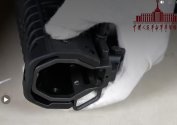
From the full disassembly video the front side rail are bolted onto the iron sight which is a metal ring that sits inside the polymer handguard semi held onto the barrel by a pin. Does it mean it hold zero that way? maybe? but it sure is better than being on the polymer.I don't particularly have a position in this discussion, but the standard removable side rails seem fairly reasonable in terms of accommodating the necessary room for a typical IR laser unit in a secure fashion.
If anything the bigger question is whether the rail section itself would be able to maintain zero as it ultimately is still connected to the polymer handguard itself.
View attachment 174539
-----
Of course, I'm of the belief that the standard 191/192 is not well suited for installing a laser to begin with, and the reason that this is "fine" is not due to some giga brain PLA intent to do effective night fighting using other means like thermal optics -- but rather it is just an acceptance that the fielding of helmet mounted NODs (needed for night navigation as well as the fighting part of a night operation) just isn't going to be widely fielded to the PLA to begin with in the near future. And if NODs are a scarce resource, why bother with a serious implementation for IR lasers?
I suspect for the few units which might see NODs as part of their regular fitout, they are likely the ones who will have the ability to buy aftermarket free floated handguards for their 191/192s to install IR laser modules as needed.
But for the rest of the PLA, fielding a laser unit on a standard 191/192 is a semi-LARP rather than a serious intent to do night fighting.
At the end of the day, modern xomplex rifle infantry tactics just isn't something that widespread for the PLA
Attachments
-
 Screenshot 2026-05-09 020028.jpeg51.3 KB · Views: 41
Guys, I'm not well versed in military realities.
Since China's opponents are mainly wealthy like the USA, wouldn't thermals be a better option?
The Ukraine war is mostly thermal Scopes to spot drones and enemies at a distance. Night vision isn't that useful when your opponents can get night vision too, and see your infrared.
Hence why the ak-12 handguard not fully holding zero wasn't a big deal for the common grunts fighting in combined arms.
I see parallelism in how both China and Russia cheapened out in the handguard because most of the troops don't need lasers, and the extra weight and cost from a better handguard.
The PLA aren't issuing thermals widely to begin with.
The best way to view the QBZ-191's handguard situation is just that the PLA clearly do not greatly value the importance of handguard mounted kit for standard infantry, and that is fine.
The problem for the AK-12 isn't about its wobbly handguard, it is that the overall AK design and furniture placement means there is no solid place to mount even a basic optic on the top that holds zero without either an extensive aftermarket zenitco style kit.
One of the things QBZ-191 does right is have a solid topside receiver picatinny rail of the AR style, that allows an optic to be solidly mounted on top.
From the full disassembly video the front side rail are bolted onto the iron sight which is a metal ring that sits inside the polymer handguard semi held onto the barrel by a pin. Does it mean it hold zero that way? maybe? but it sure is better than being on the polymer.
It's possible, but it is likely still suboptimal compared to a proper free floated handguard.

The Galil ACE doesnt hold zero properly either.The problem for the AK12 wasn’t just that flimsy handguard it was also the wobbly Top cover. Remember the AK 12 is still an AK based design in its assembly making the top cover just a cover rather than an upper receiver As it is just a cover meant to keep debris out of the track of the BCG it wasn’t meant to mount sights or hold zero. The sights were as such mounted to the trunnion making the AK12 or less a world war 2 design with rails slapped on.
This isn’t an insolvable design problem. The IWI Ace is also based on the AK structure but its top cover is forced to be rigid by means of a Rubber biscuit spacer that tensioned the cover. Older Soviet versions of the AK design used a side mount system to mount optics but this off set them.
If you’re not mounting a clip on night and or thermal scope after the day sight or using a laser or a bipod mounted to the rail then the top rail of the handguard doesn’t need to be super rigid. However the top rail over the receiver does if you intend to mount any sights there.
The AK12 gen 1 had easily 3-4moa shift on the top rail making it more an area of effect spray weapon as that’s where the iron sights were mounted or the rare red dot or Acog class sight.
Now AK12 underwent two major revisions since with the Gen 2 AK12 they moved to a cross pinned dust cover as opposed to the leaver system on the early version.
The Type 19 family uses a two piece receiver assembly similar to the AR15 family so it didn’t have this issue.
The resolution is imo to make the trunnion into a sort of massive inverted right angle triangle, with one of the 90 degree side forming top rail. Then you rework the now smaller cover around the now large trunnion. It will weight more but will be solid and hold zero.
The easier solution is the side rail, which the Soviet already did.
TerraN_EmpirE
Tyrant King
It holds it better than the gen 1 AK 12. It’s not perfect I admit.
There is a better solution, Its one seen in a number of commercial AK clones in the U.S. and actually around the world.
Even the Russians and Kalashnikov Concern know this is actually the best solution to the problem. KC even makes a rifle based on that solution.
the Russian MOD just didn’t seem to want to make the move to it for their standard issue. They will do it for Civilian and potential export’s versions though.
I can hear the AK purists having a fit now…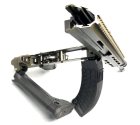
Image from M+M inc USA M10X
Take the Guts of the Ak and put it in a receiver set like an AR. A monolithic upper receiver with a lower receiver.
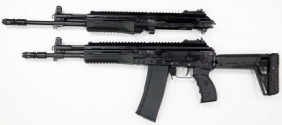
Image via The Firearms Blog from Kalashnikov Concern of the AKV 521. This has been around since late 2020. Uses the AK12 gen 2 furniture.
It’s the same solution as the AR15, CZ Bren, Sig MCX, QBZ191 and many many more. An upper and lower receiver set. Farther the Russians have a rifle in service in parallel to the AK12 that has this the Kord family of rifles with selected Speznaz.
Mind you I think they could both use a rethink on material because although the furniture is polymer. The receivers are still Steel. As a result the AK12 weights as much as an M7 reduced weight version in the similar empty slight less configuration.
There is a better solution, Its one seen in a number of commercial AK clones in the U.S. and actually around the world.
Even the Russians and Kalashnikov Concern know this is actually the best solution to the problem. KC even makes a rifle based on that solution.
the Russian MOD just didn’t seem to want to make the move to it for their standard issue. They will do it for Civilian and potential export’s versions though.
I can hear the AK purists having a fit now…
Image from M+M inc USA M10X
Take the Guts of the Ak and put it in a receiver set like an AR. A monolithic upper receiver with a lower receiver.
Image via The Firearms Blog from Kalashnikov Concern of the AKV 521. This has been around since late 2020. Uses the AK12 gen 2 furniture.
It’s the same solution as the AR15, CZ Bren, Sig MCX, QBZ191 and many many more. An upper and lower receiver set. Farther the Russians have a rifle in service in parallel to the AK12 that has this the Kord family of rifles with selected Speznaz.
Mind you I think they could both use a rethink on material because although the furniture is polymer. The receivers are still Steel. As a result the AK12 weights as much as an M7 reduced weight version in the similar empty slight less configuration.
I heard all iterations of monolithic uppers for AK designs always ends up with them weighing like a pig. Type 03 was kind of similar in regards to that the weight issue was never able to be resolved. Maybe a change in materials such as aluminum with internal rails for the the bolt to ride on, and whole lot of polymer elsewhere. But that might need a whole redesign and get expensive that the Russians military won't bite. Just my thoughts and ramble.Image from M+M inc USA M10X