North Korea Military News, Reports, Data, etc.

sahureka

Junior Member
Registered Member
I was looking at this picture of the ship and the hull shape seemed familiar somehow and I was wondering why. Now I see it could be an enlarged Grigorovich hull?View attachment 172013
Must everything the DPRK builds have been designed by others?
Perhaps in the past, but then they went their own way.
Experts claimed the KN-23 was a copy of the Russian Iskander, but after its use by the Russians, we know that the North Korean missile is larger and has a longer range, and bears only a passing resemblance to the Russian one.
Let's go back to the Choe Hyon 51 destroyer, and you write that it resembles the Admiral Grigorovich-class frigates / pr. 11356. So, are you trying to insinuate that the Russians have handed over the plans for a larger version?

I just want to remind everyone that the Admiral Grigorovich-class frigates, project 11356 in Russian, are an update of project 1135.1 - the Krivak III class,
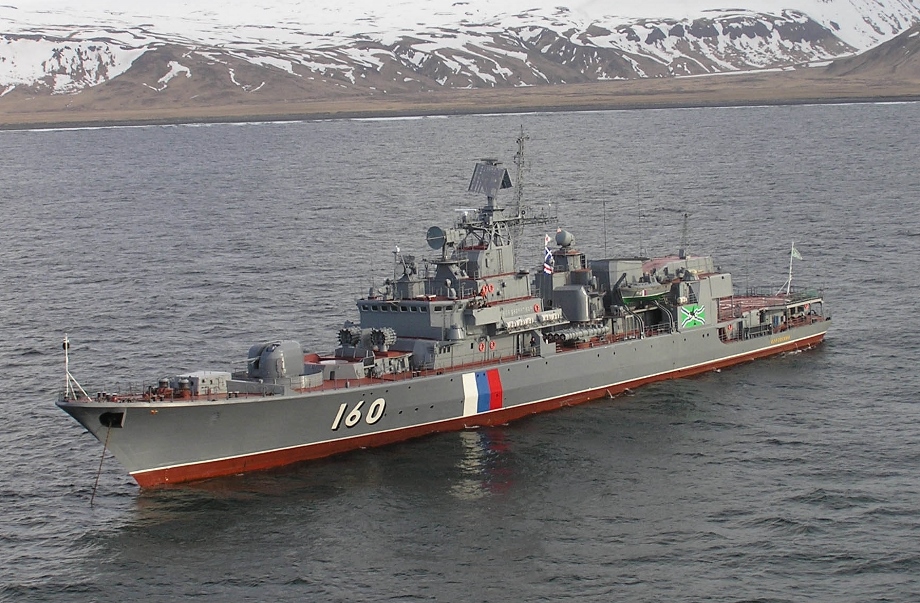
ship_984.jpg

which in the USSR and Russia were assigned to the Maritime Border Guard. After the dissolution of the USSR, one of these became the flagship in Ukraine with the name Hetman Sahaidachny (optical number), first U-130, then F-130.

I made this point to remind everyone that in the early 1990s, the DPRK managed to purchase a project 1135.1 - the Krivak III - for scrapping, on which some work was subsequently carried out.
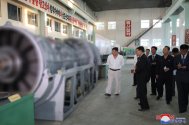
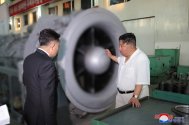
In this collage of old satellite photos, you can see that in 2004, they began modifications to the ship's stern. They likely gained access to the ship's entire propulsion system, from the propeller shaft system to the engine compartment and related gas turbines (and from these they likely developed their own naval gas turbine, seen in some photos with Kim Jong-un #).
The second was in 2006, with the stern closed.
In 2008, the ship disappeared and was never heard from again, so it was declared scrapped.
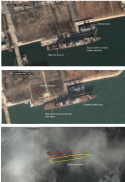
Krivak DPRK.png

#
PIC0075819.jpg

PIC0075817.jpg


But North Korean engineers and technicians likely gathered data and construction techniques from this PR. 1135.1-class Krivak III, which they then partially incorporated into the design of their new destroyer.

Does what I’ve written above seem plausible to you?
If so, don’t you think that over the last 20 years, North Korean engineers and technicians might have learnt how to build a large warship without necessarily having received direct assistance from abroad?
 
Last edited:

Valiant 1002

Junior Member
Registered Member
Please, Log in or Register to view URLs content!

The KN-23 is the system best suited for deep strikes on Peninsula targets protected by missile defences. Given the complexity of this missile, its use might be expected to remain relatively rare and to be reserved for very specific missions such as the destruction of missile defences or C2 assets. With its heavier payload, the KN-23A could also be used in strikes against hardened targets (C2 or infrastructure). The range of both missiles enables them to cover very large areas of South Korean territory.

The KN-24 appears to have a different use profile. Like the MGM-140 (ATACMS), it could be used for saturation strikes against relatively deep military targets in the theatre of operation, the priority likely being missile defences and logistical concentrations. If the missile is produced in sufficient quantity, it could be used for strikes against air bases (such as runway strikes) or critical infrastructure.

Finally, the KN-25 tests suggest that it is probably regarded as a battlefield weapon, operating alongside KN-09s, and most likely primarily targeting artillery deployments, troop concentrations and military installations in tactically and operationally deep locations around and just beyond the demilitarised zone (DMZ), including tactical anti-aircraft and anti-missile systems, logistics nodes and second-echelon forces. Combined use of the KN-09 and the KN-25, capable of engaging South Korean artillery and hindering the manoeuvring of ground forces, is a fundamental element of North Korea’s new force posture. It means that Pyongyang can envisage not only responding to a serious incident in the DMZ with a credible tactical escalation capability, but can also envisage a much more intense military operation.153 Even if KN-09 and KN-25 are exposed to counter strikes (from the air but also from ATCAM and such systems), their range and mobility are valuable protections and may allow critical strikes against US and South Korean forces and infrastructures while South Korean and US troops are rallied. Moreover, like the KN-24, the KN-25 can be used for a wider range of missions once active defences have been neutralised, including against air bases, logistics nodes etc., with or without conventional munitions.
What do you think?
 

sahureka

Junior Member
Registered Member
View attachment 172341
Choe Hyon-class will have 2 diesel and 1 gas-turbine engine.
I’d seen this photo on other forums, so I went back and watched all the available videos, but personally I couldn’t find a single frame that looks like this.
I’m not saying it can’t be the configuration of the North Korean destroyer, but from this image it appears they have fitted it with two diesel engines and a gas turbine, each with its own propeller shaft, which suggests a three-shaft propulsion system with corresponding propellers, and each engine has its own gearbox. So, if it uses the diesel engines for cruising, to avoid dragging the central propeller, this must be variable-pitch so it can be set to idle, and returns to thrust mode when the gas turbine comes into operation to enable the destroyer to reach maximum speed.
Incidentally, a destroyer must be capable of reaching at least 30 knots, or come very close to this speed; therefore, in the configuration shown in the photo, it seems impossible to me that a single gas turbine could enable this vessel, over 140 metres in length and with a displacement of 5,000 tonnes, to reach such a speed, but at least two high-powered turbines would be required.
However, I am probably misinterpreting this image, or it does not represent the propulsion system of the Choe Hyon 51.
 

sahureka

Junior Member
Registered Member

New Fabrication Buildings at Kusong Facility​

38North
March 25, 2026
Please, Log in or Register to view URLs content!

The construction of new large-scale buildings and the refurbishment of others within the industrial complex in the Kusong area and beyond.
There is talk of expanding the national drone programme, but I have a feeling that production will also extend to the construction or assembly of some sort of advanced training or combat aircraft, with a view to modernising the North Korean air force, which currently remains the poor relation of the armed forces.
This could be a heavily upgraded version of the MiG-29, which they have assembled in the past, or something similar to the SU-75, or perhaps an advanced trainer aircraft that could have a ground-attack variant.
Meanwhile, if they disregard UN sanctions, these new facilities could be used to handle a Russian supply of more advanced aircraft, potentially to be assembled in the DPRK.
The visit by the President of Belarus, Aleksandr Lukashenko, is a further indication that this could also lead to collaboration within the military industry, including the aeronautical sector, where Belarus possesses excellent infrastructure for the production of components and is renowned for the modernisation of Soviet-era aircraft.
However, I believe there will soon be surprises in the manned aviation sector too, with Kim Jong-un posing for photographs in front of these products as well.
 
Top