
You are using an out of date browser. It may not display this or other websites correctly.
You should upgrade or use an alternative browser.
You should upgrade or use an alternative browser.
J-20 5th Gen Fighter Thread VIII
- Thread starter Blitzo
- Start date
F-22 being generally stealthier than J-20 is a dead horse that never stay dead.even with the new engines, are you confident that the J-20A is stealthier and has superior kinematic performance? Stealth coating effectiveness is largely gatekept, but from the shape alone, one can reasonably conclude that the F-22 is likely stealthier from the front and rear (I think Wang Haifeng or Yang Wei also said in a video posted on this forum that the J-20 is less stealthy from the rear). As for kinematics, the J-20 is likely at parity for supercruise performance, but without TVC, it's likely still not supermaneuverable like the F-22 or Su-57
 I suggest you read some study papers such as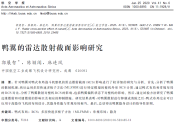
It is true that the rear RCS of J-20 is worse than F-22 due to the shape of the nozzle, this is well-known. The rest of RCS of J-20 and F-22 are equal except two areas.
1. untreated bare metal canard increase RCS in L band HH polarization.
2. F-22 is worse than J-20 in 75 to 90 degrees (0 degree is head on), because of the reflector effect of the horizontal and vertical stablizers.
The old fashioned stealth coating like RAM on F-22 is gatekeeping like you said, not decisive. But recent coating and especially stealth structure (meta material) makes huge difference, that is reducing the dependence on shape for the same RCS. Example is the extra RCS caused by canard (aft edge) of J-20 is nearly eliminated by such structure according to the paper.
While J-20 can mitigate the shortcoming of canard, F-22 can never do it to the side RCS because of its shape.
I always strongly object eyeballing complex science and engineering subject in which things are often not what they seem instinctly just like optic illusion in everyday life.
I do believe that is why we have the UADFs.Problem is that pilots can still only stand so much g-force.
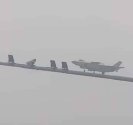
Pollution is so bad that even the mighty dragon needed to take a rest to catch some breath after routine morning exercise.

Also, it should be kept in mind that flat, rectangular nozzles actually have a higher RCS as the walls form 90° angles. 2D TVC improves frontal RCS (and sideward if you're tailless) by making the rear fuselage more flush, and marginally and improves IR signatures, but not rearward RCS.F-22 being generally stealthier than J-20 is a dead horse that never stay dead.
View attachment 167087
It is true that the rear RCS of J-20 is worse than F-22 due to the shape of the nozzle, this is well-known. The rest of RCS of J-20 and F-22 are equal except two areas.
1. untreated bare metal canard increase RCS in L band HH polarization.
2. F-22 is worse than J-20 in 75 to 90 degrees (0 degree is head on), because of the reflector effect of the horizontal and vertical stablizers.
The old fashioned stealth coating like RAM on F-22 is gatekeeping like you said, not decisive. But recent coating and especially stealth structure (meta material) makes huge difference, that is reducing the dependence on shape for the same RCS. Example is the extra RCS caused by canard (aft edge) of J-20 is nearly eliminated by such structure according to the paper.
While J-20 can mitigate the shortcoming of canard, F-22 can never do it to the side RCS because of its shape.
I always strongly object eyeballing complex science and engineering subject in which things are often not what they seem instinctly just like optic illusion in everyday life.

F-22 and even F-35 still have better rearward stealth by virtue of having a stealthy augmentor and also a better LOAN nozzle in the case of F-35 than J-20.Also, it should be kept in mind that flat, rectangular nozzles actually have a higher RCS as the walls form 90° angles. 2D TVC improves frontal RCS (and sideward if you're tailless) by making the rear fuselage more flush, and marginally and improves IR signatures, but not rearward RCS.
In the case of J-20A I find it difficult to believe that this notion will stand.F-22 and even F-35 still have better rearward stealth by virtue of having a stealthy augmentor and also a better LOAN nozzle in the case of F-35 than J-20.
Better pray we get J-20As with WS-15s in Zhuhai then. Then we might find out.
Actually, it's hard to say.In the case of J-20A I find it difficult to believe that this notion will stand.
Better pray we get J-20As with WS-15s in Zhuhai then. Then we might find out.
The J20A is the most advanced fighter aircraft of the PLAAF.
Sending out the J20A equipped with a new type of engine to participate in the air show might not be in line with the conservative style of the PLAAF.
Well, J-20 was first shown off in 2016 before it even entered serviceActually, it's hard to say.
The J20A is the most advanced fighter aircraft of the PLAAF.
Sending out the J20A equipped with a new type of engine to participate in the air show might not be in line with the conservative style of the PLAAF.
WS15 has just entered mass production, and it still needs time to go through the first half of the bathtub curve.Well, J-20 was first shown off in 2016 before it even entered service
The PLAAF is always more cautious when it comes to new engines, isn't it?
Of course, I also hope to see the J20A equipped with the new engine participate in the Zhuhai Airshow.