Future PLAN orbat discussion

sunnymaxi

Colonel
Registered Member
Huh? Why should I acknowledge mistakes when you are the one making them? Is this some sort of uneducated joke that I am too educated to understand?


This has nothing to do with high or low enrichment or supply chain. This has to do with you lacking a basic idea on what distinguishes a floating civilian nuclear powerplant from a nuclear powered military vessels. Go flip through a dictionary if you don't know the differences of "civilian" vs. "military" or "powerplant" vs. "propulsion".
COPE Harder uncle. you are not an educated person.

its nothing to do with civilian or military. ''From a design and engineering perspective both LEU and HEU reactors shared same philosophy'' also shared same supply chain in most of the core components.

let me educate you. and if you still refuse to acknowledge then you should go to the doctor.

Please, Log in or Register to view URLs content!
 

Engineer

Major
COPE Harder uncle. you are not an educated person.
Then why are you the one making mistakes, hmm? Mr. Same-but-Different?

its nothing to do with civilian or military. ''From a design and engineering perspective both LEU and HEU reactors shared same philosophy'' also shared same supply chain in most of the core components.

let me educate you. and if you still refuse to acknowledge then you should go to the doctor.

Please, Log in or Register to view URLs content!
Irrelevant. The issue here has nothing to do with enrichment levels. The issue is you not knowing the basic difference between a floating civilian nuclear powerplant and a nuclear powered military vessels, and you are trying to compare them as equals. Here is something that's actually relevant, and unlike you who is hiding your lack of knowledge behind big texts, experts explain ideas in such a way that even kids like you could understand:
Please, Log in or Register to view URLs content!
I would suggest using the term floating power unit (FPU) instead of floating nuclear power plant, to be more precise. While FPUs and nuclear-powered vessels both utilise nuclear reactors, they differ in purpose. Nuclear-powered vessels are designed for various maritime transportation tasks, whereas FPUs are non-self-propelled vessels specifically engineered to generate and supply electricity to customers. For FPU operation, coastal infrastructure is required to ensure mooring and electricity transmission onshore.
See that? Different. Civilian floating powerplant has absolute nothing to do with what's being discussed. Arguing that it's relevant because of muh "same philosphies" is just you grasping at straws after being proven wrong.
 

sunnymaxi

Colonel
Registered Member
Then why are you the one making mistakes, hmm? Mr. Same-but-Different?


Irrelevant. The issue here has nothing to do with enrichment levels. The issue is you not knowing the basic difference between a floating civilian nuclear powerplant and a nuclear powered military vessels, and you are trying to compare them as equals. Here is something that's actually relevant, and unlike you who is hiding your lack of knowledge behind big texts, experts explain ideas in such a way that even kids like you could understand:
Please, Log in or Register to view URLs content!

See that? Different. Civilian floating powerplant has absolute nothing to do with what's being discussed. Arguing that it's relevant because of muh "same philosphies" is just you grasping at straws after being proven wrong.
again wrong.

your post has nothing to do with supply chain of critical components and parts. which is the main topic of our discussion. your first point was, Money is scare so why wasting on CVNs. better to invest somewhere else.

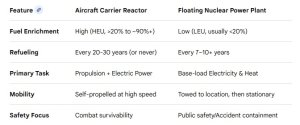
While both floating nuclear reactors (FNPPs) and nuclear reactors used in aircraft carriers are compact pressurized water reactors (PWRs) operating in maritime environments, they differ significantly in their fuel enrichment. engineering is the same.

you fundamentally wrong in this aspect, that nuclear reactor in ice breaker or floating ship or aircraft carrier does use same engineering mechanism means all these ships used basic Pressurized Water Reactors (PWRs).

565656.jpg

the main difference lies in fuel enrichment and design but share same supply chain in many components.
 
Last edited:

Engineer

Major
again wrong.

your post has nothing to do with supply chain of critical components and parts. which is the main topic of our discussion. your first point was, Money is scare so why wasting on CVNs. better to invest somewhere else.
Nope. The discussion about supply chain is your own invention with you as the sole participant, which I don't take part in. The actual discussion that I am in, which @Biltzo moved from 004 thread, is about nuclear propulsion's pros, cons, and its roles in China's future aircraft carriers. Never did I make a point that money is scarce either, quite the opposite in fact, and I quote myself:
China no longer being dirt poor doesn't mean China is now free to set money on fire, as there are always areas that could use more funding even within a military.

You have no clue what I am writing and yet you decided to interject.

While both floating nuclear reactors (FNPPs) and nuclear reactors used in aircraft carriers are compact pressurized water reactors (PWRs) operating in maritime environments, they differ significantly in their fuel enrichment. engineering is the same.

you fundamentally wrong in this aspect, that nuclear reactor in ice breaker or floating ship or aircraft carrier does use same engineering mechanism means all these ships used basic Pressurized Water Reactors (PWRs).

the main difference lies in fuel enrichment and design and share same supply chain in many components.
No such thing as same but different. They are different, which you acknowledged in bold, that means they are not the same. It's that simple. Furthermore, the difference here goes far beyond the reactor itself: a floating nuclear powerplant is not nuclear propulsion. Hence it has nothing to do with the discussion.
 

sunnymaxi

Colonel
Registered Member
Nope. The discussion about supply chain is your own invention with you as the sole participant, which I don't take part in. The actual discussion that I am in, which @Biltzo moved from 004 thread, is about nuclear propulsion's pros, cons, and its roles in China's future aircraft carriers. Never did I make a point that money is scarce either, quite the opposite in fact, and I quote myself:


You have no clue what I am writing and yet you decided to interject.


No such thing as same but different. They are different, which you acknowledged in bold, that means they are not the same. It's that simple. Furthermore, the difference here goes far beyond the reactor itself: a floating nuclear powerplant is not nuclear propulsion. Hence it has nothing to do with the discussion.
your first statement, lack of overseas naval bases can only be resolved by building oversea naval bases.

your second statement, that doesn't mean China is now free to set money on fire, as there are always areas that could use more funding even within a military.

in your second statement you clearly stated, Money doesn't grow on trees so it better to use somewhere else in military.

just look at your age and you have been lying.

Pressurized water cooled reactor does share similarities in supply chain except in core where LEU and HEU are totally different due to fuel enrichment.
 

Engineer

Major
your first statement, lack of overseas naval bases can only be resolved by building oversea naval bases.

your second statement, that doesn't mean China is now free to set money on fire, as there are always areas that could use more funding even within a military.

in your second statement you clearly stated, Money doesn't grow on trees so it better to use somewhere else in military.
And what of the two statements? You are seeing a contradiction where there isn't one. Rewrite my statements and explain how you are interpeting them, then layout what issues you are seeing in my statements, and finally explain why you consider them as issues. Launching into a monologe about civilian floating reactor then go completely off tangent with LEU vs. HEU is not the way of having a discussion.

just look at your age and you have been lying.

Pressurized water cooled reactor does share similarities in supply chain except in core where LEU and HEU are totally different due to fuel enrichment.
We have been through this. There is no such thing as same but different.
 

sunnymaxi

Colonel
Registered Member
And what of the two statements? You are seeing a contradiction where there isn't one. Rewrite my statements and explain how you are interpeting them, then layout what issues you are seeing in my statements, and finally explain why you consider them as issues. Launching into a monologe about civilian floating reactor then go completely off tangent with LEU vs. HEU is not the way of having a discussion.


We have been through this. There is no such thing as same but different.
civilian industry always interlinked with defense sector. upstream supply chain of components does share many similarities.
 

AndrewS

Brigadier
Registered Member
GAO report was written when US was at its zenith, and even then GAO recommended conventional carrier fleet. Clearly, it wasn't a rounding error and it still isn't. You offer no argument as to why China's aircraft carrier should be nuclear powered other than because US does it, and the reason US does it is on shaky foundation to begin with. China no longer being dirt poor doesn't mean China is now free to set money on fire, as there are always areas that could use more funding even within a military.

Look at the situation.

---

The US has a global network of supply bases, so that its aircraft carriers can be easily resupplied with a minimum of replenishment ships.

---

If China is operating aircraft carriers within the 2nd Island Chain (3000km), then Chinese aircraft carrier groups should be fine with a single Type-901 replenishment ship. In such a scenario, conventionally-powered aircraft carriers would be a lower-cost option, as nuclear-powered aircraft carriers would also need a Type-901 anyway.

---

But if Chinese aircraft carriers are operating to the 3rd Island Chain (say 8000km to Hawaii), China doesn't have local resupply bases.
My guess is that another 2 replenishment ships (of some sort) would be required, along with Frigate escorts.
If we use US costings, these ships should cost in excess of $2 Billion.

But note that the cost for the nuclear reactors on a Ford-class aircraft carrier comes to $2 Billion.

So it is cheaper to spend money upfront on nuclear-power for the aircraft carrier, rather than 4 additional ships.
In addition, the nuclear-power option has significantly better ongoing operating costs.

---

Granted, these are costings based on US numbers, but a similar calculation should apply to the Chinese Navy, so it makes sense for Chinese aircraft carriers to go with nuclear-power.
 

GTI

Junior Member
Registered Member
I’ve been tempted to cover this in the 004 thread, but that’s a flagship thread.

Since 2017-19, I’ve been convinced the PLA could win a costly flashpoint in the FIC or AR. Outlook for the PLA has only improved since then. By the 9.3 Parade it had become comical overmatch in the FIC, with PLA advantage in the SIC.

So I realised that if I was the US, the old plan of goading China into a conflict in the region can’t really work anymore, unless you plan on losing everything up to Hawaii. So the only option is to set the world ablaze — PLA can’t do anything to stop the US attacking Chinese investments in Africa, or invading BRICS countries, bombing everyone, destroying the space installations in Argentina, destroying or seizing RE mines in DRC, kidnapping heads of state and so on… in retaliation the PLA could only really target US military and commercial assets in China’s region, but the former could be rebased further out ahead of time, and neither would actually do anything to prevent any of those losses (US destabilising actions across the globe) in the first place.

That’s what I would do if I were running the US, in a heartbeat. It’s their last realistic option. The only downside is the loss of image and soft power, but that might not matter if you have a big enough core of vassals and defeated nations forced to be on your side of the ledger. It’s not surprising we got Takaichi’s statement and the new US defense strategy.

It would be a serious dereliction of duty if the Party hasn’t considered this possibility. I personally think they have and that 004’s construction has been sped up (normal slow mil pace, from the super slow pace we saw earlier). They are going to at least need deterrence, and that means an expeditionary navy. With CVNs, multiple. And soon (combined 3-4 additional CVNs and CVs in some state of construction to in service by 2035).

 

AndrewS

Brigadier
Registered Member
I’ve been tempted to cover this in the 004 thread, but that’s a flagship thread.

Since 2017-19, I’ve been convinced the PLA could win a costly flashpoint in the FIC or AR. Outlook for the PLA has only improved since then. By the 9.3 Parade it had become comical overmatch in the FIC, with PLA advantage in the SIC.

My view is that today, China would "win" in the 1st Island Chain, but it isn't overmatch yet.

So I realised that if I was the US, the old plan of goading China into a conflict in the region can’t really work anymore, unless you plan on losing everything up to Hawaii. So the only option is to set the world ablaze — PLA can’t do anything to stop the US attacking Chinese investments in Africa, or invading BRICS countries, bombing everyone, destroying the space installations in Argentina, destroying or seizing RE mines in DRC, kidnapping heads of state and so on… in retaliation the PLA could only really target US military and commercial assets in China’s region, but the former could be rebased further out ahead of time, and neither would actually do anything to prevent any of those losses (US destabilising actions across the globe) in the first place.

That’s what I would do if I were running the US, in a heartbeat. It’s their last realistic option. The only downside is the loss of image and soft power, but that might not matter if you have a big enough core of vassals and defeated nations forced to be on your side of the ledger. It’s not surprising we got Takaichi’s statement and the new US defense strategy.

The issue is that all those US actions have a minor effect because the Chinese economy can be largely self-sufficient.
And if the US does go too far, China will impose sanctions on the US, and watch as US weapons production and civilian factories shut down, like we saw in the recent trade war.

So I don't see this as a realistic option.

It would be a serious dereliction of duty if the Party hasn’t considered this possibility. I personally think they have and that 004’s construction has been sped up (normal slow mil pace, from the super slow pace we saw earlier). They are going to at least need deterrence, and that means an expeditionary navy. With CVNs, multiple. And soon (combined 3-4 additional CVNs and CVs in some state of construction to in service by 2035).

For expeditionary operations beyond the reach of the Rocket Force and Air Force, I think 3-4 additional Chinese aircraft carriers isn't enough to deter the US.
 
Top