Chinese semiconductor thread II

latenlazy

Brigadier
Yes. You don’t need to be advancing in a node shrink to begin EUV adoption. You can for example do an improved (one might even say “proper”) 5 nm process first for example. It’s also just not clear to me that the sudden density jump in 2030 has to be from a process node shrink.

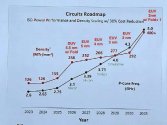
While speculative on my end it’s entirely possible that Huawei could take a tick-tock or maybe tick-tick-tock approach to its own process progression, where a tick would be a feature shrink and a tock would be a fold layer. So maybe one feature shrink with relaxed transistor densities, another feature shrink that’s more optimized, and then a fold layer which employs both advancement in 3D layout and whole process node shrink to get a massive jump in density. Remember also the point of calling it tau scaling is because their performance target is not transistor density itself but compute operation density in unit time for the same energy budget, which is why they don’t just feature transistor density in their roadmap chart but clock speed. We should be asking how they’re consistently improving clock speed for the same energy budget even when transistor density improvements are incremental.

IMG_3337 3.jpg
Just to help elaborate what I mean by a “tick-tick-tock” cadence I made the above illustration based on the chart Huawei presented two days ago.

As a point of comparison, TSMC 3 nm transistor density is listed as 224 MTr/mm2 and apparently TSMC 2 nm will only be a 15-20% improvement in density, ~268 MTr/mm2, which suggests TSMC will have to relax transistor spacing either for yield or transistor performance purposes, showing diminishing returns in transistor density gains past the 3 nm node. TSMC's roadmap after 2 nm will be 1.6 nm in 2027, 1.4 nm 2028, and then 1.2-1.3 nm in 2029, assuming no hitches and delays, with each supposed to yield ~7-10% improvement in transistor density. In other words TSMC is shifting from 50% node shrinks every 2-3 years to much more modest ~10-15% shrinks every year. Only by 2029, 3-4 years after 2 nm entered mass production, will TSMC get to another 50% node shrink, with a transistor density improvement of about 30% assuming the optimistic case of 10% density gain every iteration, or ~348 MTr/mm2. If they can sustain that annual 10% density gain going forth they will reach ~420 MTr/mm2 by 2031.

Meanwhile, Huawei is forecasting in their chart ~6% improvements in transistor density every year until 2030, before you get a massive jump into 400+ MTr/mm2 territory. While entirely conjectural on my part it's imo plausible that Huawei could be planning to introduce annual node shrink cadences with very conservative transistor spacing that focus less on density and more on per cycle time energy efficiency, while reaping the rest of their performance gains through per watt clock speed improvements of ~9-10% as they continuously optimize 3D layouts for a 2 layer "fold", and then reach their massive transistor density leap in 2031 by adding another "fold" layer at a more conservatively designed 2-3 nm node.
 
Last edited:
snake070

New Member
Registered Member
I’m confused about process level. Do they mean the performance of the chip is comparable to 3nm process not using Tao Law?
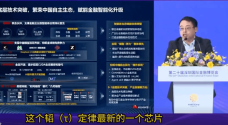
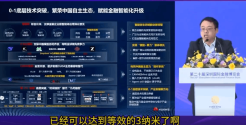
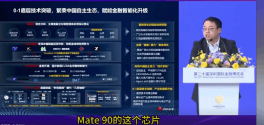
"Zheng Jun, CTO of Huawei's Financial Systems Department, said: Utilizing the Tau Law, the SoC of the Huawei Mate 90 has reached a 3nm-equivalent process node."


Please, Log in or Register to view URLs content!

19:49

tao01.png

tao02.png

等效3NM.png
 

MortyandRick

Senior Member
Registered Member
What is the "CTO of Huawei's Financial Systems Department"?

Is he the CTO of Huawei or just a specific department? And a financial department? Maybe I'm not understanding the translation
 

huemens

Junior Member
Registered Member
What is the "CTO of Huawei's Financial Systems Department"?

Is he the CTO of Huawei or just a specific department? And a financial department? Maybe I'm not understanding the translation

They have difference business units like Cloud business, smartphones, etc each with their own CTO. Financial Systems Department is one such business unit which supplies enterprise solutions to companies in the financial industry like banks, insurance companies, stock brokers, etc.
 

snake070

New Member
Registered Member
What is the "CTO of Huawei's Financial Systems Department"?

Is he the CTO of Huawei or just a specific department? And a financial department? Maybe I'm not understanding the translation
This department is called the Huawei Financial System Department, and he is the CTO of this department.
 

bsdnf

Senior Member
Registered Member
"Zheng Jun, CTO of Huawei's Financial Systems Department, said: Utilizing the Tau Law, the SoC of the Huawei Mate 90 has reached a 3nm-equivalent process node."


Please, Log in or Register to view URLs content!

19:49

View attachment 175684

View attachment 175685

View attachment 175686
Huawei provides cloud services and GPU hardware to financial institutions. However, since it's not yet time to announce the next-generation GPU using this technology, he can only use mobile phone chips as an example.
 

tokenanalyst

Lieutenant General
Registered Member

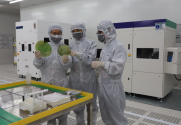
Huakang Clean: Wins 94 Million Yuan Electronic Cleanroom Project from AMEC​


Huakang Cleanroom announced that it had been selected as the winning bidder for the "R&D System Engineering of the First Phase Project of AMEC's South China Headquarters and Semiconductor and Pan-Semiconductor Equipment R&D and Production Base," with a winning bid of 94 million yuan, accounting for 4.11% of the company's 2025 operating revenue. This project is an important step for the company's electronic cleanroom business in the South China region.​

1779977945099.png

Huakang Cleanroom focuses on cleanroom technology, with its traditional core business concentrated on medical cleanrooms. In 2024, it established an electronic cleanroom division to expand into related fields such as semiconductors, forming a dual-engine growth model of medical and electronic cleanrooms. In 2025, the company achieved operating revenue of 2.286 billion yuan, a year-on-year increase of 33.87%; net profit attributable to the parent company was 118 million yuan, a year-on-year increase of 76.39%. The core driver of this performance growth was the successful bids for several leading projects in the electronic cleanroom sector, resulting in revenue growth exceeding 30% year-on-year.

Huakang Clean stated that since establishing its Electronic Cleanroom Business Unit in 2024, the company has continuously expanded its presence in the electronic cleanroom market, covering multiple sub-sectors including semiconductors and related fields, as well as new display technologies. This project represents a significant step forward for the company's electronic cleanroom business in South China, helping to enhance its brand influence in the regional market and laying a solid foundation for the company to continue expanding its customer base across the semiconductor industry chain.

Please, Log in or Register to view URLs content!
 

tokenanalyst

Lieutenant General
Registered Member

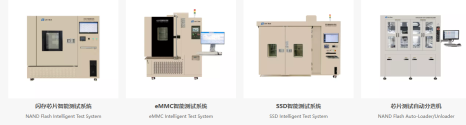
Shuhetai showcases its intelligent flash memory chip testing system at the Jiwei Conference​


From May 27th to 29th, Shenzhen Shuhetai Technology Co., Ltd. (operating under its parent entity, DataTech) made a significant presence at the 10th ICMI Conference and Semiconductor Exhibition held in Shanghai. As a core exhibitor, Shuhetai highlighted its full-stack testing capabilities spanning from chip-level to finished product levels, addressing the diverse needs of consumer, industrial, enterprise, and automotive-grade storage markets. The company demonstrated an independent intelligent flash memory testing system designed specifically for the complete lifecycle evaluation of NAND Flash chips, attracting substantial attention from industry professionals across packaging plants, module manufacturers, SSD makers, and research institutions.

The showcased intelligent testing system represents a major technological leap, featuring an independently developed architecture capable of supporting interface speeds up to 3.2GT/s with the ability to parallel test up to 512 chips simultaneously on a single unit. This high-concurrency solution ensures both precision and cost-efficiency while maintaining stable 24/7 continuous operation for comprehensive parameter testing and deep data analysis. The system offers flexible expansion capabilities (DUT) and is tailored for various scenarios ranging from functional testing production lines and R&D verification to failure analysis and on-site sampling, effectively meeting the rigorous demands of large-scale testing centers and national research institutes.

1779978478308.png

Beyond hardware performance, Shuhetai provided extensive software and algorithmic support through its proprietary tools that enable granular quality control across the entire product spectrum. At the chip level, the system facilitates bin screening, ink die analysis, quality grading, and lifespan prediction even under extreme wide-temperature conditions. For finished products like SSDs, it offers full-dimensional functional testing including performance verification, aging tests, power loss scenarios, and voltage deviation checks, all integrated with a self-developed MES (Manufacturing Execution System) for seamless process control. By engaging in deep technical discussions on algorithm optimization and system integration, Shuhetai reaffirms its commitment to strengthening the domestic storage industry's quality assurance foundation through customized solutions and continuous innovation.

Please, Log in or Register to view URLs content!
 
Top