I never said is not performant, I said is not a massive increase in performance over immersion, the low throughput and the need of multi patterning eats some of the benefits, but is being sold as the future of lithography so for many companies is better to do the investment now than to wait and being a latecomer, overcome the learning curve now than wait. Like I said throughput will increase and better resist and metrology will become better. Also a lot of companies with the exception of TSMC are bypassing the struggle of LowNA EUV and moving to directly into HighNA EUV. In the future years most ASML sales would probably be HighNA EUV with very little being LowNA EUV.If EUV is not more performant relative to DUVi despite its higher costs new process iterations wouldn’t double down on a non performant investment. Fabs moving from 5 nm to 3 nm would be designing their iterative process shrinks with less, not more, EUV. Well run businesses don’t do sunk cost fallacies.

You are using an out of date browser. It may not display this or other websites correctly.
You should upgrade or use an alternative browser.
You should upgrade or use an alternative browser.
Chinese semiconductor thread II
- Thread starter vincent
- Start date
If we see EUV being employed more as fabs advance along their node shrink pipeline despite its well documented headaches that suggests pretty strongly that the performance increase is pretty sizable and the capability is not effectively substitutable by DUVi.I never said is not performant, I said is not a massive increase in performance over immersion, the low throughput and the need of multi patterning eats some of the benefits, but is being sold as the future of lithography so for many companies is better to do the investment now than to wait and being a latecomer, overcome the learning curve now than wait. Like I said throughput will increase and better resist and metrology will become better. Also a lot of companies with the exception of TSMC are bypassing the struggle of LowNA EUV and moving to directly into HighNA EUV. In the future years most ASML sales would probably be HighNA EUV with very little being LowNA EUV.
To be clear about what I’m trying to address here I don’t dispute that EUV has its problems but I think it would be misrepresenting the technical realities to suggest that the penalties from adding multiples more patterning steps depending on DUVi compare favorably to the penalties behind the specific quirks of EUV. I think it’s more precise to say that the specific quirks of EUV and its cost profile disqualify it from wholesale replacing DUVi in the full fabrication process, but it’s also the case that DUVi is not actually a performant alternative for the most error intolerant patterning steps in more advanced node shrinks.
Last edited:
Don't get me wrong, I think immersion is going the way of dry ArF scanners, nobody is going to buy them, as EUV problems get solved and productivity increase. But there still gas in the tank in immersion lithography , if not ASML won't invest money developing scanners that don't sell.
Single pattern 28nm immersion lithography still produces the lowest cost per transistor, and 28nm has significantly lower design costs than 5nm for example.
So there is still a place for ongoing immersion lithography purchases for patterning.
Lol one think is sure, the Han Chinese have embraced capitalism even more brutally than the west who was the one preaching for this for decades lolWell, Fujian 老板 is quite the same lol, they have a bad reputation in South East Asia.
If Mao woke up today he definitely will think he is in another country/universe . LMAO
Ont thing I’ve noticed , why is that we always have to rely on western/Hong Kong/korean etc media about things about China? Is there no reputable Chinese media to report about things in China?from April month.. this is Korean Media
1. CXMT (DRAM 및 HBM)
• 2024: ~100,000 WPM level
• 2025: ~200,000 WPM
• 2026: ~300,000 WPM target = Top 3 global rankings
• 2027: 350,000-400,000 WPM
A structure that quickly approaches the level of Samsung (500,000) and Hynix (400,000)
CXMT aims to improve constitution and economies of scale at the same time, with high value-added lines centered on DDR5 and HBM (High Bandwidth Memory) rather than traditional DDR4.
• Shanghai New Fab Construction: It is building a production facility in Shanghai that is two to three times larger than Hefei's headquarters, with the goal of operating it in 2027. Equipment imports will begin in the second half of 2026.
· Target to Expand Production Capacity: We have already expanded our DRAM production capacity from 105,000 units per month at the end of 2023 to 250,000 to 270,000 units per month. With the expansion of the Shanghai plant, our production capacity is expected to double or triple its current capacity.
• Securing HBM Exclusive Line: By 2026, we plan to allocate approximately **20%** of total production capacity to mass production of HBM3 modules. Target wafer input is known to be around 60,000 units per month.
• Hefei Phase 2 Expansion: It will secure 40,000 additional production capacity per month through the Phase 2 expansion of its existing Hefei plant, bringing its total production to over 300,000 units per month.
• Technology Node: To avoid regulation, we are continuing to introduce equipment, naming the 17nm process 18.5nm class, and we are rapidly transitioning our lines to high-performance products such as DDR5-8000 and LPDDR5X.
I’ve noticed this pattern where in this forum vast majority of news about China almost always comes from western or other Asian country media to some extent, rarely is it from Chinese media . Why is that? Or maybe people can’t be bothered to translate Chinese media news to English ?
Is called betting in the future. Fab managers are betting that technology will get better and the cost will be reduced.If we see EUV being employed more as fabs advance along their node shrink timeline despite its well documented headaches that suggests pretty strongly that the performance increase is pretty sizable and the capability is nonnegotiable relative to DUVi.
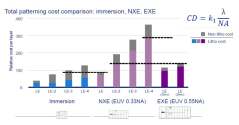
If you’re a world leading fab you don’t commit to increased adoption in high volume production if your assessment is “this is actually not that much more performant than the other cheaper technology right now”. Commercial production lines are optimized for commercial performance. If you’re still in a “betting on the future” position you have an R&D line for that. You don’t incur unnecessary risk and cost for commercial operations if you have more efficient alternatives. It’s also misleading to only look at patterning unit costs between DUVi and EUV, because the general unit cost performance for each doesn’t tell you how these two would compare for the specific critical patterning steps that informed the decision to adopt EUV in the first place.Is called betting in the future. Fab managers are betting that technology will get better and the cost will be reduced.
View attachment 175230
Anyways, I’ll leave what I said below as my last word on this.
To be clear about what I’m trying to address here I don’t dispute that EUV has its problems but I think it would be misrepresenting the technical realities to suggest that the penalties from adding multiples more patterning steps depending on DUVi compare favorably to the penalties behind the specific quirks of EUV. I think it’s more precise to say that the specific quirks of EUV and its cost profile disqualify it from wholesale replacing DUVi in the full fabrication process, but it’s also the case that DUVi is not actually a performant alternative for the most error intolerant patterning steps in more advanced node shrinks.
Last edited:

Chinese media is restrictive so they usually don't reveal much information only big tools companies like NAURA/AMEC regularly do publish their revenue sheet and number of tools/equipment.. for example, SMIC never disclose their 7nm despite they are producing 7nm for years and going to add massive 7nm capacity this year.Ont thing I’ve noticed , why is that we always have to rely on western/Hong Kong/korean etc media about things about China? Is there no reputable Chinese media to report about things in China?
I’ve noticed this pattern where in this forum vast majority of news about China almost always comes from western or other Asian country media to some extent, rarely is it from Chinese media . Why is that? Or maybe people can’t be bothered to translate Chinese media news to English ?
the same method applicable on all High tech fields.
Cambricon too required HBM as they are going to produce decent number of chips this year. 2026 is the breakout year for domestic Ai/GPU chips. so CXMT has to mass produce HBM3 to fulfil the critical gap.Same, Ascend 950DT and Atlas 950 scheduled for Q4 this year and already revealed at MWC 2026 which is good. They will be very big for domestic AI compute.
I'm concerned that the HBM3 delay could completely ruin that timeline or massively reduce the supply of 950s so it's not as significant as it could be.
If CXMT is not producing HBM3 at reasonable scale, I think it could be a disaster for Huawei but I guess we will have to wait for the IPO. The IPO itself will be very big.
Yes. In the case of new technologies companies bet.You don’t commit to increased adoption in high volume production if your assessment is “this is actually not that much more performant than the other cheaper technology right now”. Commercial production lines are optimized for commercial performance. If you’re still in a “betting on the future” position you have an R&D line for that. You don’t incur unnecessary risk and cost for commercial operations if you have more efficient alternatives. It’s also misleading to only look at patterning unit costs between DUVi and EUV, because the general unit cost performance for each doesn’t tell you how these two would compare for the specific critical patterning steps that inform the decision to adopt EUV in the first place.
Anyways, I’ll leave what I said below as my last word on this.
Different from the NXT2150I in China. We have a case of study:
TSMC is betting that Low NA EUV throughput is going to become high enough that their expertise in multi patterning is going to give them an advantage at a much lower cost.
While Intel and Samsung are betting that getting into High NA EUV earlier is going to give then an advantage over the competition in the near future regardless how expensive it is.
Who is going to win? make your bets.