Just finished watching this. Fairly comprehensive until they came to YMTC latest progress. Somehow they missed YMTC 2YY+ Layer NAND came out last year and how much they have been working on domesticating the supply chain. Still quite impressive and unbiased video from a western YouTuber1 hour deep dive into the chinese memory market by steve

You are using an out of date browser. It may not display this or other websites correctly.
You should upgrade or use an alternative browser.
You should upgrade or use an alternative browser.
Chinese semiconductor thread II
- Thread starter vincent
- Start date
China's AI Counterattack in Semiconductors… Focus on Huawei's Ascend 950 Project
With the daily barrage of news related to Chinese semiconductors, it can be difficult to discern the key issues. If you want a quick overview of the current landscape of China's semiconductor industry, look no further than Huawei's Ascend 950 AI chip project.
The Ascend 950, initially unveiled in September 2025 and scheduled for mass production in the first half of 2026, aims to compete with NVIDIA's H100. Considering memory speed, power efficiency, and software ecosystem, the Ascend 950 is estimated to deliver approximately 80% of the H100's performance. If the Chinese semiconductor industry succeeds in mass production of the 950 chip by 2026, it will have significant implications.
The Significance of the Ascend 950
The reason China, which has fallen behind in the race for advanced processing technologies, is betting everything on the Ascend 950 is simple. Unlike "AI training," which demands extreme performance, "AI inference," the actual service implementation stage, can deliver competitive performance even with a 7nm process.
While it's easy to lump AI computations together, AI training and inference are completely different in nature and difficulty. AI training requires endlessly modifying hundreds of billions of parameters, repeatedly adjusting values until the correct answer is found. This requires high-precision computational power that tolerances even the slightest error, along with overwhelming memory bandwidth to support it. Conversely, AI inference involves inputting data into a pre-built AI model to produce results. It doesn't require the extreme computational power of AI training, and smooth service delivery is possible with relatively low precision. This means that even a 7nm chip from the Huawei-SMIC alliance can be a viable solution, even without the cutting-edge 3nm process.
The Ascend 950 offers economic advantages. The Ascend 950's performance is expected to be 80% that of the NVIDIA H100, but its price is expected to be less than 50% of that of the NVIDIA chip. For Chinese companies considering data throughput relative to budget, the Ascend 950 will be an attractive option.
Furthermore, the importance of inference chips is growing from a commercial perspective. This is because the hegemony of the AI chip market is likely to shift to inference chips. While AI training was more important until 2025, inference chips are expected to account for nearly 80% of the global AI semiconductor market by 2030. This is because trained AI, rather than AI training, will be the foundation for a variety of AI services in areas such as shopping, education, healthcare, and administration.
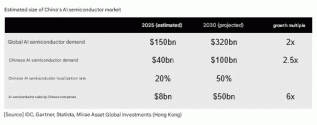
The success of the Ascend 950 will serve as a catalyst for significantly expanding the market dominance of Chinese semiconductor companies. With demand for AI semiconductors in China projected to surge from approximately $40 billion in 2025 to $100 billion in 2030, if domestic companies' market share increases from the current 20% to 50% by 2030, related sales will grow by more than sixfold, from $8 billion to $50 billion. The assumption of a 50% market share is based on the expectation that domestically produced chips, led by the Ascend series, will demonstrate sufficient technological maturity and performance in the AI inference field.
Four Challenges the Huawei Alliance Must Address
The path to successful mass production of the Ascend 950 chip by 2026 is arduous. The Huawei Semiconductor Alliance must overcome the following four technological challenges:
1) Foundry
The first and most critical challenge is to increase the yield of SMIC's N+3 process (7/5nm) to at least 50%. Unable to import EUV, the most advanced lithography equipment, due to US sanctions, China is attempting to utilize DUV, the previous generation of equipment. Currently, SMIC is the only company in the world attempting to achieve 5nm-level microfabrication using only DUV equipment. The core of this strategy is a multi-patterning process, which uses DUV lithography to laminate circuits four or more times. This increases the number of process steps by more than three times compared to using EUV equipment, inevitably leading to lower yields.
SMIC is circumventing this issue with a design-process optimization strategy. Huawei's design team intentionally adjusts chip designs to account for the foundry's lower process precision. This approach results in a slightly larger chip size, but ensures a meaningful yield. The resulting cost increase is offset by subsidies from the Chinese government's semiconductor fund.
2) HBM
The next important challenge is achieving self-sufficiency in high-bandwidth memory (HBM), which is banned from import due to US sanctions. Huawei plans to establish a system to source HBM3 from domestic companies, including CXMT (Changxin Memory) and Fujian Jinhua (JHICC), for mass production of the Ascend 950.
As of 2026, China's HBM technology is estimated to have entered the mass production stage of HBM3, the fourth generation. Compared to Samsung Electronics and Hynix, which have already begun production of the sixth generation (HBM4), there is a technology gap of approximately 1.5 generations. However, successful mass production of HBM3 is sufficient for creating AI chips for inference.
CXMT, a leader in China's DRAM industry, is believed to have recently increased HBM3 yield to around 50%. Fujian Jinhua lags behind Changxin Memory, but through a close partnership with Huawei, it is preparing a "custom HBM3" optimized for the Ascend 950 architecture.
3) Packaging
The final hurdle for Ascend 950 production is securing advanced packaging technology, namely CoWoS (Chip on Wafer on Substrate), which organically combines the GPU and HBM. SiCarrier and Tungfu Micro (TFME) are working together to address this challenge. SiCarrier, Huawei's semiconductor equipment subsidiary, developed the interposer exposure and etching solution, a key component of packaging, while Tungfu, China's largest OSAT company, is responsible for final manufacturing based on this solution.
4) General Equipment
The advancement of equipment manufacturers such as NAURA, AMEC, and Hwatsing has been a significant contributor. NAURA's etching and deposition equipment has become an essential component of semiconductor production lines in China. To overcome the risks of relying on imported core components in the past, NAURA has been aggressively nurturing its subcontractors over the past three years through its "Component Localization Fund." We are supplying customized equipment optimized for Huawei's Ascend 950 line.
If Huawei succeeds in mass production of the Ascend 950 in 2026, this will be more than just a new product announcement. It will symbolize the establishment of China's advanced semiconductor supply chain, spanning SMIC (manufacturing), CXMT (memory), SiCarrier and Tongfu Micro (packaging), and Nowra (equipment). This ecosystem, established by Huawei, will not only foster the shared growth of companies within the alliance but also serve as a catalyst for the advancement of emerging AI chip design companies like Cambricon.
After Mass Production of the Ascend 950
Of course, the successful mass production of the Huawei Ascend 950 will not solve the challenges facing China's semiconductor industry overnight. There is still a three- to four-year (more than 1.5 generations) lag behind NVIDIA's latest architectures, and Huawei will likely continue to rely on NVIDIA, particularly in the ultra-large "learning chip" market, which demands extreme computing power. The current state of China's AI industry is one where, thanks to the recent relaxation of US H200 import restrictions, it must rely on imports for some quantities or utilize bypass methods such as data centers built in the ASEAN region.
Currently, the possibility of mass production of the Ascend 950 is relatively high. However, the true test will be the Ascend 960 project after 2027. The Ascend 960 aims to surpass the NVIDIA H200 and reach 70-80% of the Blackwell (B200) performance. However, it is premature to assess the probability of success due to numerous technical challenges, including the limitations of microfabrication and the difficulty of high-performance packaging.
With the daily barrage of news related to Chinese semiconductors, it can be difficult to discern the key issues. If you want a quick overview of the current landscape of China's semiconductor industry, look no further than Huawei's Ascend 950 AI chip project.
The Ascend 950, initially unveiled in September 2025 and scheduled for mass production in the first half of 2026, aims to compete with NVIDIA's H100. Considering memory speed, power efficiency, and software ecosystem, the Ascend 950 is estimated to deliver approximately 80% of the H100's performance. If the Chinese semiconductor industry succeeds in mass production of the 950 chip by 2026, it will have significant implications.
The Significance of the Ascend 950
The reason China, which has fallen behind in the race for advanced processing technologies, is betting everything on the Ascend 950 is simple. Unlike "AI training," which demands extreme performance, "AI inference," the actual service implementation stage, can deliver competitive performance even with a 7nm process.
While it's easy to lump AI computations together, AI training and inference are completely different in nature and difficulty. AI training requires endlessly modifying hundreds of billions of parameters, repeatedly adjusting values until the correct answer is found. This requires high-precision computational power that tolerances even the slightest error, along with overwhelming memory bandwidth to support it. Conversely, AI inference involves inputting data into a pre-built AI model to produce results. It doesn't require the extreme computational power of AI training, and smooth service delivery is possible with relatively low precision. This means that even a 7nm chip from the Huawei-SMIC alliance can be a viable solution, even without the cutting-edge 3nm process.
The Ascend 950 offers economic advantages. The Ascend 950's performance is expected to be 80% that of the NVIDIA H100, but its price is expected to be less than 50% of that of the NVIDIA chip. For Chinese companies considering data throughput relative to budget, the Ascend 950 will be an attractive option.
Furthermore, the importance of inference chips is growing from a commercial perspective. This is because the hegemony of the AI chip market is likely to shift to inference chips. While AI training was more important until 2025, inference chips are expected to account for nearly 80% of the global AI semiconductor market by 2030. This is because trained AI, rather than AI training, will be the foundation for a variety of AI services in areas such as shopping, education, healthcare, and administration.
The success of the Ascend 950 will serve as a catalyst for significantly expanding the market dominance of Chinese semiconductor companies. With demand for AI semiconductors in China projected to surge from approximately $40 billion in 2025 to $100 billion in 2030, if domestic companies' market share increases from the current 20% to 50% by 2030, related sales will grow by more than sixfold, from $8 billion to $50 billion. The assumption of a 50% market share is based on the expectation that domestically produced chips, led by the Ascend series, will demonstrate sufficient technological maturity and performance in the AI inference field.
Four Challenges the Huawei Alliance Must Address
The path to successful mass production of the Ascend 950 chip by 2026 is arduous. The Huawei Semiconductor Alliance must overcome the following four technological challenges:
1) Foundry
The first and most critical challenge is to increase the yield of SMIC's N+3 process (7/5nm) to at least 50%. Unable to import EUV, the most advanced lithography equipment, due to US sanctions, China is attempting to utilize DUV, the previous generation of equipment. Currently, SMIC is the only company in the world attempting to achieve 5nm-level microfabrication using only DUV equipment. The core of this strategy is a multi-patterning process, which uses DUV lithography to laminate circuits four or more times. This increases the number of process steps by more than three times compared to using EUV equipment, inevitably leading to lower yields.
SMIC is circumventing this issue with a design-process optimization strategy. Huawei's design team intentionally adjusts chip designs to account for the foundry's lower process precision. This approach results in a slightly larger chip size, but ensures a meaningful yield. The resulting cost increase is offset by subsidies from the Chinese government's semiconductor fund.
2) HBM
The next important challenge is achieving self-sufficiency in high-bandwidth memory (HBM), which is banned from import due to US sanctions. Huawei plans to establish a system to source HBM3 from domestic companies, including CXMT (Changxin Memory) and Fujian Jinhua (JHICC), for mass production of the Ascend 950.
As of 2026, China's HBM technology is estimated to have entered the mass production stage of HBM3, the fourth generation. Compared to Samsung Electronics and Hynix, which have already begun production of the sixth generation (HBM4), there is a technology gap of approximately 1.5 generations. However, successful mass production of HBM3 is sufficient for creating AI chips for inference.
CXMT, a leader in China's DRAM industry, is believed to have recently increased HBM3 yield to around 50%. Fujian Jinhua lags behind Changxin Memory, but through a close partnership with Huawei, it is preparing a "custom HBM3" optimized for the Ascend 950 architecture.
3) Packaging
The final hurdle for Ascend 950 production is securing advanced packaging technology, namely CoWoS (Chip on Wafer on Substrate), which organically combines the GPU and HBM. SiCarrier and Tungfu Micro (TFME) are working together to address this challenge. SiCarrier, Huawei's semiconductor equipment subsidiary, developed the interposer exposure and etching solution, a key component of packaging, while Tungfu, China's largest OSAT company, is responsible for final manufacturing based on this solution.
4) General Equipment
The advancement of equipment manufacturers such as NAURA, AMEC, and Hwatsing has been a significant contributor. NAURA's etching and deposition equipment has become an essential component of semiconductor production lines in China. To overcome the risks of relying on imported core components in the past, NAURA has been aggressively nurturing its subcontractors over the past three years through its "Component Localization Fund." We are supplying customized equipment optimized for Huawei's Ascend 950 line.
If Huawei succeeds in mass production of the Ascend 950 in 2026, this will be more than just a new product announcement. It will symbolize the establishment of China's advanced semiconductor supply chain, spanning SMIC (manufacturing), CXMT (memory), SiCarrier and Tongfu Micro (packaging), and Nowra (equipment). This ecosystem, established by Huawei, will not only foster the shared growth of companies within the alliance but also serve as a catalyst for the advancement of emerging AI chip design companies like Cambricon.
After Mass Production of the Ascend 950
Of course, the successful mass production of the Huawei Ascend 950 will not solve the challenges facing China's semiconductor industry overnight. There is still a three- to four-year (more than 1.5 generations) lag behind NVIDIA's latest architectures, and Huawei will likely continue to rely on NVIDIA, particularly in the ultra-large "learning chip" market, which demands extreme computing power. The current state of China's AI industry is one where, thanks to the recent relaxation of US H200 import restrictions, it must rely on imports for some quantities or utilize bypass methods such as data centers built in the ASEAN region.
Currently, the possibility of mass production of the Ascend 950 is relatively high. However, the true test will be the Ascend 960 project after 2027. The Ascend 960 aims to surpass the NVIDIA H200 and reach 70-80% of the Blackwell (B200) performance. However, it is premature to assess the probability of success due to numerous technical challenges, including the limitations of microfabrication and the difficulty of high-performance packaging.
China Develops Photoresist Containers, Japan Loses Another Bargaining Chip
An interesting, quite niche topic: the glass "bottles" that are used to transport photoresist it seems are not easy at all to manufacture, a very small amount of metal ions chipped away from the glass are enough to contaminate the photoresist and hence many wafers.
Japan has full monopoly on these bottles, and even do not sell them separatedly from their photoresist, creating a technological barrier for Chinese photoresist producers.
Now it seems a supplier in China is in trial production with a localized version, breaking Japan monopoly.
Lol, a Japanese toilet maker is going through the roof because of a small component. Japan does have a lot of companies making random small precision/fine components.
Does anyone know if there's a Chinese supplier for electrostatic chucks?
Does anyone know if there's a Chinese supplier for electrostatic chucks?
at a Shenzhen semi event pics in the link
https://www.reddit.com/r/Semiconductors/comments/1qitolu
Was at a semiconductor event in Shenzhen today. The whole "AI needs too much power" thing is obviously the main topic, but it was interesting to see the actual hardware solutions they are mapping out.
Look at the first slide diagram. The push is hard toward 800V DC bus architectures in the racks to handle the density. The takeaway was that regular Si chips can't handle the efficiency needed at these voltages anymore, so it's basically all moving to SiC (Silicon Carbide) for the heavy lifting (the SST stage).
The second slide (sorry in Chinese) was interesting too—basically claiming that grid capacity is going to be a bigger bottleneck than actual GPU supply soon.
https://www.reddit.com/r/Semiconductors/comments/1qitolu
You have a search toolLol, a Japanese toilet maker is going through the roof because of a small component. Japan does have a lot of companies making random small precision/fine components.
Does anyone know if there's a Chinese supplier for electrostatic chucks?
Rockchip Forecasts Strong Growth for 2025, Driven by Edge AI Expansion
Rockchip (瑞芯微) projects 2025 revenue of RMB 4.387–4.427 billion, a 39.9–41.2% YoY increase, with net profit soaring 72–85% YoY to RMB 1.023–1.103 billion. Excluding non-recurring gains, core profit jumps 84–99%, reflecting robust underlying performance.
The growth is fueled by strong demand for its AIoT platforms — notably the RK3588, RK3576, and RV11 series — which are gaining traction in automotive, robotics, machine vision, and industrial automation. Despite Q3 supply chain challenges from rising storage costs, Rockchip mitigated impacts through LPDDR5-enabled solutions, rebounding strongly in Q4.
A key innovation is the RK182X, the world’s first 3D-architecture edge computing coprocessor, designed to overcome bandwidth and power bottlenecks in large-scale AI models. It has already been adopted across 10+ industries and hundreds of customers, with mass deployment expected in 2026.
Looking ahead, Rockchip is advancing a “SoC + Coprocessor” dual-track strategy, accelerating development of next-gen chips like RK3668, RK3688, and RK1860 to lead the next wave of AIoT 2.0 applications in manufacturing, agriculture, and services.
The growth is fueled by strong demand for its AIoT platforms — notably the RK3588, RK3576, and RV11 series — which are gaining traction in automotive, robotics, machine vision, and industrial automation. Despite Q3 supply chain challenges from rising storage costs, Rockchip mitigated impacts through LPDDR5-enabled solutions, rebounding strongly in Q4.
A key innovation is the RK182X, the world’s first 3D-architecture edge computing coprocessor, designed to overcome bandwidth and power bottlenecks in large-scale AI models. It has already been adopted across 10+ industries and hundreds of customers, with mass deployment expected in 2026.
Looking ahead, Rockchip is advancing a “SoC + Coprocessor” dual-track strategy, accelerating development of next-gen chips like RK3668, RK3688, and RK1860 to lead the next wave of AIoT 2.0 applications in manufacturing, agriculture, and services.
Taorun Semiconductor, a leading domestic high-speed interconnect chip company, has secured hundreds of millions of yuan in new funding.
Taorun Semiconductor announced the recent completion of a new round of financing, raising hundreds of millions of yuan in its D++ round. This round was led by Xicheng Jinrui, with participation from multiple institutions including Xinwei Capital, Galaxy Yuanhui, Zhongyuan Capital, and Jinma Investment. Existing shareholders Shenzhen Capital Group, Hillhouse Capital, and Tongchuang Weiye also made over-subscription investments. The funds raised will be used for the continuous iteration of high-end analog underlying technologies and the subsequent research and development of next-generation optical communication DSP chips and other products.
Founded in 2015, Taorun Semiconductor has accumulated core analog chip technologies such as high-performance and low-power ADCs/DACs, SerDes, and PLLs over the past decade, achieving leading domestic technical specifications. Currently, the company has established deep partnerships with numerous domestic clients in the communications, data center, and new energy vehicle sectors, driving rapid revenue growth and forming a solid foundation for the company's current development and future expansion.
Based on its deep expertise in the analog signal chain field, Taorun Semiconductor has systematically built its product matrix, achieving full coverage of core components in the high-speed interconnect field. This includes several high-end chips, such as 400G & 800G incoherent DSP chips and base station RF transceiver chips, which have gradually achieved mass production, filling several domestic gaps in the communications and data center sectors. The company will steadfastly adhere to its established development strategy, deeply cultivate the underlying technologies of analog chips, assemble top-tier design talent, and focus on providing more customers with high-performance, competitive products and solutions to meet the urgent needs of national data infrastructure.
Founded in 2015, Taorun Semiconductor has accumulated core analog chip technologies such as high-performance and low-power ADCs/DACs, SerDes, and PLLs over the past decade, achieving leading domestic technical specifications. Currently, the company has established deep partnerships with numerous domestic clients in the communications, data center, and new energy vehicle sectors, driving rapid revenue growth and forming a solid foundation for the company's current development and future expansion.
Based on its deep expertise in the analog signal chain field, Taorun Semiconductor has systematically built its product matrix, achieving full coverage of core components in the high-speed interconnect field. This includes several high-end chips, such as 400G & 800G incoherent DSP chips and base station RF transceiver chips, which have gradually achieved mass production, filling several domestic gaps in the communications and data center sectors. The company will steadfastly adhere to its established development strategy, deeply cultivate the underlying technologies of analog chips, assemble top-tier design talent, and focus on providing more customers with high-performance, competitive products and solutions to meet the urgent needs of national data infrastructure.
EUV pellicles.