Recently, the first unit of SEPA®-h755, a new generation of high-energy electron beam measurement equipment (HV-SEM) independently developed by Orient Crystal Source, was successfully delivered to a leading domestic customer. The HV-SEM is Orient Crystal Source's fourth electron beam metrology testing device, following EBI, CD-SEM, and DR-SEM, marking the company's comprehensive layout in the four core areas of front-end electron beam metrology equipment. The successful delivery of the new generation HV-SEM not only further consolidates the company's leading advantage in this domestic market but also demonstrates its core technological strength in electron beam metrology testing for advanced processes.
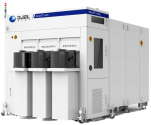
The core of high-energy electron beam (HEEB) equipment lies in its use of high-energy electron beams for scanning imaging. The landing energy of these electron beams typically reaches 30 keV or higher, far exceeding the conventional level of 5 keV or lower for other electron beam quantity detection equipment. This ultra-high landing energy endows the equipment with the ability to "see through" deep within the wafer for imaging. However, this requires overcoming a series of technical challenges, including high-voltage systems, high-energy electron beam deflection and precise control, multi-detector synchronous imaging, high-speed and high-precision motion control platforms, special scene calibration techniques, standard sample preparation, and the development of novel software algorithms. Leveraging its profound technical expertise in the electron beam field, the R&D team at Orient Crystal Source overcame these difficulties, successfully launching this new equipment and achieving rapid technological iteration and upgrades.
Looking back at the R&D process, Dongfang Jingyuan officially launched the HV-SEM R&D project in early 2024. That year, the team overcame the challenges of 30keV landing energy electron beam imaging technology, completed the overall application process setup and core algorithm development, and validated it in a real-world wafer fab scenario. In April 2025, the team successfully achieved 45keV high-energy electron beam imaging, with core indicators reaching the standards of leading international products. In December 2025, the equipment completed application demo testing in high-end process technologies such as 3D-NAND, DRAM, and advanced logic, fully demonstrating its measurement capabilities for 3D structures in advanced processes.
HV-SEM has unique application value and can play a key role in advanced processes and specialty technologies:
1. SEM Overlay Measurement: High-energy electron beams have a certain material penetration depth. Combined with a BSE (backscattered electron) detector, they can capture micron-level depth signals of the sample, achieving "see-through" imaging. By combining this with sample surface information acquired by an SE (secondary electron) detector, positional difference analysis of the structure in the two images can be performed, accurately completing SEM overlay (alignment or overlay precision) measurements. Actual measurement data shows that the SEpA®-h755 can clearly display the first three metal layers within a 1μm field of view on the Metal HMET layer.
 2. High Aspect Ratio (HAR) Structure Measurement:
 For structures with an aspect ratio greater than 10:1, such as deep holes and deep trenches, a high-energy electron beam can be incident on the bottom of the structure and feed back an effective signal to the detector, thereby achieving imaging and measurement. Currently, the equipment has completed high aspect ratio measurement verification for two-dimensional structures with a ratio of 30:1 and one-dimensional structures with a ratio of 80:1.
3. Expanding Defect Detection Applications: Leveraging the advantages of high-energy electron beam technology, it is possible to achieve expanded detection applications such as special types of defects.
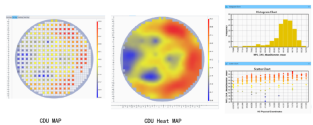
4. Big Data Visualization and Analysis: Equipped with big data visualization software independently developed by Oriental Crystal Source, it can conduct overall trend analysis of CDU and OVL, providing data support for process optimization.