Im sure landspace must be n'avons the table hard for being a few weeks late from being the fiest sucessful reusable chinese rocket . Lol congrats to CASC , thry actually came from behind to beat all others private space companies who were aleady considering this before them.Kudos to the CZ10B team, they beat those noisy domestic private companies.
This sea-based rope recovery is ingenious. While it can't be repaired, refueled, and relaunched as quickly as launch tower recovery, it's extremely economical: sea-based recovery avoids wasting fuel returning to the launch site, and rope recovery eliminates the need for a bulky landing gear, reducing structural strength requirements—all of which significantly increase launch payload.

You are using an out of date browser. It may not display this or other websites correctly.
You should upgrade or use an alternative browser.
You should upgrade or use an alternative browser.
China's Space Program Thread II
- Thread starter Blitzo
- Start date

The recovery was conducted in sea state 4, resulting in significant rolling of the recovery vessel. The second set of steel cables and the clamping arms on the side of the pylon had not yet activated when the LM-10B first stage recovery was completed, causing noticeable swaying of the suspended rocket body.
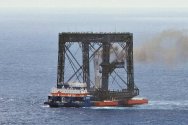
If it were a Falcon 9 or a New Glenn, it would have already fallen into the sea, as the landing legs only support sea state 2 at most.
If it were a Falcon 9 or a New Glenn, it would have already fallen into the sea, as the landing legs only support sea state 2 at most.
Is that Guowang ?

so for bigger rockets like LM-10C they will modify/upgrade ship structure ?The recovery was conducted in sea state 4, resulting in significant rolling of the recovery vessel. The second set of steel cables and the clamping arms on the side of the pylon had not yet activated when the LM-10B first stage recovery was completed, causing noticeable swaying of the suspended rocket body.
View attachment 177991
If it were a Falcon 9 or a New Glenn, it would have already fallen into the sea, as the landing legs only support sea state 2 at most.
Big achievement for China! I expect you will see some of the private space companies have success in first stage recovery in the near future.
Actually, I mentioned that around 2017, in the official white paper released by the China Aerospace Science and Technology Corporation (CASC), the timeline was already set as 2045. Now it is generally believed that this timeline will be moved forward.The matter is indeed one of time.
When you say they can afford to wait and compete in the long term, the problem that is being posed is -- how long can they actually afford to wait?
I am not necessarily talking about the concern of war, but there does exist a possibility that if one party is able to reach a sufficient critical mass of capability before another party, that it can produce disproportionate effects in "locking in" certain long term advantages (either due to policy, access, or physical occupation) which are much harder to reverse.
This isn't to say I think there is any sort of imminent short term tipping point, but what I am saying is that the time may not be infinite, and that there may be a ticking clock which is being pace set by the fastest current movers.
China’s goal is to reach a level comparable to the United States in 90–95% of aerospace fields (with no generational gap) between 2030 and 2035. Only in a few areas—those requiring long-term accumulation—does China still lag behind the U.S., such as in deep-space exploration: American spacecraft have now reached the edge of the solar system, while China remains far from achieving such milestones.
There are many things where I can only say that Chinese thinking differs from Western thinking. Many Westerners simply cannot understand it, and discussing it now is meaningless—neither side can convince the other.
I have seen many details that Westerners neither see nor hear, nor do they have the cognitive framework for them. So no consensus can be reached at present. Only time will prove things—I am not worried.
Western industry has hit a bottleneck, for reasons that are numerous and complex. I could cite tens of thousands of words of case studies and analyses, layer by layer. In fact, many Chinese enthusiasts have spent decades studying and analyzing the technological and capability gaps between China and the West (including the entire Western world), identifying problems and solving them. That is why China’s technology has developed to its current level.
Many Chinese like me saw these problems in the West long ago, and have been observing for over ten years to see whether any of them would ease or be fixed. To be honest, I haven't seen it. It is precisely because the West's own development keeps confirming the correctness of our observations and inferences that I'm making this judgment today.
I won't say much else. Actually, what the Chinese side thinks has long been said openly. The reason China is confident is that we are a country of 1.4 billion people—more than the combined total of the US, Europe, Japan, and South Korea. And the US + Europe + Japan + South Korea essentially make up the entirety of the so-called Western world (the technologically advanced nations). So China believes it is perfectly logical for China, as a single country, to stand against the entire Western technological alliance.
Therefore, China is neither worried nor bothered by so-called Western technology blockades, competition, or even confrontation. Because China's population base is sufficient to form all the soil and elements needed to cultivate homologous technologies. In other words, at worst, China can form a parallel technological or scientific world running alongside the West. That is the foundation of China's confidence. And, in fact, all of this is being confirmed one by one.
The Western technological system has two biggest problems. One is that costs are natively high (the Western economic operation model is costly); the other is that the Western market, overall a sum of some 40-plus countries, remains a fragmented market (there's an economic efficiency problem). So on the basis of scale advantage, once "technological parity" is achieved (i.e., China possesses technology of equal grade), under the principles of a market economy, the high-cost side has no future. That is the real trouble of the Western world today. In the past, they relied on a "technological scissors gap"—(1) maintaining a generational-tech advantage, (2) strangling the upward channel for non-ally countries' technological and industrial upgrading, and (3) turning other countries into resource suppliers and low value-added product providers. Coupled with financial maneuvers, they plundered all Global South countries that had a chance to rise. That's how they maintained the West's 400-year lead. After China developed to the point of technological parity, it actually blocked this cycle. Originally China didn't intend to break away from the rules and order established by the West, but the reality is clear: the West will not allow China to keep developing, and the US cannot allow China to surpass it. But for a country of China's size, a little development naturally means surpassing the US.
So here's the thing—China has to consider the possibility of an alternative, parallel path. Do you know what the consequence is? The Western economic model's premise for maintaining its lead has always been a continuous "offering" from the whole world to the Western system. China's detachment from the Western system—because China can provide better-quality, cheaper consumer and industrial goods (solar power, Chinese EVs, etc.)—breaks this cycle of economic tribute. The Western system of bleeding the Global South (including China) to sustain its high-welfare, high-cost social operation will collapse.
This problem has actually already begun transmitting to all Western countries. Under these circumstances, time is not on your side. Because the existing system will inevitably collapse. Under such a collapse—what the Chinese call "profound changes unseen in a century"—the magnitude of SpaceX's satellite launch capacity is meaningless. Because that whole game was flawed to begin with. After SpaceX goes public, many big names in Western economics have said that SpaceX's logic is questionable in many ways. I won't elaborate here.
Simply put, Western industrial costs, workforce quality, and the systematic dismantling of the education system have left their own products uncompetitive. That is the root of why the West is running out of time. Whether the US or Europe, they're both messing around, accelerating the destruction of their own advantages:
- Does the global tariff war launched by the US benefit the US economy and hegemony?
- Does the US war with Iran benefit its own economy and hegemony?
- Does the war between Europe and Russia benefit Europe? Most of us know European industry was actually built on Russia's cheap energy—is this "fight-to-the-death" posture good for Europe?
P.S. The Chinese have an old saying: "When the nest is overturned, how can any egg remain intact?"(覆巢之下,安有完卵 — from A New Account of the Tales of the World《世说新语》; meaning no one escapes when the whole system collapses.)
In Chinese memory, Russia has actually been restricting technology exports to China all along. After the Cold War, based on the Wassenaar Arrangement, Russia's technology transfers to China—especially in aerospace—were very limited. Many years ago, China wanted to buy a lot of technologies, but Russia would rather sell them to the US than give them to China. By the time they started to figure things out, China had long since stopped needing them.What do you mean? Since when was Russia an opponent participating in the blockade against China ?

Stream content from 云I天镜SpaceLens : black smoke emitted was exhaust from the Reaction control system. During the final approach to the recovery vessel, the engine replaced the RCS, and toxic exhaust was carried out whenever possible to avoid polluting the recovery vessel.
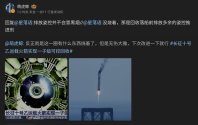
Cute Orca says otherwise, I agree w/ him given RCS exhaust is typically either monopropellent or cold gas both of which would not emit this kind of thick black smoke.
It's likely something caught on fire in the interstage, though from the fact it landed intact, whatever it is probably isn't mission critical but I suspect it may hamper reusability if some of the wiring, piping and/or structural has been damaged.

The entire ISS was a jobs program to stop soviet scientists and engineers from going to work in China.In Chinese memory, Russia has actually been restricting technology exports to China all along. After the Cold War, based on the Wassenaar Arrangement, Russia's technology transfers to China—especially in aerospace—were very limited. Many years ago, China wanted to buy a lot of technologies, but Russia would rather sell them to the US than give them to China. By the time they started to figure things out, China had long since stopped needing them.