
You are using an out of date browser. It may not display this or other websites correctly.
You should upgrade or use an alternative browser.
You should upgrade or use an alternative browser.
China's Space Program Thread II
- Thread starter Blitzo
- Start date


Suntan Space Telescope or CSST update. Epects to be used on China's space station.
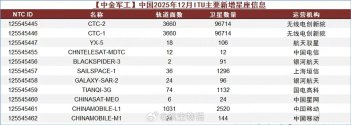
I'm honestly a little shocked by this. China has applied to ITU to add 200k+ satellites to LEO, including CTC-1 and CTC-2, both having 967114 satellites. Those are huge constellation. It's not clear how they will get granted that many spots. Looks like SpaceSail is adding 1296 more also. China Mobile & China Sat/Guowang are also looking to add more sats.
Looks like this organization 无线电创新院 was just established on 2025/12/30 and involves NUAA, CETC, Beijing Jiaoda, China satellite network group and a couple of Hebei govt and 国家无线电监测中心 (first time I have heard of these guys).南航助力无线电创新院雄安启航
供稿:杨丽娟 |编辑发布:李欣妮 | 发表日期:2026-01-06 | 点击数: 247 次
为贯彻落实党的二十届四中全会精神促进电磁频谱领域科技创新和产业创新深度融合,服务高标准高质量建设雄安新区,2025年12月30日,无线电频谱开发利用和技术创新研究院(以下简称无线电创新院)在雄安新区登记注册,这是我国无线电管理技术领域首家以技术创新和成果转化为目标的新型研发机构。
无线电创新院由国家无线电监测中心、河北雄安新区管理委员会、河北省工业和信息化厅、中国卫星网络集团有限公司、南京航空航天大学、北京交通大学、中国电子科技集团有限公司7家单位联合共建。无线电创新院将以服务卫星互联网产业、研究电磁空间技术、挖掘频谱资源价值潜力为愿景,聚焦频谱开发利用与技术创新深度融合,着力搭建无线电领域集关键技术研发、成果孵化与产业赋能于一体的政产学研用联合创新平台,推动无线电频谱资源高效利用与技术创新。
作为联合共建单位之一,南航电磁频谱研究院和低空经济创新发展研究院将充分发挥各自优势、协同攻关,聚焦低空电磁空间安全领域检测检验、安全防御系统集成、空域电磁空间安全评估、低空空域安全监管服务等技术,办好空天频谱智能创新拔尖班培养后备人才力量,与各方携手,将无线电创新院打造成共同打造战略实施的“助推器”、创新成果的“孵化器”、产业发展的“连接器”,为我国无线电产业高质量发展提供有力支撑,为雄安新区数字城市建设注入强劲动力,为推进新型工业化贡献智慧力量。
"They will focus on technologies such as detection and testing in the field of low-altitude electromagnetic space security, safety defense system integration, airspace electromagnetic space security assessment, and low-altitude airspace safety supervision services"
View attachment 167865
I'm honestly a little shocked by this. China has applied to ITU to add 200k+ satellites to LEO, including CTC-1 and CTC-2, both having 967114 satellites. Those are huge constellation. It's not clear how they will get granted that many spots. Looks like SpaceSail is adding 1296 more also. China Mobile & China Sat/Guowang are also looking to add more sats.
Looks like this organization 无线电创新院 was just established on 2025/12/30 and involves NUAA, CETC, Beijing Jiaoda, China satellite network group and a couple of Hebei govt and 国家无线电监测中心 (first time I have heard of these guys).
"They will focus on technologies such as detection and testing in the field of low-altitude electromagnetic space security, safety defense system integration, airspace electromagnetic space security assessment, and low-altitude airspace safety supervision services"
This is interesting.
Isn't there supposed to be a ~100K limit on how many LEO satellites can fit in the orbitals?


I'm pretty sure there is a time limit on this, was it 5 years or 10, that you have to have a certain amount of satellites operational to hold the slot.Is this an attempt to directly challenge the Americans head-on? And if it passes, it will also block any potential competitors from entering the market (if there are any).
Could be cubesats with electric propulsion to change orbit, a 3U is around 3 kg so 96714 will need only ~12x LM5B or equivalent.View attachment 167865
I'm honestly a little shocked by this. China has applied to ITU to add 200k+ satellites to LEO, including CTC-1 and CTC-2, both having 967114 satellites. Those are huge constellation. It's not clear how they will get granted that many spots. Looks like SpaceSail is adding 1296 more also. China Mobile & China Sat/Guowang are also looking to add more sats.
Looks like this organization 无线电创新院 was just established on 2025/12/30 and involves NUAA, CETC, Beijing Jiaoda, China satellite network group and a couple of Hebei govt and 国家无线电监测中心 (first time I have heard of these guys).
"They will focus on technologies such as detection and testing in the field of low-altitude electromagnetic space security, safety defense system integration, airspace electromagnetic space security assessment, and low-altitude airspace safety supervision services"

Yes, such restrictions do exist. Ten percent of the satellites must be launched within two years, and 50% within five years. Moreover, there is a precedent. The European company Rivada Space planned to launch 576 satellites by mid-2026 in order to comply with its license, but the company lost its ITU filings. What is interesting here is that this initially was a German–Chinese project, KLEO Connect, from which G60/Qianfan later emerged.I'm pretty sure there is a time limit on this, was it 5 years or 10, that you have to have a certain amount of satellites operational to hold the slot.
There's no way they'll launch another 20,000 satellites ontop of whatever is planned/required for Qianfan and Guowang in the next two years. The US doesn't even have that capacity and China is a decade away from their launch rate.Yes, such restrictions do exist. Ten percent of the satellites must be launched within two years, and 50% within five years. Moreover, there is a precedent. The European company Rivada Space planned to launch 576 satellites by mid-2026 in order to comply with its license, but the company lost its ITU filings. What is interesting here is that this initially was a German–Chinese project, KLEO Connect, from which G60/Qianfan later emerged.