Chinese semiconductor thread II

tokenanalyst

Lieutenant General
Registered Member

High Density Stacked Dual Channel IGZO FET 3D DRAM with Vertical BL: Process Integration, Simulation and Scalability​

Beijing Superstring Academy of Memory Technology, Beijing, China​

Abstract:​

IGZO based dual channel FET monolithic 3D DRAM architecture with vertical bit line (IGZO-VBL) is proposed in this work. The architecture design, process integration, electrical TCAD simulation and circuit design simulation are systematically investigated. The BL, WL and IGZO channel related coupling capacitance are evaluated based on the same cell architecture but different feature sizes. Furtherly, layer-layer isolation space and work function of source/drain metal are discussed to minimize passing gate effect and channel-source/drain contact barrier. The IGZO channel shows ultra-low Ioff due to its large bandgap, which is conductive to data retention. In addition, we evaluate the bitcell density, BL sensing signal, WL turn-on delay time and cell array area ratio with different cell number per WL and layer number. Considering feasible integration process, especially no channel doping, acceptable BL sensing signal and reasonable circuit design, this IGZO-VBL architecture offers a pathway to achieve promising stackable monolithic 3D DRAM with ultra-high density and low cost.​

Please, Log in or Register to view URLs content!
 

sunnymaxi

Colonel
Registered Member

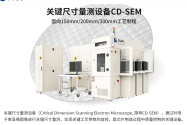
The first CDSEM unit from the 48th Research Institute of China Electronics Technology Group Corporation was successfully shipped.​


The first critical dimension measurement equipment (CDSEM) independently developed by the 48th Research Institute completed the overall debugging and factory inspection, and was officially shipped to the customer.

163045971.jpg


CDSEM is an indispensable core quantity inspection equipment in advanced semiconductor processes, hailed as the "nanoscale ruler" of semiconductor manufacturing. It can meet the R&D and production inspection needs of cutting-edge fields such as advanced integrated circuits, quantum information, artificial intelligence chips, and optoelectronics. Relying on the "three beams" core technologies, the 48th Research Institute has formed an integrated R&D, production, and service collaborative research team. Through collective wisdom and continuous breakthroughs, it has successively overcome several key core technologies such as high-resolution electron optical systems and high-precision displacement stages, achieving a leap from principle verification and prototype development to engineering products.

This shipment of CDSEM fills a product gap in the semiconductor metrology and inspection equipment field at Institute 48, establishing an electron beam product matrix that integrates manufacturing equipment and metrology and inspection equipment, and creating an independent supporting system for semiconductor micro-nano manufacturing from "processing" to "inspection". As the fifth electron beam device shipped from the institute, the product's maturity, stability, and production capacity have been continuously upgraded, laying a solid foundation for large-scale, standardized manufacturing and continuous delivery.

Next, the 48th Research Institute will take this CDSEM delivery as a new starting point, continue to deepen technological iteration and process innovation, accelerate the industrialization of electron beam equipment and the construction of a service standardization system, strengthen collaborative cooperation with leading enterprises in the industry chain, and contribute to the high-quality development of my country's semiconductor industry with "three-beam" equipment.

Please, Log in or Register to view URLs content!
Hitachi and Applied Materials are the dominant manufacturers of Critical Dimension Scanning Electron Microscopes (CDSEM) equipment.. its good one more category taken down by the Chinese player.
 

tokenanalyst

Lieutenant General
Registered Member
Hitachi and Applied Materials are the dominant manufacturers of Critical Dimension Scanning Electron Microscopes (CDSEM) equipment.. its good one more category taken down by the Chinese player.
Skyverse and DJEL are the two dominant domestic companies in CDSEM. Their tools are used in High End nodes.

Skyverse
1780428704964.png

Please, Log in or Register to view URLs content!
Oriental Crystal
1780428745943.png
Please, Log in or Register to view URLs content!
 

tphuang

General
Staff member
Super Moderator
VIP Professional
Registered Member
Please, Log in or Register to view URLs content!

Novosense is a major player in isolation sampling chips, needed for AI Server power supplies. They are used by AC/DC PFC and DC/DC LLC resonant stages. They are used for voltage, current sensing and fast protection.The main competition globally are TI, ADI and Infineon.

The main domestic competitors are 3PEAK, SG Micro and Chiapanalog.
 

tokenanalyst

Lieutenant General
Registered Member

SmartSens introduces a new 200-megapixel ultra-high resolution CMOS image sensor for mobile applications.​


Chinese semiconductor firm SmartSens has officially introduced the SCC62HS, a groundbreaking 200-megapixel CMOS image sensor designed specifically for mobile applications. Marked as their first high-performance product based on domestically produced Stacked BSI technology, this launch represents a major step forward in China's semiconductor localization efforts and aims to bring flagship-level camera capabilities to mainstream smartphones at a competitive cost.

The SCC62HS is built on SmartSens' proprietary SmartClarity®-SL platform, utilizing an advanced 55nm Stacked BSI process. It integrates three core patented technologies:​
  • PixGain HDR®: Enhances dynamic range and suppresses motion blur.​
  • SFCPixel®: Improves low-light sensitivity and noise suppression.​
  • AllPix ADAF®: Enables rapid, full-pixel autofocus even in darkness.​
  1. Ultra-High Resolution & Clarity With a pixel size of 0.5μm, the sensor captures an impressive 200 million pixels. This allows for detailed imaging of distant landscapes and group photos, retaining every minute detail while balancing performance with cost-effective manufacturing.​
  2. Exceptional Dynamic Range (HDR) Leveraging PixGain HDR®, the sensor achieves a dynamic range of up to 86.3dB. It supports on-chip dual-frame fusion, which reduces computational load on the phone's SoC and lowers power consumption during long video recordings. It is compatible with various HDR modes including Staggered HDR and NDOL HDR.​
  3. Superior Night Vision Designed to combat noise in low-light scenarios, the SCC62HS features:​
    • High sensitivity of 3574mV/lux*s.​
    • Read noise as low as 0.92e- (approx. 43.6% lower than comparable industry products). These metrics ensure clear, bright images with rich detail in challenging lighting conditions.​
  4. Adaptive Fast Autofocus The sensor offers two smart autofocus modes to optimize both speed and battery life:​
    • AllPix ADAF®: Activates for rapid night shooting using 100% full-pixel focus.​
    • Sparse PDAF®: Switches to normal lighting, utilizing only 6% of pixels for phase detection to ensure fast focus while significantly saving power.​
SmartSens positions the SCC62HS as a cost-effective solution that enables mainstream smartphones to match the imaging quality of high-end flagships. By expanding its portfolio with other sensors like the SC562HS, SC532HS, and SC512HS for telephoto and front-camera applications, SmartSens is actively promoting the widespread adoption of domestic Stacked BSI technology in China's mobile device supply chain.

Please, Log in or Register to view URLs content!
 

interestedseal

Junior Member
Registered Member
Naura is now the second company in China with Ion Beam etching tools for semiconductors. Thought their seems to made for throughput.

As integrated circuit manufacturing processes advance to advanced nodes, chip feature sizes are reaching the atomic level, placing stringent demands on processing precision, surface quality, and damage control. Traditional chemical mechanical polishing (CMP) and plasma etching suffer from drawbacks such as scratches, subsurface damage, and limited precision, failing to meet the core requirements of advanced logic, memory, and silicon photonics chips. Against this backdrop, ion beam etching, with its atomic-level precision and near-zero damage advantages, has become a key process equipment in post-Moore's Law semiconductor manufacturing.

View attachment 175992

Ion beam etching, superior to traditional processes, highlights its value.

Traditional plasma etching relies on chemical reactions and ion bombardment to remove materials, while ion beam etching accelerates and neutralizes ions before directly bombarding the wafer surface, relying on physical sputtering to remove materials. The difference in their underlying principles determines the performance gap. Compared to traditional processes, cluster ion beam etching offers nanometer-level precision, better directionality, and near-zero damage processing; it is adaptable to almost all materials, offers greater process flexibility, and can fulfill complex requirements such as localized precision finishing of wafers and etching at arbitrary angles.

Overcoming three major technologies and establishing a firm foothold in innovation

Acme Glaion130 has successfully overcome three major technical challenges in the industry, achieving independent development of key technologies:

Gas cluster ion source technology: Compared with conventional single-cell ion source technology, it has a faster etching rate, better surface quality, and lower process damage; the stability and beam quality of cluster ion sources reach a better level than similar equipment, providing core support for atomic-level etching.

Electrode technology under high-speed motion: It enables precise and rapid positioning of wafers, solves the stability problem under high-speed motion, and ensures processing accuracy.

Dynamic precision control algorithm: Equipped with an in-situ film thickness measurement device, it forms the required etching map and optimizes the stage movement trajectory to achieve local fixed-point precision finishing of the wafer.

The other company is Leuven Instruments.

View attachment 175993

Please, Log in or Register to view URLs content!
Here is another GCIB tool maker from Shenzhen. They’re working with SiCarrier
Please, Log in or Register to view URLs content!
 
Top