Jiaocheng Ultrasonic Builds Audio Defense Line for Advanced Packaging Defect Detection
In the post-Moore's Law era, artificial intelligence computing power has grown explosively. 2.5D and 3D advanced packaging technologies have become essential for overcoming chip performance limitations and enabling mass production of high-performance computing chips, AI processors, and high-bandwidth memory. However, these sophisticated packaging methods involve multi-layer stacked structures, micro-pitch interconnects, and heterogeneous material interfaces. This complexity creates micron-level defects such as bubbles, delamination, cracks, and foreign particles that act as invisible threats to manufacturing yield. If these defects are not identified early in production, product yields become difficult to guarantee.
Ultrasonic testing technology, also known as Scanning Acoustic Microscopy or SAM, offers a powerful solution. This technique works like a microscopic ultrasound scan for chips. A high-frequency ultrasonic probe emits waves that travel through deionized water into the chip package. When these waves encounter different materials or defects like air gaps, they reflect back with varying intensity and timing. By analyzing these reflections, the system can reconstruct detailed two-dimensional and three-dimensional images of the chip's internal structure.
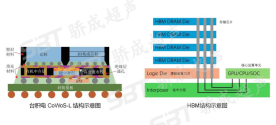
This approach provides four significant advantages for advanced packaging inspection. First, it enables completely non-destructive testing with no contact damage to valuable chips. Second, it offers deep imaging capability that penetrates silicon, glass, and molding compounds to inspect entire stacked layers. Third, it demonstrates exceptional sensitivity to air gaps, detecting micron-sized bubbles and delamination that optical and X-ray methods often miss. Fourth, it supports high-efficiency mass production with compatibility for standard wafer sizes and fully automated online testing.
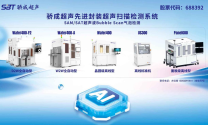
Shanghai Jiaocheng Ultrasonic Technology Company has developed a comprehensive range of ultrasonic scanning equipment designed for advanced packaging applications. Their Wafer400 series addresses wafer-level processes, while the Panel600 series serves panel-level packaging needs.
The Wafer400-F2 model supports die-to-wafer processes with an automatic wafer flipping mechanism that enables non-contact backside scanning, protecting chip surfaces from water exposure. The Wafer400-A is designed for wafer-to-wafer bonding applications, particularly suited for HBM and 3D stacking processes, with flexible probe selection for detecting bonding interface defects. The standard Wafer400 serves research, development, and pilot production needs with semi-automatic operation. The Panel600 accommodates various panel sizes for panel-level packaging and supports both reflection and transmission scanning modes. The US300 provides an offline manual option for laboratory research and small-batch production.
Jiaocheng Ultrasonic has built a complete research and development team spanning acoustics, mechanics, electrical engineering, software, and algorithms. The company has achieved full-stack self-developed capabilities in high-frequency probes, pulse generators, high-speed data acquisition, precision motion control, and artificial intelligence algorithms, breaking previous overseas technology monopolies.
To address efficiency challenges in high-volume manufacturing, the company developed a dual-station scanning platform where two probes operate independently but simultaneously on the same wafer, automatically merging images to double inspection throughput. To handle wafer warpage issues that can interfere with scanning accuracy, Jiaocheng created a Real-Time Auto Focus function. This system uses fast focusing algorithms and precise Z-axis adjustments to dynamically maintain optimal probe focus regardless of sample surface variations.
As advanced packaging technology continues evolving, ultrasonic testing is increasingly incorporating artificial intelligence for smarter defect recognition. Jiaocheng Ultrasonic has developed proprietary defect identification algorithms based on deep learning. Their end-to-end semantic segmentation model analyzes each defect instance, extracts characteristics such as shape and position, and classifies defect types including bubbles, chipping, cracks, and foreign matter. This approach delivers pixel-level segmentation accuracy and improved classification performance for complex defect scenarios.
Looking ahead, Jiaocheng Ultrasonic plans to continue advancing ultrasonic testing technology while collaborating with industry partners to drive the semiconductor packaging sector forward. With SEMI-certified equipment and systematic innovation across multiple technical domains, the company is establishing itself as a benchmark for domestically produced ultrasonic inspection solutions, helping ensure yield and reliability for next-generation chip manufacturing in the AI computing era.