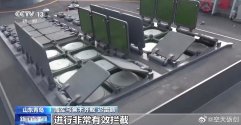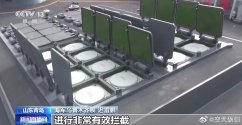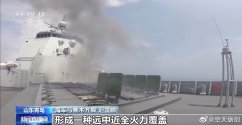
052C/052D Class Destroyers

Totoro

Major
VIP Professional
Yikes. That looks like a laborious, slow process. One crane lifts the cell from the trailer, with ample help needed to guide it and orient it. Then another crane somehow holds it after handover and inserts it in into the well. Imagine loading 64 or 112 of those... There really needs to be a special loader system devised for this. A large vehicle with a long gantry that can extend like 15 meters from its center and still hold a cell vertically, to be slid into the well. Something like this, i guess: crane.png
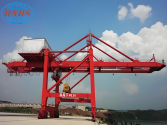
But of course smaller, narrower, more compact and optimized not for a container but for one missile cell. On the other hand, also mounted on a vehicle. When deployed, stabilizers could extend out of the vehicle, the gantry arm could swivel from transport position (longitudinal) to transfer position (perpendicular). Loads would have to be carried on top of the gentry arm instead of under it, like here. It'd still be a huge vehicle and a huge piece of equipment, but with a proper handling arm that provides some extra leeway for precision, a single vehicle could transfer a cell from a trailer to a VLS well, probably in a minute or so.
 

Blitzo

General
Staff member
Super Moderator
Registered Member
Yikes. That looks like a laborious, slow process. One crane lifts the cell from the trailer, with ample help needed to guide it and orient it. Then another crane somehow holds it after handover and inserts it in into the well. Imagine loading 64 or 112 of those... There really needs to be a special loader system devised for this. A large vehicle with a long gantry that can extend like 15 meters from its center and still hold a cell vertically, to be slid into the well. Something like this, i guess: View attachment 173193

But of course smaller, narrower, more compact and optimized not for a container but for one missile cell. On the other hand, also mounted on a vehicle. When deployed, stabilizers could extend out of the vehicle, the gantry arm could swivel from transport position (longitudinal) to transfer position (perpendicular). Loads would have to be carried on top of the gentry arm instead of under it, like here. It'd still be a huge vehicle and a huge piece of equipment, but with a proper handling arm that provides some extra leeway for precision, a single vehicle could transfer a cell from a trailer to a VLS well, probably in a minute or so.

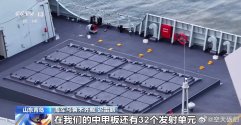
I'm pretty sure what we see in that image is not inconsistent with various other loading cranes that exist shroeside for other navies.

There are of course also additional crane types of various shapes and sizes in both the PLAN and around the world, but what we see in that picture isn't too abnormal either.
 

dingyibvs

Senior Member
Why can't they make it like some MLRS systems, reloading a whole set of 8 cells at once? Heck, just make the entire 8 cell module removable so you can just replace the whole module at once?
 

Blitzo

General
Staff member
Super Moderator
Registered Member
Why can't they make it like some MLRS systems, reloading a whole set of 8 cells at once? Heck, just make the entire 8 cell module removable so you can just replace the whole module at once?

The difference between reloading multiple MLRS at once versus multiple VLS cells at once, is that the VLS is associated with some more complex structures, venting, interfaces than a MLRS pod.
And making the whole 8 cell module removable means making many 8 cell modules to begin with (which are not cheap -- there's a reason why VLS modules are integral to a ship's hull's structure).

Also, you'll need a crane with a much heavier rating for either of those options.


In theory, one might be able to design a more bespoke VLS in the future to enable faster reloads, but you'll probably end up compromising something else with its design, such as size, payload weight, or higher cost, or a combination thereof.

There's a reason why all VLS designs over the multiple decades that VLS have existed, still reload them one by one.
 

Andy1974

Senior Member
Registered Member
Why can't they make it like some MLRS systems, reloading a whole set of 8 cells at once? Heck, just make the entire 8 cell module removable so you can just replace the whole module at once?
We saw the ease with which 4/8 VLS can be changed on the weaponized container ship, maybe that is the way to go…

Store and load the containerized VLS horizontally then raise them only to fire. That quite small container ship (<100m) had 60 VLS, and there is innumerable equipment designed to handle containers of this sort.

I suppose you just need to design a destroyer with enough flat space. You could maybe start by replacing slanted launchers with containers and increasing that flat space.

A 20m wide ship can fit 8 containers abreast, which is 32 full size VLS per row, or 64 thinner VLS.
 
Last edited:

dingyibvs

Senior Member
The difference between reloading multiple MLRS at once versus multiple VLS cells at once, is that the VLS is associated with some more complex structures, venting, interfaces than a MLRS pod.
And making the whole 8 cell module removable means making many 8 cell modules to begin with (which are not cheap -- there's a reason why VLS modules are integral to a ship's hull's structure).

Also, you'll need a crane with a much heavier rating for either of those options.


In theory, one might be able to design a more bespoke VLS in the future to enable faster reloads, but you'll probably end up compromising something else with its design, such as size, payload weight, or higher cost, or a combination thereof.

There's a reason why all VLS designs over the multiple decades that VLS have existed, still reload them one by one.
My guess is that faster reloading has just not been seen as a high priority task. If the ship has to sail back to port to reload, the vast majority of the time spent would probably be in transit. Speeding up reloading then probably doesn't make much of a difference in reducing down time. As @Andy1974 pointed out, these things can be put in containers and fired that way, so it can't be that hard to modularize them.

We saw the ease with which 4/8 VLS can be changed on the weaponized container ship, maybe that is the way to go. Store and load the VLS horizontally then raise them only to fire. That small container ship (<100m) had 60 VLS, and there is innumerable equipment designed to handle containers of this sort.

I suppose you just need to design a destroyer with enough flat space. You could maybe start by replacing slanted launchers with containers and increasing that flat space.
I don't see why they can't just be stored vertically. As mentioned above, it's probably just not seen as a priority. If needed, I don't really see any major hurdles.
 

Andy1974

Senior Member
Registered Member
I don't see why they can't just be stored vertically. As mentioned above, it's probably just not seen as a priority. If needed, I don't really see any major hurdles.
Because they would be unstable, and there is no equipment designed to move containers vertically. In that case you are not even using shipping containers.

You only need a flat space of 20m x 25m to have the same number of VLS as a Type 052D when stored in shipping containers, all of which would be 12m long.

It’s a ridiculously small area which doesn’t even require penetration of the deck. It can be above the engines even, or the hanger.

And a shipping container is a far more versatile and powerful UVLS than what the PLAN currently has, it could accommodate a single naval DF-26 or 16 short range SAM’s or all sorts of drones.

In the case of certain drones it doesn’t even need a missile raising mechanism, the top could simply just open and hundreds of quadrocopter drones can fly out.
 
Last edited:

Blitzo

General
Staff member
Super Moderator
Registered Member
My guess is that faster reloading has just not been seen as a high priority task. If the ship has to sail back to port to reload, the vast majority of the time spent would probably be in transit. Speeding up reloading then probably doesn't make much of a difference in reducing down time. As @Andy1974 pointed out, these things can be put in containers and fired that way, so it can't be that hard to modularize them.

Marginal sped gains may also be a factor yes. The other aforementioned factors like needing heavier cranes (and availability of such facilities) also poses a potential bottleneck.

Combine that with the technical complexities of pursuing it, I can see why it's just not as high of a priority.
 
Top