
PRC VCE and low bypass engines (fighters, tactical jets, UAVs, others)

gwel

New Member
Registered Member
The 120-130daN/kg/s specific thrust figure is for a TIT of 1950-2100K, which then is completely normal and within my expectation. For example the F119 again, has a estimated specific wet thrust of about 128daN/kg/s, for a TIT of 1922K. Despite the higher maximum 2100K, the engine still retains a much higher bypass ratio, thus its ST won't be much higher. Purely based off the data given from that 15 year old chart though, it would suggest an engine not optimized for supercruise.

Tbf I was too focussed on untangling the confusion latenlazy caused to read that you were trying to gleam a flight regime design point from specific thrust numbers, I thought about it only in terms of efficiency due to that.
Doing that in the context of comparing it to other modern engines for similar target applications is more than fair and smarter than I was thinking when I wrote my post.
 

latenlazy

Brigadier
Tbf I was too focussed on untangling the confusion latenlazy caused to read that you were trying to gleam a flight regime design point from specific thrust numbers, I thought about it only in terms of efficiency due to that.
Doing that in the context of comparing it to other modern engines for similar target applications is more than fair and smarter than I was thinking when I wrote my post.
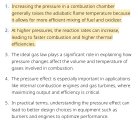
You're the one causing confusion, unfortunately. You’ve done a decent job trying to explain a Brayton cycle and a terrible job trying to explain how a turbine driven propulsion system works. Learn what a reaction mass engine is and how it works (and maybe definitely brush up on combustion processes) before trying to lecture at people about Brayton cycles and why overall pressure ratio isn’t a key parameter in *propulsion* performance.
 
Last edited:

The Observer

Junior Member
Registered Member
After reading the back n forth above, I want to confirm my understanding first.

1. From my understanding, stochiometric combustion ratio isn't affected by temperature, but by the mass ratio between the air & the fuel.

So altitude & location will affect the air composition & density, which affects how much fuel you can dump into it before it reaches the stochiometric combustion ratio.

2. Why Compressor Outlet temp matter is because the hotter it is, the less fuel you can dump into the compressed air and burn before it melts the turbine. Better material science helps, but there's always a limit

AFAIK what limits the engine is usually the air temp, not the air mass for stoichiometric combustion

3. To circumvate the turbine material limit, we bleed air from the compressor and shove it directly to the turbine for cooling. The problem is that is inefficient, because to compress air you need energy, which is taken from the gasses that passes the turbine, reducing Exhaust temp & finally pressure (thrust).

Logic: High temp = high pressure. For the same exhaust air mass, higher end pressure = higher thrust, because thrust is pressure diff between end pressure & starting pressure
 
Last edited:

latenlazy

Brigadier
After reading the back n forth above, I want to confirm my understanding first.

1. From my understanding, stochiometric combustion ratio isn't affected by temperature, but by the mass ratio between the air & the fuel.


So altitude & location will affect the air composition & density, which affects how much fuel you can dump into it before it reaches the stochiometric combustion ratio.

IMG_1786.jpeg


2. Why Compressor Outlet temp matter is because the hotter it is, the less fuel you can dump into the compressed air and burn before it melts the turbine. Better material science helps, but there's always a limit

Dumping more fuel to reach a target temperature is less fuel efficient. Your turbine and your propulsive stream is driven by the expansion of air from the combustor outlet. The total pressure change from combustor outlet to turbine is what drives your turbine and also your propulsive mass. Why dump more fuel to reach the same stream energy when you can use less? What you care about ultimately isn’t the temperature of the stream but the total pressure expansion.

3. To circumvate the turbine material limit, we bleed air from the compressor and shove it directly to the turbine for cooling. The problem is that is inefficient, because to compress air you need energy, which is taken from the gasses that passes the turbine.
This is an auxiliary system not essential to the main mechanism producing thrust, and beside the actual point of contention.

AFAIK what limits the engine is usually the air temp, not the air mass for stoichiometric combustion

Higher air mass (actually more precise to say more compressed mass) = more efficient combustion for lower fuel mix. Combustion is driven by kinetic interactions between oxygen and hydrocarbon molecules. More pressure=more molecular collisions. Also higher starting heat=more molecular collisions.

Logic: High temp = high pressure. For the same exhaust air mass, higher end pressure = higher thrust, because thrust is pressure diff between end pressure & starting pressure

High pressure is not only defined by high temp. What you care about at the end is not the temperature gain but the pressure difference from inlet to outlet. Mechanical compression is also driving your pressure difference from inlet to outlet, not only added heat from combustion. Another way to put it is that you can have propulsion with only compression alone (a fan) but you can’t have propulsion with only combustion alone (is a campfire propelling anything?), because it is pressure, not heat, that is driving your propulsion system (and also your turbine).
 
Last edited:

The Observer

Junior Member
Registered Member
View attachment 172151


Dumping more fuel to reach a target temperature is less fuel efficient. Your turbine and your propulsive stream is driven by the expansion of air from the combustor outlet. The total pressure change from combustor outlet to turbine is what drives your turbine and also your propulsive mass. Why dump more fuel to reach the same stream energy when you can use less?


This is an auxiliary system not essential to the main mechanism producing thrust, and beside the actual point of contention.
Hmmm... How would your scenario affect the compressor bleed air that's being used to cool the turbine? Will it increase bleed air temp, necessitating more air to cool the same turbine?

Also, the sources I found suggest higher Compressor Outlet temp increases the risk of compressor breakage (the same way higher TIT increases the risk of turbine breaking).

Would the higher Compressor Outlet temp necessitates more durable material for the later compressor stages, increasing weight & cost?

Higher air mass (actually more precise to say more compressed mass) = more efficient combustion for lower fuel mix. Combustion is driven by kinetic interactions between oxygen and hydrocarbon molecules. More pressure=more molecular collisions. Also higher starting heat=more molecular collisions.

But isn't the Compressor outlet pressure (air mass) the same whether the temp is higher/lower? Because it uses the same compressor?

So for lower Compressor outlet temp, you have more heat budget (more fuel) to dump into the compressed air until it reaches the same TIT. That means more expansion during combustion, meaning higher final pressure & higher thrust

Does my logic make sense?

p.s. Sorry for the scatterbrain logic progression
 
Last edited:

latenlazy

Brigadier
Hmmm... How would your scenario affect the compressor bleed air that's being used to cool the turbine? Will it increase bleed air temp, necessitating more air to cool the same turbine?
More compression means more available air mass that you can spend on more bleed air if you want. But that’s a bit beside the point. The point is your turbine is driven by pressure difference, not temperature difference. The temperature difference helps increase the pressure difference but ultimately it’s pressure difference that drives the mechanical interaction. The point of burning fuel is in one sense to drive increased pressure without further mechanical work and in another sense to add external energy from outside the closed mechanical loop so that your mechanical loop can drive itself via momentum recovery from the turbine. That’s why adding more turbine stages will make your turbine more mechanically efficient. But there’s a reason you don’t add more turbine stages to a jet engine. The mechanical efficiency driving the turbine comes at the expense of the air stream’s momentum (you are converting more linear air stream momentum into circular turbine momentum with more turbine stages), and presumably the point of a jet engine is the propulsion, not the turbine mechanical efficiency alone.

(And before someone else sneers about heat enthalpy or Carnot efficiencies or what not, yes a jet engine is a “heat engine”, but it’s not heat by itself physically moving the turbine sustaining the engine cycle, it’s *mechanical energy from a gas medium converting heat into motion* physically moving the turbine. The mechanical motion efficiencies matter just as much as heat efficiencies in heat engines. A Brayton cycle doesn’t work without *gas compression*).


But isn't the Compressor outlet pressure (air mass) the same whether the temp is higher/lower? Because it uses the same compressor?


So for lower Compressor outlet temp, you have more heat budget (more fuel) to dump into the compressed air until it reaches the same TIT. That means more expansion during combustion, meaning higher final pressure & higher thrust

Does my logic make sense?

Insofar as your temperature design limit is concerned what you care about wrt temperature is agnostic to whether that heat comes from fuel burn or greater compression. If you have a system with lower compression ratio and thus lower compressor outlet heat of course you can dump more fuel into that air stream before hitting a designated TIT but relative to a system with higher compression ratio and thus higher compressor outlet heat the amount of work you do on the turbine is the same assuming same overall pressure reached at those same temperatures. It’s just that in the first system you are burning more fuel per cycle to achieve that work on the turbine than in the second system. This is why it makes no sense to describe more capacity to add heat to your air stream before hitting a TIT limit as a *superior* efficiency. Having to burn more fuel to reach the same pressure differential is not more efficient! In fact it’s the opposite!

Overall it’s the total pressure change from inlet to outlet driving your propulsion and total pressure change from combustor outlet to turbine inlet driving your turbine. If you burn less fuel to reach the same temperature limit that is by definition more fuel efficient. Another way to see this is that if you are more mechanically efficient at converting your rotations into compressed air, aka you are getting more air compression from the same amount of mechanical rotations, you need less fuel to keep your turbine going with the same momentum.

In summary *the total potential work delivered onto your turbine by your airstream is not defined by how much additional heat you dumped into the airstream in the combustor via fuel burn but the total pressure of the gas medium when it’s reached the turbine*. That gas medium literally does not care how you reached that pressure. It will do the same amount of work on the turbine so long as the pressure is the same.

Also, the sources I found suggest higher Compressor Outlet temp increases the risk of compressor breakage (the same way higher TIT increases the risk of turbine breaking).

Would the higher Compressor Outlet temp necessitates more durable material for the later compressor stages, increasing weight & cost?

Yes of course. Higher compressor outlet pressure and temp means more thermal load and mechanical strain on the compressor assembly. This acts as a mechanical constraint on achievable compression ratios. You can beef up the compressor assembly to compensate for those load limits, but you could just be incurring mechanical efficiency penalties that way which would defeat the point, eating up any margins you gained with higher compression ratios. In essence there’s an optimization problem here. But that’s also why lightweight high strength high temperature materials like single crystal superalloys aren’t only used to improve turbine performance, but later stage compressor performance as well. There’s a reason why single crystal blisks (and potentially single piece CMC blisks too) are popular design options for the later compressor stages of advanced high performance jet engines.

p.s. Sorry for the scatterbrain logic progression

No need to apologize. I understand why some of functional details can be a bit hard to follow. It is a cyclical system after all so there’s a natural heads or tails question that can be confusing to parse out. I think in these situations it would probably be easier to explain via a flow chart.
 
Last edited:

ZeEa5KPul

Brigadier
Registered Member
Or to put it another way, is your design goal to design an efficient higher performance propulsion system or an efficient high performance heater?
I think I've found a way to close this argument. Pressure determines what fraction of the enthalpy E (with the condition E <= H) can be converted into kinetic energy of the stream along the engine's longitudinal axis (i.e., thrust). Call it K = eE <= eH.

This e is an efficiency factor given by 1 - (P_atm/P_turbine_ext)^c where c is some constant.

If we take the extreme case of zero compression, the stream would be at 1 atmosphere at the "turbine exit" (here there's no turbine because there's no compressor) and the enthalpy would be entirely heat. There would be no expansion in the nozzle, the stream would just flow out and e = 0. The higher the pressure, the smaller the denominator and the bigger e.

[Reminder, H = c_p * (turbine inlet temperature - compressor outlet temperature)]

This is the central tension we're all trying to get at. For a fixed TIT, raise the OPR and and you're inevitably raising COT and shrinking H, but you make e bigger. Lower OPR and you make H bigger but e smaller. For a fixed TIT, you're designing the engine to maximize this product.
 

The Observer

Junior Member
Registered Member
Insofar as your temperature design limit is concerned what you care about wrt temperature is agnostic to whether that heat comes from fuel burn or greater compression. If you have a system with lower compression ratio and thus lower compressor outlet heat of course you can dump more fuel into that air stream before hitting a designated TIT but relative to a system with higher compression ratio and thus higher compressor outlet heat the amount of work you do on the turbine is the same assuming same overall pressure reached at those same temperatures. It’s just that in the first system you are burning more fuel per cycle to achieve that work on the turbine than in the second system. This is why it makes no sense to describe more capacity to add heat to your air stream before hitting a TIT limit as a *superior* efficiency. Having to burn more fuel to reach the same pressure differential is not more efficient! In fact it’s the opposite!

Overall it’s the total pressure change from inlet to outlet driving your propulsion and total pressure change from combustor outlet to turbine inlet driving your turbine. If you burn less fuel to reach the same temperature limit that is by definition more fuel efficient. Another way to see this is that if you are more mechanically efficient at converting your rotations into compressed air, aka you are getting more air compression from the same amount of mechanical rotations, you need less fuel to keep your turbine going with the same momentum.

In summary *the total potential work delivered onto your turbine by your airstream is not defined by how much additional heat you dumped into the airstream in the combustor via fuel burn but the total pressure of the gas medium when it’s reached the turbine*. That gas medium literally does not care how you reached that pressure. It will do the same amount of work on the turbine so long as the pressure is the same.

Am I correct in assuming you're comparing the efficiencies of 2 compressor designs with different compression ratio?

1. lower compression, lower Compressor Outlet temp

2. higher compression, higher Compressor Outlet temp

Both targets the same TIT & Operating window.

Because if so then I think your explaination made sense.


I was assuming a different scenario:

2 compressor designs, same compression ratio.

  • 1st design lower Compressor Outlet temp
  • 2nd design higher Compressor Outlet temp.

Both targets the same TIT & the same operating window.

In that case I think the one with cooler Compressor Outlet temp has better potential thrust wise, because In my mind more fuel until Target TIT = more expansion = more pressure = more thrust

Yes, it will guzzle more fuel to reach the same TIT, but higher thrust in the same package.
 
Last edited:

latenlazy

Brigadier
Am I correct in assuming you're comparing the efficiencies of 2 compressor designs with different compression ratio?

1. lower compression, lower Compressor Outlet temp

2. higher compression, higher Compressor Outlet temp

Both targets the same TIT & Operating window.

Because if so then I think your explaination made sense.


I was assuming a different scenario:

2 compressor designs, same compression ratio.

  • 1st design lower Compressor Outlet temp
  • 2nd design higher Compressor Outlet temp.

Both targets the same TIT & the same operating window.

In that case I think the one with cooler Compressor Outlet temp has better potential thrust wise, because In my mind more fuel until Target TIT = more expansion = more pressure = more thrust

Yes, it will guzzle more fuel to reach the same TIT, but higher thrust in the same package.
Lower compression will always mean lower compression outlet temperature. Higher compression will always mean higher compressor outlet temp unless you’re employing active cooling of your compressor stages. Don’t think anyone does that because the net effect of active cooling is drawing energy away from your compressed air and that kinda defeats the purpose of having a high energy air stream to move your turbine. In fact I think the net effect of cooling your compressor stage would be to lower the pressure entering the combustor, and lower pressure difference means less mechanical work done on the turbine. The point of the compressor and combustor both is injecting potential energy in your air stream so that your turbine can extract it to continue pushing the cycle.
 
Last edited:

latenlazy

Brigadier
I think I've found a way to close this argument. Pressure determines what fraction of the enthalpy E (with the condition E <= H) can be converted into kinetic energy of the stream along the engine's longitudinal axis (i.e., thrust). Call it K = eE <= eH.

This e is an efficiency factor given by 1 - (P_atm/P_turbine_ext)^c where c is some constant.

If we take the extreme case of zero compression, the stream would be at 1 atmosphere at the "turbine exit" (here there's no turbine because there's no compressor) and the enthalpy would be entirely heat. There would be no expansion in the nozzle, the stream would just flow out and e = 0. The higher the pressure, the smaller the denominator and the bigger e.

[Reminder, H = c_p * (turbine inlet temperature - compressor outlet temperature)]

This is the central tension we're all trying to get at. For a fixed TIT, raise the OPR and and you're inevitably raising COT and shrinking H, but you make e bigger. Lower OPR and you make H bigger but e smaller. For a fixed TIT, you're designing the engine to maximize this product.
You’re still talking around the point and overcomplicating the analysis. Your pressure isn’t only coming from your heat from combustion. For a propulsion system especially you're designing to maximize for pressure difference not heat difference. That pressure difference is coming partly from heat added by combustion yes *but it’s also coming from how efficiently you can convert mechanical rotations of the turbine into air compression*. If you have to increase fuel burn to reach the same pressure difference you are actually being less efficient about the process of converting mechanical rotations into pressure differences. It means your mechanical system is doing worse at preserving more momentum to sustain its own mechanical cycles with fewer additional energy inputs. You are burning more fuel to do the same mechanical work.

Analyze the system as about extracting work from pressure, not work from heat, because even though it’s called a “heat” engine the actual mechanical work is being done by pressure. The point of the added heat is to make your mechanical system self driving, but the work that you care about and are designing for is ultimately mechanical. No mechanical conversion no work. Once again, ask how much mechanical work you are doing in the scenario where you have no compression. In a 0 compression system you would have to burn a lot more fuel to reach the same pressure using only heat alone, and in actuality without compression you’re probably never reaching close to the same burner temperatures because you also have to factor in the thermochemical relationship between combustion, starting air temp, and pressure. For reasons that I cannot fathom you guys seem to fixate on energy from heat when the fundamental point of the system is mechanical work from pressure.

Yet another way to see the matter in a general abstract sense is that the more your energy budget is allocated to heat the less mechanically efficient you actually are. For the same total energy budget the more you can allocate to mechanical work rather than heat the more mechanically efficient. The point of your turbine is to do mechanical work after all. Your goal isn’t to maximize the energy budget toward heat. In fact quite the opposite.
 
Last edited:
Top