PLA (strategic) news, pics, and videos

Blitzo

General
Staff member
Super Moderator
Registered Member
@ Blitzo. That's why I added the disclaimer that there is so much happening behind the scenes that we could never know the true and full picture.

Yes, it goes without saying that we could never know the true and full picture.

That doesn't mean the disclaimer allows freewheeling speculation in absence of more specific indicators.
If we had evidence of changes in PRC/PLA policy to Taiwan or rumours of near term conflict, or anything suggesting a major change in long term PRC stance to Taiwan, then sure that would be a basis for it.


But still, I based my speculation partly on the official allegations against Zhang that he was trying to put into question the authority of Xi as the Chairman of the CMC.

Or maybe I have missed the mark somewhat??

It's not so much that you've missed the mark, but rather that you are not thinking broadly enough.

Not following the authority of the chairman of the CMC has a near infinite variety of possibilities -- there's no particular reason to think it was due to disagreements for a Taiwan contingency. It could be due to disagreements on strategic policy, procurement priorities, or (if there are corruption/graft elements as suggested) -- not disclosing past impropriety as made clear by civilian leadership, trying to preserve or hide benefits of historical graft, passing a blind eye or not being disciplined enough to underlings... the list of possibilities is near endless.
 

AndrewJ

Junior Member
Registered Member
PLA is a military who didn't fight a hot war for 40+ years. This maybe good for a country, but not so for a military force.

Many senior military officials were promoted from Deng/Jiang/Hu era, when corrupt is a popular culture. Though Jiang stopped military guys running business, but the culture is deeply rooted in their gene. "Everyone" is thinking how to make more money, instead of training & exercising to fight a war, cause everyone knows it's now peacetime. Many join in PLA not because they want to fight, but because it's a stable place/position to enjoy life and earn good salary & welfare. No real war is ahead, so exercises & training become pointless formalities, procuring become methods to increase incomes. Many believe "After all, these corruptions can only be found in a real war, by then I've already made enough money & retired. Taiwan is just a rhetoric, CCP won't dare to fight for it in my term cause everyone knows we can never defeat US militarily around Taiwan."

Xi is a man who clearly realizes "When China is rising steadily as a superpower, a cold war or a hot war is inevitable". Meanwhile PLA is such corrupt, unprepared & technologically outdated when he's taking stage. He needs to reform PLA fundamentally from not only institutions and technology, but also culture. A culture that make everyone is acknowledged that a real war on Taiwan is imminent, become confident that China can win and fully prepare for it, rather than taking military positions as somewhere to make money & relax. The reform process is painful, and takes decades.

Time to promote more young men as senior generals rather than "war-experienced" but corrupt old guys.
 
Last edited:

tokenanalyst

Lieutenant General
Registered Member
@Blitzo What's your take on the whole political side of PLA that has been cumulating during the past years

On one hand, there is so much rumour and speculation. While we are no strangers to rumours, in this case a lot are not even verifiable.

On the other hand, there is clearly something major going on and goes beyond "it's just corruption and graft". It's not illogical to conclude that there is a serious impact on PLA's combat readiness.
I think the way China military has been modernizing is to operate more on its own, commanders, like an hydra, in theory, should be able to fulfill their mission even if Xi is killed in a nuclear attack, so I don´t think the lack of the old bureaucracy would affect current combat readiness.

The real danger now in my opinion is miscalculation. China enemies, from the separatists in Taiwan province to the stooges in the WH could embolden themselves to the point of directly provoking China thinking that there will no reaction. Unless that is what the top brass in China wants to justify an invasion.
 

Kalec

Junior Member
Registered Member
I believe that before discussing the authenticity of this claim, as I have consistently maintained since the “Rocket Force leak case" since 2023 and given that the alleged leak is merely the result of OSINT analysis, we should not assume that DoW cannot ascertain the deployment of the certain brigades through satellites and the same OSINT methods.

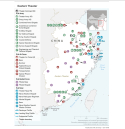
Can someone just please and please look at DoW on theater-level ORBAT map like the one below? From pure point of ORBAT analysis, DoW did a much better job than Decker or Ma Xiu on the completeness of map, always quicker than OSINT glowie to update the latest ORBAT. DoW doesn‘t update everything into details, but it doesn't mean they dont have the full picture.

Another long-standing view is that secrecy does not provide deterrent value, on the contrary transparency deters the aggression. Similar analogy would be "if you had doomsday system, you would have to demonstrate it before everything went south." unless China really wants to get the hair mussed.

Back to the point what really matters for nuclear data, perhaps how long it will take for China to ID incoming attack, the IR signature of penaid, retaliation planning, NC3 structure etc.

Nuclear war planning has been, is and will be always about math game. It is always about how to maximize RVs to destroy the adversary's retaliatory capability and inflict unacceptable damage when deterrence fails, none of these can be greatly changed or nullified by a "leak"
Even if US can correctly identify thousands of penaids and get enough NGI with MKV to destroy them, strategic missile defense will still be at least 4-5 times more expensive than strategic missile offensive before accounting for procurement price difference. It can be offset by just building more.

Eastern Theater ORBAT in 2021 (before "leak")
1769400179507.png
 

tokenanalyst

Lieutenant General
Registered Member
I believe that before discussing the authenticity of this claim, as I have consistently maintained since the “Rocket Force leak case" since 2023 and given that the alleged leak is merely the result of OSINT analysis, we should not assume that DoW cannot ascertain the deployment of the certain brigades through satellites and the same OSINT methods.

Can someone just please and please look at DoW on theater-level ORBAT map like the one below? From pure point of ORBAT analysis, DoW did a much better job than Decker or Ma Xiu on the completeness of map, always quicker than OSINT glowie to update the latest ORBAT. DoW doesn‘t update everything into details, but it doesn't mean they dont have the full picture.

Another long-standing view is that secrecy does not provide deterrent value, on the contrary transparency deters the aggression. Similar analogy would be "if you had doomsday system, you would have to demonstrate it before everything went south." unless China really wants to get the hair mussed.

Back to the point what really matters for nuclear data, perhaps how long it will take for China to ID incoming attack, the IR signature of penaid, retaliation planning, NC3 structure etc.

Nuclear war planning has been, is and will be always about math game. It is always about how to maximize RVs to destroy the adversary's retaliatory capability and inflict unacceptable damage when deterrence fails, none of these can be greatly changed or nullified by a "leak"
Even if US can correctly identify thousands of penaids and get enough NGI with MKV to destroy them, strategic missile defense will still be at least 4-5 times more expensive than strategic missile offensive before accounting for procurement price difference. It can be offset by just building more.


View attachment 168654
China and the US have two different nuclear doctrine. US targets for its first strike capability is at first mostly "military". China second strike capability is to kill. To destroy enemy cities. Therefore the arsenal is been built to have that capability, like hardened silos that may or may not have missiles on then, disguised road mobile TELs dispersed in 10 million squared kilometers, nuclear submarines and so on. Apart from the early warning radars that I think they are pretty much capable of building. I think that is deterrence that China is looking for is to keep a convectional conflict convectional

Is up to the US to decide if what they are looking in China is worth the sacrifice of cities in the US, but I don´t think that the US want to risk a nuclear exchange for an industry that they can rebuilt in the US in a few years. And I think US is aware even small yield theater nuclear weapons risk a dangerous retaliatory escalation.
 

latenlazy

Brigadier
China and the US have two different nuclear doctrine. US targets for its first strike capability is at first mostly "military". China second strike capability is to kill. To destroy enemy cities. Therefore the arsenal is been built to have that capability, like hardened silos that may or may not have missiles on then, disguised road mobile TELs dispersed in 10 million squared kilometers, nuclear submarines and so on. Apart from the early warning radars that I think they are pretty much capable of building. I think that is deterrence that China is looking for is to keep a convectional conflict convectional

Is up to the US to decide if what they are looking in China is worth the sacrifice of cities in the US, but I don´t think that the US want to risk a nuclear exchange for an industry that they can rebuilt in the US in a few years. And I think US is aware even small yield theater nuclear weapons risk a dangerous retaliatory escalation.
Tactical exchange also doesn’t make much sense for the US. Even if China tries to limit escalation dynamics by responding only 1 for 1 on a tactical exchange the US losing Guam is much worse than anything the US could reasonably attack for a purely tactical strike that doesn’t look like an attack on the civilian population. Doing a single tactical strike in exchange for guaranteed loss of minimum Guam and likely also Kadena basically ends the US’s ability to fight.
 

00CuriousObserver

Senior Member
Registered Member
Xi and his allies being a true believer of bureaucratic reform in the PLA (and CPC, PRC overall) and pursuit of contemporary standards for corruption and graft would be more than enough of a basis to make these sort of changes, and is probably the most simple answer rather than anything more exotic.

I'm certainly against much of the speculation here and elsewhere, but putting it simply, Occam's razor here is vastly simplifying what is happening.

I don’t understand the fixation on this. If you guys recall several years back there were high level scandals in the semiconductor industry as well with high profile arrests. Did that mean Chinese semiconductor industry lacked readiness and was unable to perform? I don’t much think so. Head of Olympics Gou Wenzhong was convicted and imprisoned as well. Did that stop China for winning gold medals? Did the arrest of the God Father of Chinese HSR stop it from becoming the longest and most technologically sophisticated HSR of its kind?

The fact that they pulled off a cold start near the tail end of 2025 with basically no warning at all and the coordination of assets/across branches shows that with or without “purges” things are improving at a rapid pace. Winologists from across the strait are in for a big surprise if they think that they are spared because of this.

I understand and agree with your point that this is not going to halt the PLA from advancing, but this is significant. We're talking about the #1 (or #2 but y'know) guy in the military, along with basically all of the senior command. And it's the military we're talking about; especially with the Taiwan question in context, this is on a different level compared to... Winning the Olympics.


The correct answer is probably "we don't know", and we may never know. And that's fine. What I am trying to say is that not knowing is not the same as minimizing its existence. It should carry some nonzero (or decently above zero) weight in our minds, whether in the form of increasing the uncertainty of our PLA analyses or in some other way.

Do also keep in mind that this is an area where our usual information stream does not feed us the data/knowledge in an appropriate manner.
 

AndrewS

Brigadier
Registered Member
No real war is ahead, so exercises & training become pointless formalities, procuring become methods to increase incomes. Many believe "After all, these corruptions can only be found in a real war, by then I've already made enough money & retired. Taiwan is just a rhetoric, CCP won't dare to fight for it in my term cause everyone knows we can never defeat US militarily around Taiwan."

That attitude does have to change.

If you look at what the Chinese military is buying, then around 2035, I reckon the Chinese military should have enough military capability to win blue-water naval battles around the Second Island Chain. That would open up the global oceans for the Chinese Navy, never mind just Taiwan.

Xi is a man who clearly realizes "When China is rising steadily as a superpower, a cold war or a hot war is inevitable". Meanwhile PLA is such corrupt, unprepared & technologically outdated when he's taking stage. He needs to reform PLA fundamentally from not only institutions and technology, but also culture. A culture that make everyone is acknowledged that a real war on Taiwan is imminent, become confident that China can win and fully prepare for it, rather than taking military positions as somewhere to make money & relax. The reform process is painful, and takes decades.

Time to promote more young men as senior generals rather than "war-experienced" but corrupt old guys.
 

abenomics12345

Junior Member
Registered Member
However, that doesn't mean that suddenly the entire military, defense ministry, or MIC, has open season for freewheeling speculation, which for the purposes of PRC defense watching, means we also have to deal with random rumours from all manner of questionable (and often some less than good faith) sources.

That is what I mean, the onus is now different considering we have evidence of what we clearly observe to be 塌方式 corruption.

As an example, I recall there was a bit of a headscratcher as to why the PLAAF purchased the 24 oddball Su-35s in 2015.

Looking back, Zhang Youxia was the Head of General Armaments (2012-2016) and was responsible for that. Is it not more suspicious now that there was kickbacks involved in that purchase?

I'm sure there are very plausible arguments that can be made about how the PLAAF needed it for testing/trial/long range patrols yadayada, or that J-20 ramp up was delayed or whatever, but to flip the question around, how do we know what the true rationale was?

What is the likelihood that there were shenanigans involved, especially considering the degree of Russian corruption on the other side?

Additionally, in hindsight, when Li Shangfu was taken down, it was explicitly stated in his official indictment that he conducted bribery for his own benefit (Exact Quote: "
Please, Log in or Register to view URLs content!
"). It also stood to reason that he bribed the person who promoted him to be the head of the then new Equipment Development Department (2017-2022) or that he bribed someone for him to be promoted to be Minister of Defence. Considering it was literally just two CMC Vice Chairmen and Xi above him at the time (Xu Qiliang, who passed away; and Zhang Youxia), it stands to reason that he bribed at least one of them (presumably he wasn't stupid enough to bribe Xi).
 
Last edited:
Top