Chinese semiconductor thread II

tokenanalyst

Lieutenant General
Registered Member

Wafer-level packaging integration of LPDDR5X-signal integrity design and simulation exploration.​

China Electronics Technology Group Corporation 58th Research Institute

In the past 10 years, excessive research enthusiasm has been focused on 2.5D/3D advanced packaging (e.g. CoWoS/SoIC) used for data-center artificial intelligence (AI) chips and high bandwidth memory integration. For the edge AI chips with lightweight computing power, very thin FBGA (VFBGA), low power double data rate 5/5X (LPDDR5/5X) and wafer-level (WL) packaging with the redistribution layer (RDL)-first process are the integration technology trends. This paper focuses on AI system on chip (SoC) and LPDDR5X on-package integration design only using 3 RDL on the WL package. This paper aims to examine the influence to explore the trace routing scheme and corresponding signal integrity (SI) performance of the RDL interconnection for the on-package LPDDR5X, thereby providing RDL design and simulation reference for the ever-increasing demand for AI SoC and LPDDR5X on-package integration that is an alternative for on-board interconnection.​

Please, Log in or Register to view URLs content!
 

tokenanalyst

Lieutenant General
Registered Member

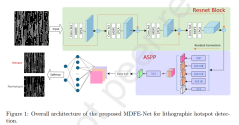
Multi-Directional Feature Enhancement Network for Lithographic Hotspot Detection​


Ensuring IC manufacturability and yield depends critically on accurate lithographic hotspot detection. We identify a fundamental shortcoming in existing deep learning-based methods used for hotspot detection: current approaches are predominantly centered on extracting local texture features, yet they fail to adequately account for the distinct directional patterns inherent in Manhattan structures, which are essential for a comprehensive layout representation. Consequently, we present MDFE-Net, an architecture that embeds directional structural features of layouts as explicit prior knowledge. The proposed Multi-Directional Feature Enhancement (MDFE) module is central to this design, significantly boosting the networks sensitivity to directional features. This enhancement is key to establishing a strong correlation between the Manhattan structures in mask layouts and the directionality of lithographic defects. By further combining MDFE with an Atrous Spatial Pyramid Pooling (ASPP) module, our framework achieves robust multi-scale and multi-directional feature extraction, thereby comprehensively modeling layout context. Experimental results demonstrate state-of-the-art performance, with our method achieving leading scores in accuracy, false-alarm rate, and F1 score.

1767891857378.png

Please, Log in or Register to view URLs content!


ForcedTrend

New Member
Registered Member
I think when you zoom out and look at the situation from a long term perspective, how many H200s get in and where they are used isn't going to be an ultimate game changer. The trend of moving towards domestic stuff can't be undone especially when you consider the domestic solutions are also improving and getting to a point where they will satisfy domestic demand to an appropriate standard.

That being said, @CMP does have a point, but I doubt the gov will allow the country to be dependent on H200s, not when you've got promising domestic alternatives that are up and coming.
This is a software problem than hardware and they worked for so long with CUDA that they can't just switch that quickly

H200 won't be the last Nvidia GPU, they will release blackwell when everyone moves to Rubin and Rubin when they move to next thing
the us is trying to keep china stuck in their comfort zone by still relying on CUDA and Nvidia GPUs wich are currently superior to anything mass produced.
when china gets their EUV working, the US will probably start selling old ASML EUV to distrupt their domestic stuff while they move to High NA EUV
 

tokenanalyst

Lieutenant General
Registered Member

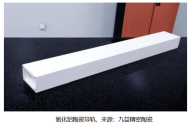
Ceramic Guide Rails For Lithography Machines​


Shandong Siyuan New Materials Co., Ltd. has successfully developed a domestic 995 alumina ceramic guideway product for lithography machines, overcoming key technological barriers in China’s precision ceramic manufacturing industry. In collaboration with the Shanghai Institute of Ceramics, Chinese Academy of Sciences, the company established a dedicated research team in 2014 to develop high-performance alumina and silicon carbide ceramics suitable for ultra-precision applications.

The Sicer-312 series of 995 alumina ceramic materials produced using advanced processes like isostatic pressing (IPC), optimized sintering, and ultrafine grinding achieves dense sintering at ≤1600°C with grain sizes between 1.0–5.0 μm, resulting in superior mechanical properties including high strength, hardness, and elastic modulus. These materials meet strict application demands, particularly for ceramic cylinder liners in oilfield mud pumps (with tens of thousands of units deployed) and are now used in semiconductor devices and ultra-precision ceramic guide rails.

1767892720297.png

Key challenges addressed include:​
  • Material development: Using cost-effective industrial alumina with nano-sintering aids to enhance density and performance.​
  • Processing: Achieving uniform microstructure via IPC molding, followed by precision machining (turning, milling, grinding).​
  • Machinability: Employing high-speed diamond grinding (linear speeds >25 m/s) using CNC machines to improve surface quality and efficiency due to the poor machinability of 995 alumina.​
  • Precision manufacturing: Solving issues related to large dimensions, complex shapes, low-stress machining, and accurate measurement through near-net-shape forming and high-precision grinding.​
The resulting ceramic guideways achieve a straightness error of just 0.002 mm/m, matching international standards—effectively replacing imported products and filling critical domestic gaps in semiconductor and precision machinery. Shandong Siyuan is now a leader in China’s development of high-end ceramic components for ultra-precision applications, supporting national self-reliance in advanced manufacturing.

Please, Log in or Register to view URLs content!
 

tphuang

General
Staff member
Super Moderator
VIP Professional
Registered Member
Please, Log in or Register to view URLs content!

Please, Log in or Register to view URLs content!

2 good ads here by Huawei to showcase their Kunpeng and Ascend hardware usage and status. Taishan-950 is coming. There are 3.8m Kunpeng developers and 6800+ partners as of end of 2025.

Kunpeng CPUs cme in 16/24 core lite variant, 24/32 core "smart variant" and 48/64 core 'Max variant". Can be used for DPU, RAID card, Nic card and SSD controller (all things you need for large data centers). Top end Kunpeng-920 cores with 80 cores and 160 threads, supports HCCS, DDR5. This is more for high end computing.

CANN got open sourced in August and now has 1500+ internal developers and 30+ community projects. It has completed structure upgrade. Atlas 950 series include the 950 SuperPoD and Atlas 850 air cooled super node. Both to launch in 2026Q4.
 

Phead128

Major
Staff member
Moderator - World Affairs
Just a reminder that the MAIN REASON Trump admin even allows H200 sale is they concluded that Huawei's CloudMatrix 384 rack (using Ascend 910C) has comparable performance to GB200 NVL72 rack (using H200), so it's not a security threat. Basically, Huawei was going to get GB200 rack performance anyways, let's get them addicted on CUDA and use the profits to recycle into R&D leadership and keep China forever 2 generations behind.

President Donald Trump decided to let
Please, Log in or Register to view URLs content!
sell its H200 artificial intelligence chips to China after concluding the move carried a lower security risk because the company’s Chinese archrival,
Please, Log in or Register to view URLs content!
, already offers AI systems with comparable performance, according to a person familiar with the deliberations.
....
Underpinning the move was an assessment that Huawei can compete far more closely with Nvidia than the US has acknowledged. White House officials focused on a Huawei AI platform known as CloudMatrix 384 that relies on the company’s newer Ascend chips, the person said. Officials found that CloudMatrix 384 performed as well as a similar Nvidia system known as NVL72 that uses the US company’s most advanced Blackwell-design chips, according to the person, who spoke on condition of anonymity to discuss sensitive matters.
Please, Log in or Register to view URLs content!

So while individual 7nm Huawei 910C chips are inferior to 4nm Nvidia H200 chips on individual chip basis, with use of high bandwidth optical interconnectors, Huawei can string together 383 Ascend 910C chips to have equivalent performance to GB200 NVL72 which has 72 H200 chips, at the cost of more energy use and power usage, which China can subsidized and China has ample low cost electricity anyways.
 

CMP

Captain
Registered Member
Just a reminder that the MAIN REASON Trump admin even allows H200 sale is they concluded that Huawei's CloudMatrix 384 has comparable performance to H200 (GB200 NVL72 rack), so it's not a security threat. Basically, Huawei was going to get GB200 rack performance anyways, let's get them addicted on CUDA and use the profits to recycle into R&D leadership and keep China forever 2 generations behind.


....

Please, Log in or Register to view URLs content!

So while individual 7nm Huawei 910C chips are inferior to 4nm Nvidia H200 chips on individual chip basis, with use of high bandwidth optical interconnectors, Huawei can string together 383 Ascend 910C chips to have equivalent performance to GB200 NVL72 which has 72 H200 chips, at the cost of more energy use and power usage, which China can subsidized and China has ample low cost electricity anyways.
Exactly. I'm ultimately still against the Chinese use of non-Chinese products when a Chinese product of similar performance is already available for this very reason. Then again, China has a very poor history of getting addicted to foreign products in more ways than one. It's highly problematic and CPC needs to manage it very carefully. There need to be punitive measures for individuals and institutions who select Nvidia for personal preference hidden behind thinly veiled business rationale. If supply of the Chinese product is insufficient, that is one thing. If they just prefer using foreign products for biased or hanjian libshit racist China-disliking/hating reasons, that's another issue entirely and perhaps needs to be penalized.
 

huemens

Junior Member
Registered Member
Just a reminder that the MAIN REASON Trump admin even allows H200 sale is they concluded that Huawei's CloudMatrix 384 rack (using Ascend 910C) has comparable performance to GB200 NVL72 rack (using H200), so it's not a security threat. Basically, Huawei was going to get GB200 rack performance anyways, let's get them addicted on CUDA and use the profits to recycle into R&D leadership and keep China forever 2 generations behind.

I think that's just a pretext they floated to justify it to China hawks. If the US government's line of thinking was really related to Huawei's cluster level performance then they should sell Blackwell too. The GB200 NVL72 is Blackwell, not H200 and CM384 exceeds even the more powerful rack GB300 NVL72 Blackwell Ultra. And the upcoming 950 cluster exceeds NVL 576 Rubin Ultra, Nvidia has planned for 2027.

It's more likely to be just a result of heavy lobbying from Nvidia because they are stuck with a huge inventory, they could not off load to western customers who have access to Blackwell, at a margin close to what they are used to. Remember it's Nvidia who is putting all the efforts to make this happen. It's not like the govt is telling them here's a 25% subsidy, go and sell as many Chips to China. Instead they are forced to pay a cut to the government, pay more transport fees and then sell it to China at a cheaper price all to the detriment of their margin. Nvidia's own line of thinking may be close to what you are saying, but the actions of US government does not look like they are very eager for this. Despite Trump having given the word Nvidia is having to cross so much red tape for this and they are yet to actually receive the export license.

This has already happened before. They allowed H20 to be sold when Nvidia was stuck with an inventory. But when China refused to buy they had to write off billions. If they are able to sell these H200s even at $27k to somewhere other than China they stand to make more money from it and would be able to ask a higher price from Chinese customers. Of course Nvidia's own drive to get China hooked to CUDA would factor in too.
 

antiterror13

Brigadier
This is a software problem than hardware and they worked for so long with CUDA that they can't just switch that quickly

H200 won't be the last Nvidia GPU, they will release blackwell when everyone moves to Rubin and Rubin when they move to next thing
the us is trying to keep china stuck in their comfort zone by still relying on CUDA and Nvidia GPUs wich are currently superior to anything mass produced.
when china gets their EUV working, the US will probably start selling old ASML EUV to distrupt their domestic stuff while they move to High NA EUV

That is always the case .. including CNC machine, robot, until China dominating it
 

ForcedTrend

New Member
Registered Member
I think that's just a pretext they floated to justify it to China hawks. If the US government's line of thinking was really related to Huawei's cluster level performance then they should sell Blackwell too. The GB200 NVL72 is Blackwell, not H200 and CM384 exceeds even the more powerful rack GB300 NVL72 Blackwell Ultra. And the upcoming 950 cluster exceeds NVL 576 Rubin Ultra, Nvidia has planned for 2027.

It's more likely to be just a result of heavy lobbying from Nvidia because they are stuck with a huge inventory, they could not off load to western customers who have access to Blackwell, at a margin close to what they are used to. Remember it's Nvidia who is putting all the efforts to make this happen. It's not like the govt is telling them here's a 25% subsidy, go and sell as many Chips to China. Instead they are forced to pay a cut to the government, pay more transport fees and then sell it to China at a cheaper price all to the detriment of their margin. Nvidia's own line of thinking may be close to what you are saying, but the actions of US government does not look like they are very eager for this. Despite Trump having given the word Nvidia is having to cross so much red tape for this and they are yet to actually receive the export license.

This has already happened before. They allowed H20 to be sold when Nvidia was stuck with an inventory. But when China refused to buy they had to write off billions. If they are able to sell these H200s even at $27k to somewhere other than China they stand to make more money from it and would be able to ask a higher price from Chinese customers. Of course Nvidia's own drive to get China hooked to CUDA would factor in too.
i agree with this, why was nvidia sitting on 700K unsold H200s?

all the sales figures of blackwell and rubin are probably fake too to boost their stock market with fake deals
if you follow their marketing blackwell is now useless because it consumes more power for lower compute than rubin
 
Top