Chinese semiconductor thread II

Wahid145

Junior Member
Registered Member
Slightly less then what I thought (126 vs 120 MTr/mm2) but it's an mind boggling feat from SMIC and Huawei.

Just to recap, the biggest Chip juggernaut TSMC implemented EUV for its 7nm+ node and managed to get density of around 115 MTr/mm2.
SMIC and Huawei is going through the strongest sanction possible by the west cutting off access to all the advanced equipments and under the wrath of american empire still managed to make a chip using DUVi (God knows what kind of machines are they using since the advanced ASML DUVi are also restricted....) having higher Transistor Density then EUV powered chips from TSMC and Samsung.

The saying "Necessity is the mother of Innovation" couldn't be more self fulfilling in this case.
 

tphuang

General
Staff member
Super Moderator
VIP Professional
Registered Member
Addendum: This means the proclaimed TSMC guy on Weibo who has an essay saying it's 113MTr/mm2 and he's viewed the SMIC N+3 report, also have a twitter account with the same exact handle(taog_1575) ferociously saying its 113
Please, Log in or Register to view URLs content!
, claiming he's saw the Techinsights tear down report on TSMC N5, Samsung 5LPE and Samsung's 3GAP on Exynos 2500 is wrong
Please, Log in or Register to view URLs content!
, also Jukan saying it's just 110MTr/mm2
Please, Log in or Register to view URLs content!
, need a full 9% to go to 120MTr/mm2 btw, again in a later post(
Please, Log in or Register to view URLs content!
) are wrong, Now SMIC just need another 14% denser to equal Samsung's 4nm node
I think TSMC guy refers to different calculation of transistor density. I would just ignore Jukan. He is a high school kid.

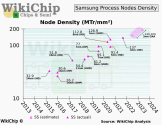
Yeah, so 120MTr/mm2, 32nm M0, 38nm M2, same size as 9020 but added a whole cpu core, just (126.9-120)/126.9=~5.43% less than Samsung's 5nm 5LPE meanwhile Intel 4 is a 4nm with 123.4MTr/mm2 but techinsights call SMIC N+3 that made the 9030 pro have stellar cpu gpu and thermal performance not a real 5nm and much behind Samsung's 5nm, okay okay
keep in mind that 120 for N+3 is possibly measured differently than how they got to 126.9 for Samsung 5nm. As such, I would not use Wikipedia for this.
see here, 228nm logic cell heigh and 224nm SRAM bit cell Height and transistor density again is estimated.

SRAM cell height is not at N5 level, but not that far off. IIRC, TSMC had issues with SRAM scaling for N3.
Again, using their calculation Samsung 5LPE is 134, not 126.9.
If you want to be optimistic about anything, this is probably the most interesting. They achieved M0 pitch reduction to 30nm through SAQP. And based pm what they are are saying here, it can achieve further improvement through optical shrink.
 

JPaladin32

New Member
Registered Member
Techinsights tend to give higher density numbers than others because people define density differently. What I gather from different discussions here and elsewhere is that two things are for sure:

1. The critical dimensions of N+3 are all smaller than either TSMC or Samsung 6nm.
2. The absolute density number may vary depending on who does the teardown, but they roughly all give a 22% density improvement over N+2.
 

tphuang

General
Staff member
Super Moderator
VIP Professional
Registered Member
Please, Log in or Register to view URLs content!

SiCarrier's Wanliyan discuss such major semi related tech breakthroughs from 2025 that may effect next generation products.

They include CEC's PSIM (Plant Simulation Information Modeling) solution

Jingle Electronics AR/VR ISPM-MRGB

new SiC trench etching equipment, required for producing NEV eDrive and industrial power supply.

its own ExWave TS oscilloscope

Rayban's X3 Pro AR glasses using Micro-LED.

GoerTek's all SiC based MicroLED display.

Innoscience's 4.2kW AI data center all GaN power supply.

JFS's GaN power module.

United Nova's SiC G2.0 platform which can be used in SST and HVDC AI data center applications

Various 12-inch SiPo platform and PDKs.

HGTech's 400G EML chip and 3.2T CPO.

Looks like we are going to get some next generation AI data center and such at the next JFS conference in 2026.
 

Phead128

Major
Staff member
Moderator - World Affairs
I wonder why Reuters felt the urge to publish this outdated EUV news from "early 2025" here and now in December 2025? The timing is suspicious given the steady stream of reports throughout 2025 on China's rapid EUV progress such as light sources, patents, etc. Why publish this now and not earlier?

I believe this connects to the proposed H200 chip sales to China. As White House AI Czar David Sacks noted, China is rapidly catching up in AI NPUs and semiconductors. By highlighting China's EUV breakthrough now......even though it's old(er) news.......Reuters may be supporting the argument that the U.S. should sell Nvidia chips to China while there's still time to make them dependent on Western technology.

The logic appears to be: if China is going to catch up anyway (as this EUV news suggests), we might as well profit from it and create technological dependence before they become fully self-sufficient.

You can see how Reuter's EUV articles got quickly amplified throughout the entire social and media network, it's US propaganda to serve a White House narrative on selling Nvidia chips to China.
 

huemens

Junior Member
Registered Member
I wonder why Reuters felt the urge to publish this outdated EUV news from "early 2025" here and now in December 2025? The timing is suspicious given the steady stream of reports throughout 2025 on China's rapid EUV progress such as light sources, patents, etc. Why publish this now and not earlier?

I believe this connects to the proposed H200 chip sales to China. As White House AI Czar David Sacks noted, China is rapidly catching up in AI GPUs and semiconductors. By highlighting China's EUV breakthrough now......even though it's old news.......Reuters may be supporting the argument that the U.S. should sell Nvidia chips to China while there's still time to make them dependent on Western technology.

The logic appears to be: if China is going to catch up anyway (as this EUV news suggests), we might as well profit from it and create technological dependence before they become fully self-sufficient.

You can see how Reuter's EUV articles got quickly amplified throughout the entire social and media network, it's US propaganda to serve a White House narrative on selling Nvidia chips to China.

Another angle may be to create a narrative to pressure the Dutch and Japanese governments to ban export of parts for existing machines in China.
Reuters article claimed "ASML, Canon and Nikon DUV parts were used in the EUV prototype" then today FT dropped an article which says China is buying ASML parts to upgrade older machines to the same capabilities as export restricted ASML machines.
 
Last edited:
Top