Instead of using the first stage to provide large delta V, it might be optimal to use expendable second stage in case of ZQ3. Why not use first stage stage to launch in the higher trajectory so that it does not have to use more fuel returning back?Jiuquan LC won't let you do the RTLS, plus it will burn much more fuel compare to the "not far enough" downrange pad. It is faster than the F9 when landing burn started, sources estimated the stage was in super/trans sonic range. while F9 typically start the landing burn at 0.7 Ma.
Yellow line is the V/T line of the first stage.
View attachment 165694

You are using an out of date browser. It may not display this or other websites correctly.
You should upgrade or use an alternative browser.
You should upgrade or use an alternative browser.
China's Space Program Thread II
- Thread starter Blitzo
- Start date

Generally speaking more of the delta-V is desired to be in the first stage for LEO focusing rockets, because of the thrust of the first stage. With reusability, this is even more important because you only save the resources for the structures you recover. More first stage = more structure recovered.Instead of using the first stage to provide large delta V, it might be optimal to use expendable second stage in case of ZQ3. Why not use first stage stage to launch in the higher trajectory so that it does not have to use more fuel returning back?
Even with a smaller payload capacity for now, it’s still a great achievement once it’s successful (they can switch engines easily once they have ironed out the kinks with proven successful launches) .That's not the current version, that's the full version. The rocket used in this experiment has a non recovery capacity of 11.8 tons and a recovery capacity of 8 tons. In the future, TQ-12A and TQ-15A will be changed to TQ-12B and TQ-15B to achieve the goals you mentioned.
I think people don’t understand how hard it is to achieve this. Many underestimate the complexities simply because spacex has been doing this easily and casually for almost a decade now, so they assume it’s not that difficult. Yet they forget that it took spacex and musks almost a dozen failures, huge tolerance for risk and persistence to achieve this. We also have to commend US space authorities for being open to allow the risks associated with such constant failures and exposions (especially for a new project that was unproven and which many detractors where saying it’s impossible and a waste of time) and still giving the go ahead to spacex during this tough moments . Spacex was an inspiration to all space enthusiast in the world and they are to be commended for that. Blue origin by contrast took over a decade to be able to achieve what spacex has achieved with a reusable rocket first stage and they did so just recently despite having been in operation for longer than spacex . So this tells you how difficult this is.
So China and Landspace precisely should be commended for such a great project and they almost succeeded on their first try. I’m sure they will succeed with time. It’s only a matter of time now, the most difficult part in any major project is starting. Once you have started then it’s only a matter of time .

Airbus just signed a deal with the SpaceSail Constellation representatives, SSST/Yuanxin Satellite, to provide LEO broadband into their onboard connectivity systems. I believe this is the first major deal that a Chinese satellite internet service has signed with a western aircraft manufacturer/airline.

aside from the airbus news
垣信卫星 CTO says on-orbit service test results of SpaceSail communication system met expectations, and comprehensive testing in overseas application scenarios has been carried out, with positive real-world service experiences. Has been tested in Malaysia, Mongolia, and Kazakhstan.
A good thing out of the bad thing is that the 1st stage is extremely accurate in landing to the target point, right next to the circle. Considerring the engine did not provide any correction before re-ignition and exploded at re-ignition, this is like a snipper hitting the chest while aiming at the head at 10 km away.View of the ZQ-3 1st stage rocket booster crash site. Looks like the engineering teams at LandSpace will have to largely depend on the real-time data transmitted from the rocket booster and external observations to investigate and resolve the problems.
Posted by @人畜无害遥感星 on Weibo.
View attachment 165695

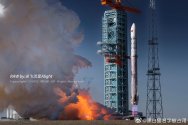
where stainless steel body?Zhuque-3
View attachment 165713

I was fooled by it in the original video too, but the stainless steel body is still there, just covered in ice.where stainless steel body?