
Future PLAAF fleet procurement and composition

Blitzo

General
Staff member
Super Moderator
Registered Member
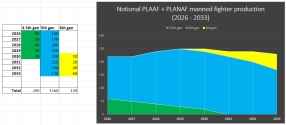
On the "notional manned fighter production" projection front, this is my own personal quick and dirty estimate between 2026 to 2033.

The graph below is somewhat self explanatory, and divides between 4.5th gen, 5th gen and 6th gen manned aircraft. There are a few assumptions that go into it.
1772175807808.png

First is breakdown of types:
4.5th gen aircraft = J-16D, J-15T, J-15DT types
5th gen aircraft = J-20A, J-20S, J-35, J-35A
6th gen aircraft = J-36 and J-XDS

Second, is the "demand for 4.5th gen airframes". As you can see, between 2026 to 2030 there will "only" be a total of 200x 4.5th gen aircraft procured. The assumptions which underlie this are broken down as follows:
- J-15Ts will aim to be able to populate 2x STOBAR + 3x CATOBAR carriers (i.e.: the number of carriers they'll have in operation probably by 2032) making up half a carrier's total fighter airwing (other half being J-35s by footprint size). So that's 12x J-15Ts per STOBAR, 24x J-15Ts per CATOBAR, and that number is then multiplied by 1.5 to account for spares, attrition, etc. (12x2 + 24 x3) x 1.5 gets us 144 (let's call it 150) J-15Ts. I assume that currently there are 40 J-15Ts in existence, so that leaves about 100ish J-15Ts to be built between now and 2030.
- J-15DTs will be a bit more niche, but again to populate 2x STOBAR and 3x CATOBAR carriers, let's say 3x J-15DT per STOBAR and 6x J-15DT per CATOBAR, and again multiplied by 1.5, so.... (3x2 + 6x3) x 1.5 gets us 36 jets, let's call it 40 J-15DTs to be clean, and let's add another 10 J-15DTs to be able to support another carrier circa 2035 onwards in case it takes them time to develop a J-35 or navalized J-XDS derived EW jet, for a requirement of 50 airframes. If we assume they have 5x J-15DTs in existence currently, that's 45 J-15DTs to add to the 100 or so J-15Ts
- Then for J-16Ds, it's a bit more tricky, but if we assume they have a PLAAF wide requirement for 100 J-16Ds, and that if we assume they've got 40 such airframes built currently, then that's another 60 J-16Ds to add.

So in total, the "demand for 4.5th gen airframes" between 2026 and 2030 would be around 200 airframes (100x J-15T, 60x J-16D, 45x J-15DT). Now obviously the numbers can be played around with a bit (for example, if one makes the PLAAF's J-16D fleet requirement to be 150 rather than 100 total), but overall a 200+ 4.5th gen airframe requirement from now seems reasonable to me.


Third is the 5th gen build rate. One has to somewhat use their imaginations to consider the likely build rates of J-20A/S and J-35/A.
- For J-20A/S, I am assuming in 2025 their production rate was maybe 80-100 aircraft rather than the peak of 120 aircraft of 2023/2024, due to retooling to produce J-20A/S from baseline J-20. Going forwards into 2026 onwards, I think a rate of 100-120 aircraft annually could be viable, but I also expect the rate to drop a little bit approaching 2028, as CAC gets ready to build J-36 as well as more CCA/UCAVs. I expect J-20A/S production to continue into the early 2030s, but at only a few dozen per year by then, and to fully cease before 2035. Assuming currently there are 450-500 J-20 family aircraft in service, between 2026 and 2033 I could see them adding some 700-800 airframes, and then between 2033-2035 adding a further 100 before finishing its run, for a total of 1200-1400 J-20s produced across J-20, J-20A and J-20S.
- For J-35/A, I expect them in this year and next to slowly build up production (40 this year, 50 next year), but that full rate production and exploitation of the new production site in particular may not fully kick in until 2028. The exact composition of J-35 vs J-35A can be debated year by year, but I expect J-35 production to meet carrier needs as the new carriers are launched/fitted out in preparation of their service, and J-35A production to take up the rest of the slots, with long term J-35A production numbers likely exceeding that of J-35. I expect annual J-35 and J-35A production to make up an equal the no. of annual J-20A/S by late 2020s, and then outnumber J-20A/S post 2030, and for J-35/A production to continue post 2035 and fully finish a couple years after that. Between 2026-2033 I'd say maybe 760 J-35/A could be built (over half being J-35A), and between 2033 to 2038 another 400-500 could be built before ceasing. Assuming currently there are 40 J-35/A in existence, let's call it 1200-1300 J-35/A built for the PLA overall.... a similar number to the overall J-20/A/S family total.


For 6th gens, I assume that PLAAF will buy J-36 and J-XDS, and PLANAF will buy a notional navalized "J-XDSH".
J-36 and J-XDS may start initial single digit LRIP in 2030, and then slowly build up both types per year into the early 2030s.
A navalized J-XDSH of course is even more speculative; but assuming they want something ready prior to 2035, I could see them flying a navalized J-XDSH prototype before 2028/9, and share common subsystems with the land based J-XDS to expedite development, and enable service entry and production before 2034.
Needless to say, post 2033 into the late 2030s, annual 6th gen production will likely eventually climb to three digit numbers (albeit perhaps not the halcyon 220/yr the 5th gens) as J-35/A production winds down (at this point J-20A/S production would have ceased before 2035) -- but given how much more sophisticated and larger the 6th gen airframes are, that may not be a huge surprise.
Additionally, one will note that the annual fighter production per year in my depiction peaks in 2030/2031 -- that's because I expect the "excess/unused" fighter production capacity at CAC, SAC and others to be utilized for various types of UCAVs and CCAs instead, which of course is not depicted in this graph.

Not displayed is the trend of "old" 4th gen aircraft. Depending on if they seek to maintain current fleet size or greatly expand it, their retirement could start in small numbers anywhere from this year or post 2030.


In any case, the idea of building 300 aircraft per year (with large scale 4.5th gen production between now and early 2030s) seems very unlikely to me. Note, the idea of building 300 aircraft per year, would have those additional 4.5th gen aircraft on top of what I have depicted here.
 

Totoro

Major
VIP Professional
As we saw for years, until J-7 frontline fleet reportedly retired for good in 2025 (not counting pilot training units), PLAAF seems to value keeping units alive, keeping the ground crews and air crews trained, even if the planes they serve and fly might be of fairly little use anymore. One could argue that a JH-7A or a J-11A or a J-10A would be much more useful in 2030 than J-7s were in 2020. So one can assume those won't be retired en mass but that they would rather get retired gradually, just as J-7 were, as certain airframes simply age out and become financially inefficient to have their lifespans prolongued.

Active duty USAF has, as per 2025 AFA Almanac, 2387 fighter pilots. and 369 combat system officers (often second seat crew) Also keep in mind this does not include ANG or AFRC.
Active duty USAF, as per same source, had the following tactical combat planes in inventory:
141 A-10 (141 pilot seats)
218 F-15E (436 seats)
8 F-15X (16 seats)
400 F-16C (400 seats)
98 F-16D (196 seats)
165 F-22 (165 seats)
400 F-35A (400 seats)
Total 1430 tactical combat aircraft. 1430 pilot seats plus 324 additional seats.
That would lead to 1.67 fighter pilots per available seat, and 1.139 CSOs per available seat. Though I imagine not all two seater planes always fly with CSOs. Sometimes the second seat is empty or simply another fighter pilot is there. If one would just aggregate those that'd be 1754 seats for 2756 personnel. Leading to 1.57 persons per seat.

Now let's get back to Chinese AF. Assuming various 4th gen planes are flown 150-200 hours per pilot, per year, and assuming similar pilot/CSO to airframe ratios as USAF, that would suggest said airframes fly 235 to 315 hours per year. Though, they likely haven't flown that much since they've been put into service. I imagine that in mid 2000s a lot of those airframes were getting like 200 to 250 hours per year.

Now we can't know airframe life for sure but if one assumes (sort of an educated guess compiled from various announced flanker and fulcrum lifespans, F16 lifespans and so on) the following lifespans:
4000-6000 hours for J-10A
6000-9000 hours for JH-7A
4000-5000 hours for J-11A
5000-8000 hours for J-11B
8000-12000 hours for J-16
6000-8000 hours for J-10B/C
and then use middle values for all, to make it all a bit easier to calculate, also using known or reported production values for each type per year, since their induction into service,
then we should get the following airframe retirement starts, per type:

Around 2023 for J-10A
Around 2034 for JH-7A
Approximately around 2020 for J-11A
Around 2033 for J-11B
Around 2056 for J-16
Around 2044 for J-10B/C

Now, I am not sure if we actually god indication that either J-10A or J-11A have started getting retired. Maybe, maybe not. If someone has such a source, please share.

Su30s from russia came from december 2000 onward, and those are advertised with a max 6000 hours, with life extension modifications. that might result in 2025 or so as the retirement start year.

I think all three early types, 10A/S, 11A and 7A didn't really have a production of over 24 airframes per year.

So we might actually be looking at close to a 75 old planes being retired per year, now after J7s have been retired. 24 each for J10, J11 and Su30. That might dip to just 25 per year by 2030, as all Su30s and all J-11A get retired. Then again pick up at 75 per year around 2033 for a few years as J-11B and JH-7A start get retired. J-10A retirement might last all the way to 2035, after which the retirement total per year might again drop to 50 or so airframes per year.

Of course, all this is very conditional. PLAAF could easily say they don't want the last 100 or so J-10A or JH-7 some years earlier and simply get rid of the type en masse. But I think it broadly illustrates the point and the volume of retirement of old types.

So if influx of new planes is, say, 200 per year, maybe 250 in the near future, then total increase per year for the coming 10 years or so might be 125 to 175 per year.
 

Blitzo

General
Staff member
Super Moderator
Registered Member
As we saw for years, until J-7 frontline fleet reportedly retired for good in 2025 (not counting pilot training units), PLAAF seems to value keeping units alive, keeping the ground crews and air crews trained, even if the planes they serve and fly might be of fairly little use anymore. One could argue that a JH-7A or a J-11A or a J-10A would be much more useful in 2030 than J-7s were in 2020. So one can assume those won't be retired en mass but that they would rather get retired gradually, just as J-7 were, as certain airframes simply age out and become financially inefficient to have their lifespans prolongued.

As discussed on previous pages, the past 3rd gen fighters were kept around not because the PLA enjoyed supporting obsolescent aircraft for laughs, but rather because they helped to keep the relevant units intact until production of modern, competitive aircraft could catch up with the aspired fleet size.

The factor which will determine the fate of the PLA's old 4th gen aircraft will similarly be what their planned fleet size is, followed by the absolute airframe age/flight hours of these old 4th gen aircraft. However I think in this case, it will be planned fleet size that may end up being the more prominent factor earlier on
 

siegecrossbow

Field Marshall
Staff member
Super Moderator
That 2030 fleet would look like :

~1000 5th Gen Stealth Fighters (J-20 and J-35)
~400 4.5 Gen J-16
~300 4.5 Gen J-10B/C

That feels insufficient, given the objective is air dominance as soon as possible.

So I think they'll keep all the J-11B (~250 aircraft) and also the JH-7A. (But yes, they would retire the J-10A and Su-30)

The J-11B can be upgraded to near 4.5 Gen capability, and when not needed for air superiority missions, they can act as bomb trucks. Then we have the JH-7A dedicated to strike missions.

That would mean an increase from 2000 to 2500 tactical aircraft, from 2025-2030.

---

By 2035, based on 200 5th Gen fighters annually, it could look like this:

Some 6th Gen (J-36 and J-50)
~2000 5th Gen (J-20 and J-35)
~400 4.5 Gen J-16
~300 4.5 Gen J-10B/C
~250 4.5 Gen J-11B
~100? JH-7A

That would be a further increase from 2500 to 3500 tactical aircraft, from 2030-2035

That looks like overwhelming superiority on Day 1, but only a "comfortable" level of superiority in a long war of attrition.
Number and timeline for sixth gen is too conservative. I’ll say that much.
 

AndrewS

Brigadier
Registered Member
On the "notional manned fighter production" projection front, this is my own personal quick and dirty estimate between 2026 to 2033.

The graph below is somewhat self explanatory, and divides between 4.5th gen, 5th gen and 6th gen manned aircraft. There are a few assumptions that go into it.

View attachment 170294

First is breakdown of types:
4.5th gen aircraft = J-16D, J-15T, J-15DT types
5th gen aircraft = J-20A, J-20S, J-35, J-35A
6th gen aircraft = J-36 and J-XDS

Second, is the "demand for 4.5th gen airframes". As you can see, between 2026 to 2030 there will "only" be a total of 200x 4.5th gen aircraft procured. The assumptions which underlie this are broken down as follows:
- J-15Ts will aim to be able to populate 2x STOBAR + 3x CATOBAR carriers (i.e.: the number of carriers they'll have in operation probably by 2032) making up half a carrier's total fighter airwing (other half being J-35s by footprint size). So that's 12x J-15Ts per STOBAR, 24x J-15Ts per CATOBAR, and that number is then multiplied by 1.5 to account for spares, attrition, etc. (12x2 + 24 x3) x 1.5 gets us 144 (let's call it 150) J-15Ts. I assume that currently there are 40 J-15Ts in existence, so that leaves about 100ish J-15Ts to be built between now and 2030.
- J-15DTs will be a bit more niche, but again to populate 2x STOBAR and 3x CATOBAR carriers, let's say 3x J-15DT per STOBAR and 6x J-15DT per CATOBAR, and again multiplied by 1.5, so.... (3x2 + 6x3) x 1.5 gets us 36 jets, let's call it 40 J-15DTs to be clean, and let's add another 10 J-15DTs to be able to support another carrier circa 2035 onwards in case it takes them time to develop a J-35 or navalized J-XDS derived EW jet, for a requirement of 50 airframes. If we assume they have 5x J-15DTs in existence currently, that's 45 J-15DTs to add to the 100 or so J-15Ts
- Then for J-16Ds, it's a bit more tricky, but if we assume they have a PLAAF wide requirement for 100 J-16Ds, and that if we assume they've got 40 such airframes built currently, then that's another 60 J-16Ds to add.

So in total, the "demand for 4.5th gen airframes" between 2026 and 2030 would be around 200 airframes (100x J-15T, 60x J-16D, 45x J-15DT). Now obviously the numbers can be played around with a bit (for example, if one makes the PLAAF's J-16D fleet requirement to be 150 rather than 100 total), but overall a 200+ 4.5th gen airframe requirement from now seems reasonable to me.


Third is the 5th gen build rate. One has to somewhat use their imaginations to consider the likely build rates of J-20A/S and J-35/A.
- For J-20A/S, I am assuming in 2025 their production rate was maybe 80-100 aircraft rather than the peak of 120 aircraft of 2023/2024, due to retooling to produce J-20A/S from baseline J-20. Going forwards into 2026 onwards, I think a rate of 100-120 aircraft annually could be viable, but I also expect the rate to drop a little bit approaching 2028, as CAC gets ready to build J-36 as well as more CCA/UCAVs. I expect J-20A/S production to continue into the early 2030s, but at only a few dozen per year by then, and to fully cease before 2035. Assuming currently there are 450-500 J-20 family aircraft in service, between 2026 and 2033 I could see them adding some 700-800 airframes, and then between 2033-2035 adding a further 100 before finishing its run, for a total of 1200-1400 J-20s produced across J-20, J-20A and J-20S.
- For J-35/A, I expect them in this year and next to slowly build up production (40 this year, 50 next year), but that full rate production and exploitation of the new production site in particular may not fully kick in until 2028. The exact composition of J-35 vs J-35A can be debated year by year, but I expect J-35 production to meet carrier needs as the new carriers are launched/fitted out in preparation of their service, and J-35A production to take up the rest of the slots, with long term J-35A production numbers likely exceeding that of J-35. I expect annual J-35 and J-35A production to make up an equal the no. of annual J-20A/S by late 2020s, and then outnumber J-20A/S post 2030, and for J-35/A production to continue post 2035 and fully finish a couple years after that. Between 2026-2033 I'd say maybe 760 J-35/A could be built (over half being J-35A), and between 2033 to 2038 another 400-500 could be built before ceasing. Assuming currently there are 40 J-35/A in existence, let's call it 1200-1300 J-35/A built for the PLA overall.... a similar number to the overall J-20/A/S family total.


For 6th gens, I assume that PLAAF will buy J-36 and J-XDS, and PLANAF will buy a notional navalized "J-XDSH".
J-36 and J-XDS may start initial single digit LRIP in 2030, and then slowly build up both types per year into the early 2030s.
A navalized J-XDSH of course is even more speculative; but assuming they want something ready prior to 2035, I could see them flying a navalized J-XDSH prototype before 2028/9, and share common subsystems with the land based J-XDS to expedite development, and enable service entry and production before 2034.
Needless to say, post 2033 into the late 2030s, annual 6th gen production will likely eventually climb to three digit numbers (albeit perhaps not the halcyon 220/yr the 5th gens) as J-35/A production winds down (at this point J-20A/S production would have ceased before 2035) -- but given how much more sophisticated and larger the 6th gen airframes are, that may not be a huge surprise.
Additionally, one will note that the annual fighter production per year in my depiction peaks in 2030/2031 -- that's because I expect the "excess/unused" fighter production capacity at CAC, SAC and others to be utilized for various types of UCAVs and CCAs instead, which of course is not depicted in this graph.

Not displayed is the trend of "old" 4th gen aircraft. Depending on if they seek to maintain current fleet size or greatly expand it, their retirement could start in small numbers anywhere from this year or post 2030.


In any case, the idea of building 300 aircraft per year (with large scale 4.5th gen production between now and early 2030s) seems very unlikely to me. Note, the idea of building 300 aircraft per year, would have those additional 4.5th gen aircraft on top of what I have depicted here.

Couple of comments:

---

By 2028, there would already be 1000+ 5th gens in service.
The investment to increase production 10% only results in an extra 20 aircraft annually, and just for 3 years.
This doesn't seem worth it, just for 60 aircraft, considering there would be 1000+ already existing.

So I would reduce peak 5th gen production to 200 per year, or keep 220 annually for longer.

---

I also think at least some existing 4 Gen Brigades convert to 5th Gen, even if their airframes have service lives available. Those spare airframes would be given to the active Brigades, and serve as spares/attrition reserve for a long conflict.

---

As for the Navy, I think they would stop procurement of newbuild J-15s, aside from a few specialised variants.

Instead, they would replace all the existing J-15s with the J-35 as soon as possible, again, with the exception of some of the specialised J-15 variants.
 

ACuriousPLAFan

Lieutenant General
Registered Member
On the "notional manned fighter production" projection front, this is my own personal quick and dirty estimate between 2026 to 2033.

The graph below is somewhat self explanatory, and divides between 4.5th gen, 5th gen and 6th gen manned aircraft. There are a few assumptions that go into it.

View attachment 170294

First is breakdown of types:
4.5th gen aircraft = J-16D, J-15T, J-15DT types
5th gen aircraft = J-20A, J-20S, J-35, J-35A
6th gen aircraft = J-36 and J-XDS

Second, is the "demand for 4.5th gen airframes". As you can see, between 2026 to 2030 there will "only" be a total of 200x 4.5th gen aircraft procured. The assumptions which underlie this are broken down as follows:
- J-15Ts will aim to be able to populate 2x STOBAR + 3x CATOBAR carriers (i.e.: the number of carriers they'll have in operation probably by 2032) making up half a carrier's total fighter airwing (other half being J-35s by footprint size). So that's 12x J-15Ts per STOBAR, 24x J-15Ts per CATOBAR, and that number is then multiplied by 1.5 to account for spares, attrition, etc. (12x2 + 24 x3) x 1.5 gets us 144 (let's call it 150) J-15Ts. I assume that currently there are 40 J-15Ts in existence, so that leaves about 100ish J-15Ts to be built between now and 2030.
- J-15DTs will be a bit more niche, but again to populate 2x STOBAR and 3x CATOBAR carriers, let's say 3x J-15DT per STOBAR and 6x J-15DT per CATOBAR, and again multiplied by 1.5, so.... (3x2 + 6x3) x 1.5 gets us 36 jets, let's call it 40 J-15DTs to be clean, and let's add another 10 J-15DTs to be able to support another carrier circa 2035 onwards in case it takes them time to develop a J-35 or navalized J-XDS derived EW jet, for a requirement of 50 airframes. If we assume they have 5x J-15DTs in existence currently, that's 45 J-15DTs to add to the 100 or so J-15Ts
- Then for J-16Ds, it's a bit more tricky, but if we assume they have a PLAAF wide requirement for 100 J-16Ds, and that if we assume they've got 40 such airframes built currently, then that's another 60 J-16Ds to add.

So in total, the "demand for 4.5th gen airframes" between 2026 and 2030 would be around 200 airframes (100x J-15T, 60x J-16D, 45x J-15DT). Now obviously the numbers can be played around with a bit (for example, if one makes the PLAAF's J-16D fleet requirement to be 150 rather than 100 total), but overall a 200+ 4.5th gen airframe requirement from now seems reasonable to me.


Third is the 5th gen build rate. One has to somewhat use their imaginations to consider the likely build rates of J-20A/S and J-35/A.
- For J-20A/S, I am assuming in 2025 their production rate was maybe 80-100 aircraft rather than the peak of 120 aircraft of 2023/2024, due to retooling to produce J-20A/S from baseline J-20. Going forwards into 2026 onwards, I think a rate of 100-120 aircraft annually could be viable, but I also expect the rate to drop a little bit approaching 2028, as CAC gets ready to build J-36 as well as more CCA/UCAVs. I expect J-20A/S production to continue into the early 2030s, but at only a few dozen per year by then, and to fully cease before 2035. Assuming currently there are 450-500 J-20 family aircraft in service, between 2026 and 2033 I could see them adding some 700-800 airframes, and then between 2033-2035 adding a further 100 before finishing its run, for a total of 1200-1400 J-20s produced across J-20, J-20A and J-20S.
- For J-35/A, I expect them in this year and next to slowly build up production (40 this year, 50 next year), but that full rate production and exploitation of the new production site in particular may not fully kick in until 2028. The exact composition of J-35 vs J-35A can be debated year by year, but I expect J-35 production to meet carrier needs as the new carriers are launched/fitted out in preparation of their service, and J-35A production to take up the rest of the slots, with long term J-35A production numbers likely exceeding that of J-35. I expect annual J-35 and J-35A production to make up an equal the no. of annual J-20A/S by late 2020s, and then outnumber J-20A/S post 2030, and for J-35/A production to continue post 2035 and fully finish a couple years after that. Between 2026-2033 I'd say maybe 760 J-35/A could be built (over half being J-35A), and between 2033 to 2038 another 400-500 could be built before ceasing. Assuming currently there are 40 J-35/A in existence, let's call it 1200-1300 J-35/A built for the PLA overall.... a similar number to the overall J-20/A/S family total.


For 6th gens, I assume that PLAAF will buy J-36 and J-XDS, and PLANAF will buy a notional navalized "J-XDSH".
J-36 and J-XDS may start initial single digit LRIP in 2030, and then slowly build up both types per year into the early 2030s.
A navalized J-XDSH of course is even more speculative; but assuming they want something ready prior to 2035, I could see them flying a navalized J-XDSH prototype before 2028/9, and share common subsystems with the land based J-XDS to expedite development, and enable service entry and production before 2034.
Needless to say, post 2033 into the late 2030s, annual 6th gen production will likely eventually climb to three digit numbers (albeit perhaps not the halcyon 220/yr the 5th gens) as J-35/A production winds down (at this point J-20A/S production would have ceased before 2035) -- but given how much more sophisticated and larger the 6th gen airframes are, that may not be a huge surprise.
Additionally, one will note that the annual fighter production per year in my depiction peaks in 2030/2031 -- that's because I expect the "excess/unused" fighter production capacity at CAC, SAC and others to be utilized for various types of UCAVs and CCAs instead, which of course is not depicted in this graph.

Not displayed is the trend of "old" 4th gen aircraft. Depending on if they seek to maintain current fleet size or greatly expand it, their retirement could start in small numbers anywhere from this year or post 2030.


In any case, the idea of building 300 aircraft per year (with large scale 4.5th gen production between now and early 2030s) seems very unlikely to me. Note, the idea of building 300 aircraft per year, would have those additional 4.5th gen aircraft on top of what I have depicted here.

In the meantime, what's your prospective view on the induction timeline and scale progression of the tactical-domain, MUMT-type UAVs (if subdivided into strike (GJ-11/21), low-tier (UADF-C/D/E), and high-tier (UADF-A/B/F) categories)?
 
Last edited:

tamsen_ikard

Captain
Registered Member
On the "notional manned fighter production" projection front, this is my own personal quick and dirty estimate between 2026 to 2033.

The graph below is somewhat self explanatory, and divides between 4.5th gen, 5th gen and 6th gen manned aircraft. There are a few assumptions that go into it.

View attachment 170294

First is breakdown of types:
4.5th gen aircraft = J-16D, J-15T, J-15DT types
5th gen aircraft = J-20A, J-20S, J-35, J-35A
6th gen aircraft = J-36 and J-XDS

Second, is the "demand for 4.5th gen airframes". As you can see, between 2026 to 2030 there will "only" be a total of 200x 4.5th gen aircraft procured. The assumptions which underlie this are broken down as follows:
- J-15Ts will aim to be able to populate 2x STOBAR + 3x CATOBAR carriers (i.e.: the number of carriers they'll have in operation probably by 2032) making up half a carrier's total fighter airwing (other half being J-35s by footprint size). So that's 12x J-15Ts per STOBAR, 24x J-15Ts per CATOBAR, and that number is then multiplied by 1.5 to account for spares, attrition, etc. (12x2 + 24 x3) x 1.5 gets us 144 (let's call it 150) J-15Ts. I assume that currently there are 40 J-15Ts in existence, so that leaves about 100ish J-15Ts to be built between now and 2030.
- J-15DTs will be a bit more niche, but again to populate 2x STOBAR and 3x CATOBAR carriers, let's say 3x J-15DT per STOBAR and 6x J-15DT per CATOBAR, and again multiplied by 1.5, so.... (3x2 + 6x3) x 1.5 gets us 36 jets, let's call it 40 J-15DTs to be clean, and let's add another 10 J-15DTs to be able to support another carrier circa 2035 onwards in case it takes them time to develop a J-35 or navalized J-XDS derived EW jet, for a requirement of 50 airframes. If we assume they have 5x J-15DTs in existence currently, that's 45 J-15DTs to add to the 100 or so J-15Ts
- Then for J-16Ds, it's a bit more tricky, but if we assume they have a PLAAF wide requirement for 100 J-16Ds, and that if we assume they've got 40 such airframes built currently, then that's another 60 J-16Ds to add.

So in total, the "demand for 4.5th gen airframes" between 2026 and 2030 would be around 200 airframes (100x J-15T, 60x J-16D, 45x J-15DT). Now obviously the numbers can be played around with a bit (for example, if one makes the PLAAF's J-16D fleet requirement to be 150 rather than 100 total), but overall a 200+ 4.5th gen airframe requirement from now seems reasonable to me.


Third is the 5th gen build rate. One has to somewhat use their imaginations to consider the likely build rates of J-20A/S and J-35/A.
- For J-20A/S, I am assuming in 2025 their production rate was maybe 80-100 aircraft rather than the peak of 120 aircraft of 2023/2024, due to retooling to produce J-20A/S from baseline J-20. Going forwards into 2026 onwards, I think a rate of 100-120 aircraft annually could be viable, but I also expect the rate to drop a little bit approaching 2028, as CAC gets ready to build J-36 as well as more CCA/UCAVs. I expect J-20A/S production to continue into the early 2030s, but at only a few dozen per year by then, and to fully cease before 2035. Assuming currently there are 450-500 J-20 family aircraft in service, between 2026 and 2033 I could see them adding some 700-800 airframes, and then between 2033-2035 adding a further 100 before finishing its run, for a total of 1200-1400 J-20s produced across J-20, J-20A and J-20S.
- For J-35/A, I expect them in this year and next to slowly build up production (40 this year, 50 next year), but that full rate production and exploitation of the new production site in particular may not fully kick in until 2028. The exact composition of J-35 vs J-35A can be debated year by year, but I expect J-35 production to meet carrier needs as the new carriers are launched/fitted out in preparation of their service, and J-35A production to take up the rest of the slots, with long term J-35A production numbers likely exceeding that of J-35. I expect annual J-35 and J-35A production to make up an equal the no. of annual J-20A/S by late 2020s, and then outnumber J-20A/S post 2030, and for J-35/A production to continue post 2035 and fully finish a couple years after that. Between 2026-2033 I'd say maybe 760 J-35/A could be built (over half being J-35A), and between 2033 to 2038 another 400-500 could be built before ceasing. Assuming currently there are 40 J-35/A in existence, let's call it 1200-1300 J-35/A built for the PLA overall.... a similar number to the overall J-20/A/S family total.


For 6th gens, I assume that PLAAF will buy J-36 and J-XDS, and PLANAF will buy a notional navalized "J-XDSH".
J-36 and J-XDS may start initial single digit LRIP in 2030, and then slowly build up both types per year into the early 2030s.
A navalized J-XDSH of course is even more speculative; but assuming they want something ready prior to 2035, I could see them flying a navalized J-XDSH prototype before 2028/9, and share common subsystems with the land based J-XDS to expedite development, and enable service entry and production before 2034.
Needless to say, post 2033 into the late 2030s, annual 6th gen production will likely eventually climb to three digit numbers (albeit perhaps not the halcyon 220/yr the 5th gens) as J-35/A production winds down (at this point J-20A/S production would have ceased before 2035) -- but given how much more sophisticated and larger the 6th gen airframes are, that may not be a huge surprise.
Additionally, one will note that the annual fighter production per year in my depiction peaks in 2030/2031 -- that's because I expect the "excess/unused" fighter production capacity at CAC, SAC and others to be utilized for various types of UCAVs and CCAs instead, which of course is not depicted in this graph.

Not displayed is the trend of "old" 4th gen aircraft. Depending on if they seek to maintain current fleet size or greatly expand it, their retirement could start in small numbers anywhere from this year or post 2030.


In any case, the idea of building 300 aircraft per year (with large scale 4.5th gen production between now and early 2030s) seems very unlikely to me. Note, the idea of building 300 aircraft per year, would have those additional 4.5th gen aircraft on top of what I have depicted here.
I overall liked your assessment on the 4th gen and J-20 production. But I do not think China will produce that many J-35. Especially J-35A, the land version.

The biggest reason being that J-35 is a smaller plane with lower range than the J-20. For China to fight against the likes of Japan, India and US naval fighters, they need long range and large fighters. Flankers, JH-7 and J-20 fit this, but J-35 do not.

J-20 can also fit bigger radar and sensors and more suitable for BVR and drone control.

The need for smaller point defense fighter can be fulfilled by the CCAs.

I think this is the reason PLAAF did not pickup J-31 for almost a decade. They didnt think it fits their needs.

They eventually picked up J-35A but likely reluctantly to boost its export potential.

I think J-35A procurement will be smaller and more focus will be on J-20S production.
 
Top