Chinese UCAV/CCA/flying wing drones (ISR, A2A, A2G)

00CuriousObserver

Senior Member
Registered Member
When you have EMALS everything looks like a carrier


wzR5IeS.jpeg
 

ACuriousPLAFan

Brigadier
Registered Member
The real question, I suppose is how feasible this thing is as a concept, whether it's launched from land or from sea. Depending on the actual weight of the aircraft, the utility and significance of it might be relatively limited.

I would suppose that container ships equipped with UAVs and EMCAT trucks as seen on the Zhong Da 79 could actually serve as mobile forward bases that can provide rapid ISTAR capabilities for allied assets to conduct strikes against enemy ground targets. In this case, payload capacity may not emerge as much of a crucial factor.

Say, for example - Intelligence sources reported the existence of several HIMARS units at an area in Tainan or Kaohsiung. The weather over the target area (if not the wider region) is bad, and there are no friendly ISTAR platforms nearby at the moment, but strikes against these HIMARS are needed ASAP to minimize the chances of them conducting strikes against certain PLA assets located in Xiamen or Shantou. However, the closest available runway (i.e. Xiamen Airport, assuming runway has been made dual-use) to the area is at least 280 kilometers away.

Should one such container ship be situated ~100-150 kilometers off the target area, this would enable a XQ-58-counterpart UAV to reach that area in ≤10 minutes (by taking XQ-58's crusing speed of ~880 km/h) and provide critical ISTAR guidance for shore-based PHL-191 units or sea-based 054A FFGs/052D DDGs to enact strikes against these HIMARS. To reach that same area from the closest available runway would require about 19 minutes.

Sure, these two options only has a difference of about 9 minutes, which may not be that big. However, if the targets are located much farther away from the coastal regions of China (say, the eastern seaboard of Taiwan, the Ryukyu Islands or the SCS Islands) and there are no PLAN CVs or LHDs located nearby/available, then the difference in response time would certainly amplify.

Of course, this is just one of the possible scenarios where the EMCAT trucks launching containerized UAVs has their unique utility and importance. There is are also the conventional strike and close-support (for amphibious assault forces) functionalities which can be executed by such setups, among others.


In the meantime, considering that these EMCAT trucks can be joined together front-to-back to form a longer EMCAT track on the ship (instead of just a rocket-powered sled for the containerized XQ-58 variant) - Then nominally speaking, this setup could enable launching UAVs that are slightly/somewhat larger and heavier than the XQ-58.
 
Last edited:

Temstar

Brigadier
Registered Member
I would suppose that container ships equipped with UAVs and EMCAT trucks as seen on the Zhong Da 79 could actually serve as mobile forward bases that can provide rapid ISTAR capabilities for allied assets to conduct strikes against enemy ground targets. In this case, payload capacity may not emerge as much of a crucial factor.

Say, for example - Intelligence sources reported the existence of several HIMARS units at an area in Tainan or Kaohsiung. The weather over the target area (if not the wider region) is bad, and there are no friendly ISTAR platforms nearby at the moment, but strikes against these HIMARS are needed ASAP to minimize the chances of them conducting strikes against certain PLA assets located in Xiamen or Shantou. However, the closest available runway (i.e. Xiamen Airport, assuming runway has been made dual-use) to the area is at least 280 kilometers away.

Should one such container ship be situated ~100-150 kilometers off the target area, this would enable a XQ-58-counterpart UAV to reach that area in ≤10 minutes (by taking XQ-58's crusing speed of ~880 km/h) and provide critical ISTAR guidance for shore-based PHL-191 units or sea-based 054A FFGs/052D DDGs to enact strikes against these HIMARS. To reach that same area from the closest available runway would require about 19 minutes.

Sure, these two options only has a difference of about 9 minutes, which may not be that big. However, if the targets are located much farther away from the coastal regions of China (say, the eastern seaboard of Taiwan, the Ryukyu Islands or the SCS Islands) and there are no PLAN CVs or LHDs located nearby/available, then the difference in response time would certainly amplify.

Of course, this is just one of the possible scenarios where the EMCAT trucks launching containerized UAVs has their unique utility and importance. There is are also the conventional strike and close-support (for amphibious assault forces) functionalities which can be executed by such setups, among others.


In the meantime, considering that these EMCAT trucks can be joined together front-to-back to form a longer EMCAT track on the ship (instead of just a rocket-powered sled for the containerized XQ-58 variant) - Then nominally speaking, this setup could enable launching UAVs that are slightly/somewhat larger and heavier than the XQ-58.
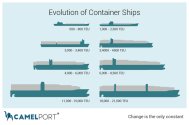
Given 076 is something like 260m long and the largest 24k TEU container ships are nearly 400m long, you could maybe convert one of the larger container ships so it could handle arrested landing too. Although question would be how modular you could make it.

58443661_2259917690721226_1550046125099057152_n.jpg
The largest container ships tend to have that design where they have a bridge near the front and a smokestack near the back, which is probably bad for carrier conversion. The ideal ship would probably be the 6000-8500 TEU type design above. For comparison the ship that Iran used to convert to a drone carrier, the Perarin was 240m long, beam 32.2m, 42k ton and 3280 TEU capacity, but obviously that was done in a permanent, non-modular way.
 

phrozenflame

Junior Member
Registered Member
Imagine something like Tet offensive across the global seas and choke points.

Difference being, a much higher % of soft targets and locking up alot of opposition sea power away from actual conflict.

Blockade or hitting a merchant ship will literally bring global trade to a halt and destruction of key civil ports.

FA containership FO
 

mack8

Senior Member
Imo the only think missing is a helicopter and pad, probably because the current ship is to small. But on larger conversions this should be a logical addition, so they will have helicopters manned or otherwise, EMALS launched CCAs, as well as an entire panoply of SAMs, AShMs, and AsuWs and associated sensors, covering pretty much all basic requirements combat capability wise.
 

another505

Junior Member
Registered Member
I assume one of the containers there is holding a crane to lift these UCAV ontop of the truck since I don't see an onboard crane or ramp.

I feel like this would be less common than the more utilitarian "arsenal ship" layout. This take up more deck space but more importantly, since it doesn't have a runway to land, the UCAV has to be either inexpensive to be a one way trip mission (but a missile can do the same for less except ISTR missions), or has to be close enough to friendly airbase to land after the mission which means it operation range is limited.

At first when I heard the post-apocalyptic idea I thought it was crazy, impractical, and out of the world. Now it make some sense after I thought it through.

The main practical purpose is to disincentives USA to use nuclear in an armed unification by having a Pyrrhic win condition instead of the usual lose-lose nuclear exchange. It might never be even used in post-apocalypse world because who can tell what happens after a nuclear exchange but the same unknown means USA wouldn't know FOR CERTAIN if it can survive and work.


Slightly off topic. I just found it hilarious that it is a ship carrying a bunch of trucks that are launching planes (UCAV). Legit, something I would think of when I was 8.
 

ismellcopium

Junior Member
Registered Member
They again reiterated the claim that the project's goal is intended for a post-apocalypse world. Shilao painted a story where in a Fallout-isk world, descendants of China might decide Darwin is a good place to have since it's a good harbour and not contaminated with fallout. But upon realising the natives might have a few working F/A-18 left they load the catapult trucks and CCAs onto the container ships.
As cartoonish as these claims are. I wonder, if there's actually any truth to them, if it was born as much out of a desire to further deter nuclear war and prevent the West from even contemplating it as the stated motive. As in, "even if we go that route, I'll still win and dominate you in the aftermath".
Anyway even if this was truly the main motivation for this I sure hope it doesn't prevent them from quickly building these in large numbers given the conventional military utility.
 

Andy1974

Senior Member
Registered Member
I would suppose that container ships equipped with UAVs and EMCAT trucks as seen on the Zhong Da 79 could actually serve as mobile forward bases that can provide rapid ISTAR capabilities for allied assets to conduct strikes against enemy ground targets. In this case, payload capacity may not emerge as much of a crucial factor.

Say, for example - Intelligence sources reported the existence of several HIMARS units at an area in Tainan or Kaohsiung. The weather over the target area (if not the wider region) is bad, and there are no friendly ISTAR platforms nearby at the moment, but strikes against these HIMARS are needed ASAP to minimize the chances of them conducting strikes against certain PLA assets located in Xiamen or Shantou. However, the closest available runway (i.e. Xiamen Airport, assuming runway has been made dual-use) to the area is at least 280 kilometers away.

Should one such container ship be situated ~100-150 kilometers off the target area, this would enable a XQ-58-counterpart UAV to reach that area in ≤10 minutes (by taking XQ-58's crusing speed of ~880 km/h) and provide critical ISTAR guidance for shore-based PHL-191 units or sea-based 054A FFGs/052D DDGs to enact strikes against these HIMARS. To reach that same area from the closest available runway would require about 19 minutes.

Sure, these two options only has a difference of about 9 minutes, which may not be that big. However, if the targets are located much farther away from the coastal regions of China (say, the eastern seaboard of Taiwan, the Ryukyu Islands or the SCS Islands) and there are no PLAN CVs or LHDs located nearby/available, then the difference in response time would certainly amplify.

Of course, this is just one of the possible scenarios where the EMCAT trucks launching containerized UAVs has their unique utility and importance. There is are also the conventional strike and close-support (for amphibious assault forces) functionalities which can be executed by such setups, among others.


In the meantime, considering that these EMCAT trucks can be joined together front-to-back to form a longer EMCAT track on the ship (instead of just a rocket-powered sled for the containerized XQ-58 variant) - Then nominally speaking, this setup could enable launching UAVs that are slightly/somewhat larger and heavier than the XQ-58.
As the trio mentioned Darwin and F/A-18s I suspect there must be an AAM option as well.
 

iewgnem

Captain
Registered Member
This ship has migrated to UCAV thread so I'll just post it here:

The concept is evidently more than just containerized missiles or EMAL modules, its a systemic approach to extending naval capabilities to cargo fleet beyond one off conversions.

Which means theres a good chance there are ASW modules too, i.e. ASW containers with towed/variable depth sonar, containerized torpedo/UUV launchers, drone helicopter in containers with dipping sonars. Those can all arguably be much easier to hide than EMAL on deck or radar arrays.

The ability to put full ASW suite on hundreds or even thousands of cargo ship, big and small, with cargo ship acustic profiles and visually indistinguishable from an unarmed ship, is a nightmare scenerio for US subs that has even greater implications than destroyer or EMAL drone carrier configurations.
 
Top