Yup, they have been there since 2018-2019. Still, it may not be a good idea given the region’s proximity to the Russian border (again, nobody knows more about what Russia would do in a crisis than the Tsar himself).IIRC, a DF-41 brigade is already stationed in Heilongjiang

You are using an out of date browser. It may not display this or other websites correctly.
You should upgrade or use an alternative browser.
You should upgrade or use an alternative browser.
Chinese Hypersonic Developments (HGVs/HCMs)
- Thread starter A.Man
- Start date
I see your point. But wouldn’t increasing the range to 12,000km give the PLA even more flexibility akin to the Obama-era Prompt Global Strike? Wouldn’t an intercontinental-range hypersonic glider (but only conventionally armed) be better able to hold the entire US Pacific Fleet at risk, including at the latter’s homeports of Bremerton and San Diego?However, isn't the more logical way to view the range as being a reflection that it has the flexibility to be viable for certain additional target sets depending on where it is launched, or that it has additional capability to take on evasive trajectories/lateral movements by virtue of a greater range as a glide vehicle?
Especially the case if this weapon gets an anti-ship capability as well, where the greater range would see benefit in
On the other hand, increasing the DF-27’s range to more than 11,000 km (like PGS) could risk triggering a nuclear response in a hypothetical conflict. That’s why I somewhat suspect that limiting the weapon’s range to 8,000 km could be a self-imposed restraint on Beijing’s behalf, whilst still holding every U.S. capital ship and base west the Second Island Chain at risk.

FriedRiceNSpice
Major
Downside of launching large salvos of ICBM ranged missiles is the potential for such an attack to be interpreted as a strategic first strike. Especially when considering that for HGVs, the intended target can no longer be determined from flight trajectory (as opposed to conventional ballistic missiles that follow a parabolic trajectory).I see your point. But wouldn’t increasing the range to 12,000km give the PLA even more flexibility akin to the Obama-era Prompt Global Strike? Wouldn’t an intercontinental-range hypersonic glider (but only conventionally armed) be better able to hold the entire US Pacific Fleet at risk, including at the latter’s homeports of Bremerton and San Diego?
On the other hand, increasing the DF-27’s range to more than 11,000 km (like PGS) could risk triggering a nuclear response in a hypothetical conflict. That’s why I somewhat suspect that limiting the weapon’s range to 8,000 km could be a self-imposed restraint on Beijing’s behalf, whilst still holding every U.S. capital ship and base west the Second Island Chain at risk.

I see your point. But wouldn’t increasing the range to 12,000km give the PLA even more flexibility akin to the Obama-era Prompt Global Strike? Wouldn’t an intercontinental-range hypersonic glider (but only conventionally armed) be better able to hold the entire US Pacific Fleet at risk, including at the latter’s homeports of Bremerton and San Diego?
On the other hand, increasing the DF-27’s range to more than 11,000 km (like PGS) could risk triggering a nuclear response in a hypothetical conflict. That’s why I somewhat suspect that limiting the weapon’s range to 8,000 km could be a self-imposed restraint on Beijing’s behalf, whilst still holding every U.S. capital ship and base west the Second Island Chain at risk.
An ICBM ranged hypersonic glide vehicle may be in the future (i.e. we cannot rule it out) but this is the equivalent of asking why DF-31 doesn't have the range of DF-41.
The answer is that they're different missiles.

My guy, it literally already can. Have you not seen this months old graphic yet? In this graphic, you can see it can already cover portions of the upper northwest part of CONUS like Bremerton, and can pretty much cover the entire Western coast and even further inland of CONUS if launched from northeastern China. 8000km is already pushing it and should more than enough. That can already cover large parts of the globe near China from and most of the oceanic waters near China stretching thousands of miles. At most if you were to increase it, 10,000km. 8000km is already basically ICBM, hence the classification by the West, although China may classify it differently.I see your point. But wouldn’t increasing the range to 12,000km give the PLA even more flexibility akin to the Obama-era Prompt Global Strike? Wouldn’t an intercontinental-range hypersonic glider (but only conventionally armed) be better able to hold the entire US Pacific Fleet at risk, including at the latter’s homeports of Bremerton and San Diego?
On the other hand, increasing the DF-27’s range to more than 11,000 km (like PGS) could risk triggering a nuclear response in a hypothetical conflict. That’s why I somewhat suspect that limiting the weapon’s range to 8,000 km could be a self-imposed restraint on Beijing’s behalf, whilst still holding every U.S. capital ship and base west the Second Island Chain at risk.
In fact, it can already cover basically everywhere from all of Europe, to most of Africa, to Asia, with the exceptions of countries like New Zealand, just the lower tip of Africa, and South/Central America. It could even cover almost the entirety of CONUS if launched from very deep in northeastern China, but unlikely to be ever used in such a way unless for nuclear missions. That is already plenty of range.
Attachments
-
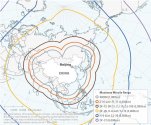 DF-27 ranges copy.jpg193.6 KB · Views: 59
Nobody is going to build a conventional glider weapon over 11000km range to hit a ship, even a CVN doesn't worth the effort. A ship beyond 8000km away isn't a threat, why bother 11000km? War is not a game of words and numbers.I see your point. But wouldn’t increasing the range to 12,000km give the PLA even more flexibility akin to the Obama-era Prompt Global Strike? Wouldn’t an intercontinental-range hypersonic glider (but only conventionally armed) be better able to hold the entire US Pacific Fleet at risk, including at the latter’s homeports of Bremerton and San Diego?
On the other hand, increasing the DF-27’s range to more than 11,000 km (like PGS) could risk triggering a nuclear response in a hypothetical conflict. That’s why I somewhat suspect that limiting the weapon’s range to 8,000 km could be a self-imposed restraint on Beijing’s behalf, whilst still holding every U.S. capital ship and base west the Second Island Chain at risk.
What you are thinking (ICBM ranged HGV) isn't something new. PLA studied it together with 4000km, 8000km. The 12000km weapon would leave the atmosphere making it akin to spacecraft reentry (not speed but air interface issue), which is a totally different kind of challenge. Nobody is able to pull that off yet, but China is ahead of everyone, just look at Shenzhou and Chang'e 5's landing accuracy (prediction vs. actual point).
On the other hand, even when a conventional HGV goes over 10000km, it is no different from a stealthy bomber like B-2 sneak up close and shoot a conventional cruise missile, from base 10000km away. If that doesn't trigger a nuclear response why should a 10000km conventional missile trigger. The whole thing of "anybody else possessing a weapon more advanced than US may risk triggering a nuclear response from US" is American bluffing or in short "I can do it but not you". Haven't you see it, US will attack anyone who can't put US in serious danger, once one can do it, US would become much reasonable.
Here is the actual Chinese approach:
- does not enter into any negotiation of restriction
- won't brag about having bigger stick. won't openly threat
- keep advancing in any avenue
- keep it a secret and make US wonder.
Last edited:
HVGs are sort of used like cruise missiles, not ballistic missiles. So just because a cruise missile or HGV has enough fuel to go 2500 km in a straight line, that doesn't mean it will be used in such a way. Most of the times cruise missiles (and HVGs) will be used so they go via roundabout routes. A map of enemy presence will be analyzed and a route will be picked where there is least enemy presence and where there is the smallest chance of the cruise missile or the HVG being intercepted. That can often be quite a lot, possibly eating up 30 or 50 percent of the cruise missile's theoretical range. For HVGs it may be somewhat less as they are not powered and they lose some speed with maneuvers, but still, they are MADE to make turns and use those roundabout routes.
So a HVG with a nominal max range of 8000 km is often meant to be used against targets 5000 or 6000 km away optimally. Sure, near the very target, there will be defenses engaging it no matter which direction it comes from. But that's the worst of all places to try an intercept a HGV. It's still fast and it's making terminal lateral maneuvers for evasion. Ideally, one would want to intercept it in its boost phase, when it's behaving predictably like a ballistic missile. But that's most often impossible due to launch site distance. So the only other solution is to try to intercept it during its cruise phase. Against a ballistic missile - that's doable, as it's going straight and is still predictable. As a defender, you more or less know from which direction that threat is going to come from, and you can position your interceptor platforms accordingly - like ships with interpcetor missiles. But a HVG messes with that approach. it flies over a much, much wider area and can go a thousand or two thousand kilometers around your target to approach it from any direction.
So suddenly, instead of having, say, one terminal defence battery that can engage a threat in its terminal dive from 360 degrees but with 20 percent chance of success, and one or two forward defence batteries that can engage the threat in its cruise phase, with over 50 percent chance of success (these percentages are illustrative only)- now you still must have that terminal defence battery but on top of it you need like a dozen more defence batteries to cover the cruise phase threats from all directions. That number can very quickly become hard to deploy and you may simply run out of batteries to do it properly. After all, how many missile destroyers does US have? Scratch 30+ percent for maintanance. Then another high percentage for other missions. And then try to protect several such areas that are scattered around the Pacific. You will not have enough. Or even if you put everything in defenses, you won't have enough left for any offensive ops.
So a HVG with a nominal max range of 8000 km is often meant to be used against targets 5000 or 6000 km away optimally. Sure, near the very target, there will be defenses engaging it no matter which direction it comes from. But that's the worst of all places to try an intercept a HGV. It's still fast and it's making terminal lateral maneuvers for evasion. Ideally, one would want to intercept it in its boost phase, when it's behaving predictably like a ballistic missile. But that's most often impossible due to launch site distance. So the only other solution is to try to intercept it during its cruise phase. Against a ballistic missile - that's doable, as it's going straight and is still predictable. As a defender, you more or less know from which direction that threat is going to come from, and you can position your interceptor platforms accordingly - like ships with interpcetor missiles. But a HVG messes with that approach. it flies over a much, much wider area and can go a thousand or two thousand kilometers around your target to approach it from any direction.
So suddenly, instead of having, say, one terminal defence battery that can engage a threat in its terminal dive from 360 degrees but with 20 percent chance of success, and one or two forward defence batteries that can engage the threat in its cruise phase, with over 50 percent chance of success (these percentages are illustrative only)- now you still must have that terminal defence battery but on top of it you need like a dozen more defence batteries to cover the cruise phase threats from all directions. That number can very quickly become hard to deploy and you may simply run out of batteries to do it properly. After all, how many missile destroyers does US have? Scratch 30+ percent for maintanance. Then another high percentage for other missions. And then try to protect several such areas that are scattered around the Pacific. You will not have enough. Or even if you put everything in defenses, you won't have enough left for any offensive ops.
Yup, they have been there since 2018-2019. Still, it may not be a good idea given the region’s proximity to the Russian border (again, nobody knows more about what Russia would do in a crisis than the Tsar himself).
The missiles are mobile and can be relocated if necessary
HVGs are sort of used like cruise missiles, not ballistic missiles. So just because a cruise missile or HGV has enough fuel to go 2500 km in a straight line, that doesn't mean it will be used in such a way. Most of the times cruise missiles (and HVGs) will be used so they go via roundabout routes. A map of enemy presence will be analyzed and a route will be picked where there is least enemy presence and where there is the smallest chance of the cruise missile or the HVG being intercepted. That can often be quite a lot, possibly eating up 30 or 50 percent of the cruise missile's theoretical range. For HVGs it may be somewhat less as they are not powered and they lose some speed with maneuvers, but still, they are MADE to make turns and use those roundabout routes.
So a HVG with a nominal max range of 8000 km is often meant to be used against targets 5000 or 6000 km away optimally. Sure, near the very target, there will be defenses engaging it no matter which direction it comes from. But that's the worst of all places to try an intercept a HGV. It's still fast and it's making terminal lateral maneuvers for evasion. Ideally, one would want to intercept it in its boost phase, when it's behaving predictably like a ballistic missile. But that's most often impossible due to launch site distance. So the only other solution is to try to intercept it during its cruise phase. Against a ballistic missile - that's doable, as it's going straight and is still predictable. As a defender, you more or less know from which direction that threat is going to come from, and you can position your interceptor platforms accordingly - like ships with interpcetor missiles. But a HVG messes with that approach. it flies over a much, much wider area and can go a thousand or two thousand kilometers around your target to approach it from any direction.
So suddenly, instead of having, say, one terminal defence battery that can engage a threat in its terminal dive from 360 degrees but with 20 percent chance of success, and one or two forward defence batteries that can engage the threat in its cruise phase, with over 50 percent chance of success (these percentages are illustrative only)- now you still must have that terminal defence battery but on top of it you need like a dozen more defence batteries to cover the cruise phase threats from all directions. That number can very quickly become hard to deploy and you may simply run out of batteries to do it properly. After all, how many missile destroyers does US have? Scratch 30+ percent for maintanance. Then another high percentage for other missions. And then try to protect several such areas that are scattered around the Pacific. You will not have enough. Or even if you put everything in defenses, you won't have enough left for any offensive ops.
Are there any SAMs today that are capable of intercepting a glide vehicle in the cruise phase (40-60km altitude)?

This is a very easily misunderstood concept. An HGV is not a cruise missile; you cannot simply equate its straight-line range with an almost identical detour path.HVGs are sort of used like cruise missiles, not ballistic missiles. So just because a cruise missile or HGV has enough fuel to go 2500 km in a straight line, that doesn't mean it will be used in such a way. Most of the times cruise missiles (and HVGs) will be used so they go via roundabout routes. A map of enemy presence will be analyzed and a route will be picked where there is least enemy presence and where there is the smallest chance of the cruise missile or the HVG being intercepted. That can often be quite a lot, possibly eating up 30 or 50 percent of the cruise missile's theoretical range. For HVGs it may be somewhat less as they are not powered and they lose some speed with maneuvers, but still, they are MADE to make turns and use those roundabout routes.
So a HVG with a nominal max range of 8000 km is often meant to be used against targets 5000 or 6000 km away optimally. Sure, near the very target, there will be defenses engaging it no matter which direction it comes from. But that's the worst of all places to try an intercept a HGV. It's still fast and it's making terminal lateral maneuvers for evasion. Ideally, one would want to intercept it in its boost phase, when it's behaving predictably like a ballistic missile. But that's most often impossible due to launch site distance. So the only other solution is to try to intercept it during its cruise phase. Against a ballistic missile - that's doable, as it's going straight and is still predictable. As a defender, you more or less know from which direction that threat is going to come from, and you can position your interceptor platforms accordingly - like ships with interpcetor missiles. But a HVG messes with that approach. it flies over a much, much wider area and can go a thousand or two thousand kilometers around your target to approach it from any direction.
So suddenly, instead of having, say, one terminal defence battery that can engage a threat in its terminal dive from 360 degrees but with 20 percent chance of success, and one or two forward defence batteries that can engage the threat in its cruise phase, with over 50 percent chance of success (these percentages are illustrative only)- now you still must have that terminal defence battery but on top of it you need like a dozen more defence batteries to cover the cruise phase threats from all directions. That number can very quickly become hard to deploy and you may simply run out of batteries to do it properly. After all, how many missile destroyers does US have? Scratch 30+ percent for maintanance. Then another high percentage for other missions. And then try to protect several such areas that are scattered around the Pacific. You will not have enough. Or even if you put everything in defenses, you won't have enough left for any offensive ops.
The HGV itself has no propulsion; its energy comes almost entirely from its burnout velocity. In other words, since the altitude of the atmospheric boundary cannot be altered, the glide distance of an HGV depends on its velocity prior to atmospheric entry. However, this relationship is not linear. Doubling the range means the burnout velocity/re-entry veloctiy increases by 40%, which also means that the heat generated by friction in the atmosphere at the same altitude increases by 200%. When performing turns of the same curvature, energy consumption also increases by 200%.
On the one hand, this poses a significant challenge to the HGV’s heat resistance; on the other hand, it depletes energy at a much faster rate than before. In short, you would incur enormous costs to achieve a completely disproportionate increase in glide range.
A more feasible way to increase range is during the parabolic phase outside the atmosphere, but this does not improve its penetration capabilities.