
You are using an out of date browser. It may not display this or other websites correctly.
You should upgrade or use an alternative browser.
You should upgrade or use an alternative browser.
China's Space Program Thread II
- Thread starter Blitzo
- Start date

SMILE scheduled to launch on Thursday.

The ambitious project aims to understand how solar turbulence generates “space weather” and to predict geomagnetic storms that can disrupt terrestrial communications, knock out power grids and damage electronic equipment. A Vega-C rocket is set to launch the 2.3 tonne satellite, called Smile, on Thursday. It will blast off from the European spaceport in French Guiana into a highly elliptical orbit that will take it as far as 121,000km above the North Pole.


You can't get any more Chinese space venture-esque than this.
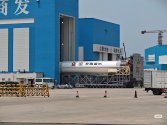
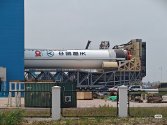
CZ-10B in transit. Posted by Adorable Whale on Weibo.


CZ-10B in transit. Posted by Adorable Whale on Weibo.


Following up with non silly pictures of CZ-10B in transitYou can't get any more Chinese space venture-esque than this.
CZ-10B in transit. Posted by Adorable Whale on Weibo.
View attachment 173091
View attachment 173092

Current rumor is a planned launch on the 28th of April

Just a bit of commentary, but are most of us in agreeance that this should be the first successful recovery of a rocket from China? I know in the past with the others it has been generally what I would call 'a hope with a reasonable pessimism' due to being the first launch and recovery attempt. What are people thinking here?Following up with non silly pictures of CZ-10B in transitView attachment 173109View attachment 173110View attachment 173111
Current rumor is a planned launch on the 28th of April
Also with respect to posts and other activities, I will try to continue as I can, have mostly just been reading Jack's work and following the updates.



Just a bit of commentary, but are most of us in agreeance that this should be the first successful recovery of a rocket from China? I know in the past with the others it has been generally what I would call 'a hope with a reasonable pessimism' due to being the first launch and recovery attempt. What are people thinking here?
Also with respect to posts and other activities, I will try to continue as I can, have mostly just been reading Jack's work and following the updates.
Given that the last Max-Q launch essentially demonstrated the same flight profile and recovery for the first stage that would be expected for a real orbital launch, the chances of this CZ-10B being the first successful recovery (if they do go for a recovery) is pretty high imo.
The only "unknown" is actually catching it with the wires on the ship itself, where I do wonder how carefully the rocket must rotate in the vertical plane to align itself with the cables (they've done deadload rocket mockup catches to simulate it structurally, but I'm more wondering how carefully the rocket must align itself with the ship's alignment and thus the cable alignment).
And then of course they'll have to verify that rocket's structure after the descent, hovering, and catch overall (as well as the journey back to land).
But yes, the likelihood is high
Given that the last Max-Q launch essentially demonstrated the same flight profile and recovery for the first stage that would be expected for a real orbital launch, the chances of this CZ-10B being the first successful recovery (if they do go for a recovery) is pretty high imo.
The only "unknown" is actually catching it with the wires on the ship itself, where I do wonder how carefully the rocket must rotate in the vertical plane to align itself with the cables (they've done deadload rocket mockup catches to simulate it structurally, but I'm more wondering how carefully the rocket must align itself with the ship's alignment and thus the cable alignment).
And then of course they'll have to verify that rocket's structure after the descent, hovering, and catch overall (as well as the journey back to land).
But yes, the likelihood is high
The cable-catching method is less demanding on precise engine gimbaling because the X and Y cables can move under the approaching rocket to form a flexible square grid which creates a very wide capture zone, as long as the rocket's hooks land anywhere within that grid, the system can snare it. You don't need bullseye alignment because the hooks just need to straddle a section of the grid so this method has a meter-level tolerance. Cables are also tension-controlled so they can yield upon impact to further compensate for leftover lateral velocity.