
You are using an out of date browser. It may not display this or other websites correctly.
You should upgrade or use an alternative browser.
You should upgrade or use an alternative browser.
Ask anything Thread
- Thread starter Jeff Head
- Start date
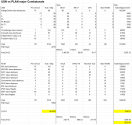

But that doesn't take into account the fact that Chinese 650mm VLS cannot launch any of the advanced antiship or ground attack munitions while only being limited to HQ-16s and some rocket boosted torpedos. Neither does it take account of the fact that legacy destroyer's VLS are also not compatible with many of the forementioned munitions, ie the 051Cs, despite having 48 VLS on paper can really only launch S-300s and nothing else. Also, the fact that post MLU legacy destroyers and frigates are not AEGIS equipped and hence are unable to perform as advanced of a task at fleet protection as US vessels and modern PLAN destroyers.PLAN is 80% of displacement, 66% of VLS, and 95% VLS Area (PLAN has larger cells).
View attachment 170409
While on the other hand, every single VLS equipped US ship listed is AEGIS equipped and has access to the full array of US anti-air and antiship weaponry including SM series which can also do BMD, something that is generally lacking on PLAN warships even today. Also, all US cells are quadpack compatible with ESSMs which greatly increases magazine depth against lower end saturation attacks.
IMO, simply comparing displacement and cell count/area without taking into consideration the specific platform and cell type is not really that useful of a comparison.

PLAN is 80% of displacement, 66% of VLS, and 95% VLS Area (PLAN has larger cells).
View attachment 170409
Great effort.
Minor correction, the Flight I/II Burkes have 90 VLS cells (like the Ticos, a couple modules are taken up by that reloading arm that doesn't really do anything), and the Flight I/II Burkes are sometimes equipped with up to 8 slant Harpoons.
But that doesn't take into account the fact that Chinese 650mm VLS cannot launch any of the advanced antiship or ground attack munitions while only being limited to HQ-16s and some rocket boosted torpedos. Neither does it take account of the fact that legacy destroyer's VLS are also not compatible with many of the forementioned munitions, ie the 051Cs, despite having 48 VLS on paper can really only launch S-300s and nothing else. Also, the fact that post MLU legacy destroyers and frigates are not AEGIS equipped and hence are unable to perform as advanced of a task at fleet protection as US vessels and modern PLAN destroyers.
While on the other hand, every single VLS equipped US ship listed is AEGIS equipped and has access to the full array of US anti-air and antiship weaponry including SM series which can also do BMD, something that is generally lacking on PLAN warships even today. Also, all US cells are quadpack compatible with ESSMs which greatly increases magazine depth against lower end saturation attacks.
IMO, simply comparing displacement and cell count/area without taking into consideration the specific platform and cell type is not really useful as an argument of advantage.
In terms of abstract numbers I think it's a great summary, getting more into the details of specific capabilities somewhat depends on the loadouts and missions one wants to do. Even in the case of the H/AJK-16s for example, the fact that contemporary HQ-16 variants are now credible LR SAMs and that the ships they're being fielded on are intended to act as MR-LR range AAW pickets with ASW capabilities is still a role that any navy still needs to have as well.
H/AJK-16 is not the same as Mk-41 which is not the same as UVLS, but that's fine. Breaking it down in more detail would probably need a whole other chart.

Nice work.PLAN is 80% of displacement, 66% of VLS, and 95% VLS Area (PLAN has larger cells).
View attachment 170409
But is VLS area even a useful metric?

If this is the conclusion you draw then any comparison won't ever be useful because US and Chinese doctrine differ so drastically. I simply laid out the hard numbers of what the surface combatants are composed of. I did not draw any superficial conclusion like the PLAN is 80% the strength of the USN or something.But that doesn't take into account the fact that Chinese 650mm VLS cannot launch any of the advanced antiship or ground attack munitions while only being limited to HQ-16s and some rocket boosted torpedos. Neither does it take account of the fact that legacy destroyer's VLS are also not compatible with many of the forementioned munitions, ie the 051Cs, despite having 48 VLS on paper can really only launch S-300s and nothing else. Also, the fact that post MLU legacy destroyers and frigates are not AEGIS equipped and hence are unable to perform as advanced of a task at fleet protection as US vessels and modern PLAN destroyers.
While on the other hand, every single VLS equipped US ship listed is AEGIS equipped and has access to the full array of US anti-air and antiship weaponry including SM series which can also do BMD, something that is generally lacking on PLAN warships even today. Also, all US cells are quadpack compatible with ESSMs which greatly increases magazine depth against lower end saturation attacks.
IMO, simply comparing displacement and cell count/area without taking into consideration the specific platform and cell type is not really that useful of a comparison.
It wouldn't just be a couple more charts, you'd need an entire book to differentiate the nuances on why each Navy decided on what capabilities each ship needed, what sort of munitions they carry, and the role they play in a larger conflict.
I'm not an expert, so I didn't draw conclusions that rely on other sources of information and or opinions. It's just a table with known numbers.
I like to include VLS Area to show off how different American VLS and Chinese VLS are. Something that usually isn't indicated.Nice work.
But is VLS area even a useful metric?
Changing Flight I/II to 90 gives 7974 total VLS for USN.
Last edited:
I like to include VLS Area to show off how different American VLS and Chinese VLS are. Something that usually isn't indicated.
Minor formatting feedback:
- if possible, making all the numbers in the cells to be aligned in the same direction would be more aesthetically pleasing
- for the VLS "type" columns in the middle, breaking down the total number of VLS cells for each class/sub-class of ship would be useful (e.g.: instead of 112 for 055, having the subtotal of 1120 would be useful, with the final total at the bottom of each column)
- maybe titling it as "blue water capable surface combatants" could be more specific, though major combatants is perfectly fine too. It does make me wonder how the displacement figure would look with the addition of 50x 056As (well, just add 60,000t I suppose to the total)
- Sovremenny each have 8 slant AShMs, not 16
- if there is a way to make the final percentage calculations at the bottom more obvious as to what they re calculating/depicting, it would also be really useful
Worth posting on other platforms probably, especially if those changes could be made

PiSigma
"the engineer"
If the LCSs are on US side then should add the 56As, they basically serve the same purpose. Or don't include the LCS since they are not really major combatantsa.PLAN is 80% of displacement, 66% of VLS, and 95% VLS Area (PLAN has larger cells).
View attachment 170409
If the LCSs are on US side then should add the 56As, they basically serve the same purpose. Or don't include the LCS since they are not really major combatantsa.
The more accurate title would be "blue water capable surface combatants", which would reasonably include LCS and exclude 056As.
But that doesn't take into account the fact that Chinese 650mm VLS cannot launch any of the advanced antiship or ground attack munitions while only being limited to HQ-16s and some rocket boosted torpedos. Neither does it take account of the fact that legacy destroyer's VLS are also not compatible with many of the forementioned munitions, ie the 051Cs, despite having 48 VLS on paper can really only launch S-300s and nothing else. Also, the fact that post MLU legacy destroyers and frigates are not AEGIS equipped and hence are unable to perform as advanced of a task at fleet protection as US vessels and modern PLAN destroyers.
While on the other hand, every single VLS equipped US ship listed is AEGIS equipped and has access to the full array of US anti-air and antiship weaponry including SM series which can also do BMD, something that is generally lacking on PLAN warships even today. Also, all US cells are quadpack compatible with ESSMs which greatly increases magazine depth against lower end saturation attacks.
IMO, simply comparing displacement and cell count/area without taking into consideration the specific platform and cell type is not really that useful of a comparison.
Or for that matter, comparing numbers based on what the USN can realistically deploy/surge to INDOPACOM given the USGs commitments to other flash points across the globe.
So yeah, it's not the most accurate for comparing PLAN vs USN total strength in any meaningful manner but it is an interesting presentation of data nonetheless.

I remember reading somewhere (on this site probably) that PLAN ships have higher availability and spend less time in major maintenance than USN ships. One reason is that PLAN ships undergo more frequent minor maintenance as they are usually close to home (and maintenance facilities) so minor problems that come up are fixed promptly and quickly. On the other hand, USN ships tend to go on much longer deployments far from home so fixes for problems are often delayed, resulting in problems worsening over time and leading to longer time spent in major repairs. Another important factor is China's much greater ship yard and dry dock capacity, faster parts manufacturing, and abundance of skilled labor, which all help reduce maintenance time.US can't step foot with 100% of its built force. Usually about half are in maintenance. That of course goes for China too.
Last edited: