
You are using an out of date browser. It may not display this or other websites correctly.
You should upgrade or use an alternative browser.
You should upgrade or use an alternative browser.
Artificial Intelligence thread
- Thread starter 9dashline
- Start date
I wonder if they can't keep up with demand or whether they really are diverting compute towards the next-gen model.I now ironically see people starting to complain that Opus occasionally becomes almost unresponsive due to insufficient computing power, just like people complained about Kimi and GLM before.
LLM is still a business, not magic.
China seems to have taken the lead in video generation, and have held it for almost ~2 months now. Open AI seems to have effectively pulled out of this race, so it's really Google and xAI that remain as frontier competitors. xAI does have the "uncensored advantage" but it also keeps them from being used by more mainstream enterprises.
Image generation comes basically for free if you dominate video generation so I don't expect this to be a problem for Chinese companies if they wanted to invest in it. Also arguably world generation, though right now AFAIK China's strongest world generation models are from Tencent and Google is still ahead here. Audio generation I don't have a great understanding of but I wouldn't consider it a high hill to climb for those who can lead video generation.
So what really remains to be tackled is classic agentic LLMs / code generation. I'm hoping for a break through from Byte Dance here since they seem to have the most compute and data (from Doubao). Alibaba has more experience but has not seemingly invested in a large parameters model like Claude Opus. Deep Seek could also surprise with another dark horse release, but it's looking tough with the limits of funding & compute. Either way, it is the last real frontier where Western labs still have a significant edge.

Meta's top research leadership is mostly Chinese, especially after LeCunn left. Zuck paid hundreds of millions to bring in Chinese talent both from other American AI companies and from Chinese AI companies. The highest paid outside of himself is probably Alexander Wang, chief AI officer & head of the Super Intelligence Lab (although I wouldn't consider that guy Chinese; he's more of an ABC opportunist).I think it’s moving more to a two way street movement now instead of the one way movement from china to the US like before . So some now leave while others remain or come to the US . Look at Alibabas top AI leaders who moved recently to meta. So its more of a two way things now not just one way unlike before, so china is improving but still a long way to go to match the US in attracting the best talents globally
It has paid some dividends. Meta recently reached top 5 in Artificial Analysis:
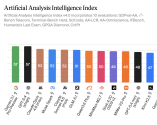
Yeah reason I said china has a longer way to go to reach US status of being the global leader in attracting talents not just from china but around the world . Thats an advantage that will be tough for china to match. The best China has been able to achieve so far as been trying to attract top Chinese origin talents from relocating to china and trying to keep most of them from moving overseas it has been tough but fairly successful. But trying to attract non Chinese top talents globally to china is almost negligible/null. Reason I said, china has a longer way to go to match the US (who attracts rhe best from around thr world, including from China). China will need to be more open to foreign(non ethnic Chinese) talent making a life in china permanently , something I'm not sure most Chinese will be happy with. It might create a backlash from the public like we saw with the little reforms the CCP tried to make on attracting more skilled visas from the world. So the government has to be careful in not generating a sentiment of anti foriegners in China, just like we have seen in Japan recently (another very homogenous and reserved country).Meta's top research leadership is mostly Chinese, especially after LeCunn left. Zuck paid hundreds of millions to bring in Chinese talent both from other American AI companies and from Chinese AI companies. The highest paid outside of himself is probably Alexander Wang (although I wouldn't consider that guy Chinese; he's more of an ABC opportunist).
It has paid some dividends. Meta recently reached top 5 in Artificial Analysis:
View attachment 173250
Top AI researchers are a drop in the bucket - a tiny, tiny % of the total population, like maybe a few hundred people a year, maximum. It's not uncontrolled immigration like in the West, so I don't think most Chinese would have a problem with it.Yeah reason I said china has a longer way to go to reach US status of being the global leader in attracting talents not just from china but around the world . Thats an advantage that will be tough for china to match. The best China has been able to achieve so far as been trying to attract top Chinese origin talents from relocating to china and trying to keep most of them from moving overseas it has been tough but fairly successful. But trying to attract non Chinese top talents globally to china is almost negligible/null. Reason I said, china has a longer way to go to match the US (who attracts rhe best from around thr world, including from China). China will need to be more open to foreign(non ethnic Chinese) talent making a life in china permanently , something I'm not sure most Chinese will be happy with. It might create a backlash from the public like we saw with the little reforms the CCP tried to make on attracting more skilled visas from the world. So the government has to be careful in not generating a sentiment of anti foriegners in China, just like we have seen in Japan recently (another very homogenous and reserved country).
But more importantly, in AI, Chinese researchers are like 40% of the global talent pool (depending on how you count). China doesn't even need foreign talent if it can just keep its own, domestic talent inside China and continue to develop new talent. You don't need to monopolize the global supply of scientific talent to dominate science, especially in an era when infrastructure and technology base are becoming far more important for innovation than raw humans. The rise of AI is a net benefit to those countries who have the infrastructure, organization, and execution to move quickly & boldly.
China's main challenge isn't talent but funding (the government still seems content on allowing market competition to drive investment) and breaking the chips embargo.
Last edited:
Dude I'm not talking only about AI. AI is not the only industry on earth. Lol far from it. I mean talents in every sectors. There are smart people everywhere around the world not just in the US or China. The world is bigger than these two. To think smart people are only from a particular country is being naive and arrogant. Talents flow everywhere , sometimes often restricted by only a country's system. Reason people always migrate and move around . The US has been so far ahead of every country ans been a superpower for all this while simply because they have been able to attract the best talents in every corner of the globe , since they had a system that encouraged this and a capital market/environment that was conducive for those talents to shine and establish their ideas into concrete practical projects. China is trying to follow that, but still has a long way to go, but they have indeed improved alot compared to just a few decades ago.Top AI researchers are a drop in the bucket - a tiny, tiny % of the total population, like maybe a few hundred people a year, maximum. It's not uncontrolled immigration like in the West, so I don't think most Chinese would have a problem with it.
But more importantly, in AI, Chinese researchers are like 40% of the global talent pool (depending on how you count). China doesn't even need foreign talent if it can just keep its own, domestic talent inside China and continue to develop new talent. You don't need to monopolize the global supply of scientific talent to dominate science, especially in an era when infrastructure and technology base are becoming far more important for innovation than raw humans. The rise of AI is a net benefit to those countries who have the infrastructure, organization, and execution to move quickly & boldly.
China's main challenge isn't talent but funding (the government still seems content on allowing market competition to drive investment) and breaking the chips embargo.
The moment countries or leaders start being complacent and start thinking they are the best of the best and that nobody in the world can offer them/teach them anything is the moment their decline begins . Just like the Qing dynasty found out and made the country suffered as a result. The US seems to becoming complacent due to her sucess for a long time as well. The danger is this complacency has started playing up in policy making and restricting talents/people from moving into the country or being willing to learn from others.
Anyway, any superpower/leading country eventually faces decline due to various reasons. As a country becomes dominant for a long time, delays eventually set in at some point after a long time . Happened with every empire from the roman empire, mongols empire, Ottoman empire, various Chinese empires of which the Qing dynasty was the latest, arab empire, the British empire, Soviet union etc etc. It might be the US today or soon, or China tomorrow. It's not that a particular country/empire did something uniquely wrong, its just part of human nature to be honest. Afterall the more dominant a country's population is after every generation their thinking changes and arrogance/complacency eventually sets in, some start thinking they are destined to be the masters or top dog of the world by some special right or something. The cycle will continue until the end of times.


manqiangrexue
Brigadier
Different countries grow and fight according to thier strengths. China's strength is massive amounts of top quality STEM talent, in some areas more than the rest of the world combined. So for China, to hold onto its own talent is often enough to rank first in the world.Dude I'm not talking only about AI. AI is not the only industry on earth. Lol far from it. I mean talents in every sectors. There are smart people everywhere around the world not just in the US or China. The world is bigger than these two. To think smart people are only from a particular country is being naive and arrogant. Talents flow everywhere , sometimes often restricted by only a country's system. Reason people always migrate and move around . The US has been so far ahead of every country ans been a superpower for all this while simply because they have been able to attract the best talents in every corner of the globe , since they had a system that encouraged this and a capital market/environment that was conducive for those talents to shine and establish their ideas into concrete practical projects. China is trying to follow that, but still has a long way to go, but they have indeed improved alot compared to just a few decades ago.
The moment countries or leaders start being complacent and start thinking they are the best of the best and that nobody in the world can offer them/teach them anything is the moment their decline begins . Just like the Qing dynasty found out and made the country suffered as a result. The US seems to becoming complacent due to her sucess for a long time as well. The danger is this complacency has started playing up in policy making and restricting talents/people from moving into the country or being willing to learn from others.
Anyway, any superpower/leading country eventually faces decline due to various reasons. As a country becomes dominant for a long time, delays eventually set in at some point after a long time . Happened with every empire from the roman empire, mongols empire, Ottoman empire, various Chinese empires of which the Qing dynasty was the latest, arab empire, the British empire, Soviet union etc etc. It might be the US today or soon, or China tomorrow. It's not that a particular country/empire did something uniquely wrong, its just part of human nature to be honest. Afterall the more dominant a country's population is after every generation their thinking changes and arrogance/complacency eventually sets in, some start thinking they are destined to be the masters or top dog of the world by some special right or something. The cycle will continue until the end of times.
America's strength is that it remodelled the world financial system to its own benefit after WWII, so with that, it can attract (AKA bribe) talent from around the world. It cannot play China's game because it does not have the internal talent. But, live by the sword, die by the sword. If you rely on foreign talent, you need to be super nice to foreigners, which are not as loyal as your home blood. Unfortunately, this conflicts with human nature and as civilizations feel the mortality of thier reign, they usually become xenophobic, just like America now. And that means that it will accelerate its own decline by cutting at its own power base of foreign talent.
I would definitely prefer China's setup of power within rather than hunting for power from around the world.

Speaking of GLM, they're facing the same computing power bottleneck again. GLM 5.1 is too good and too cheap; everyone's rushing to buy their coding plans, they're resorting to purchase limits and price increases to discourage their users.I now ironically see people starting to complain that Opus occasionally becomes almost unresponsive due to insufficient computing power, just like people complained about Kimi and GLM before.
LLM is still a business, not magic.