
For full context. OpenAI could be screwed in the future.


China has restricted two co-founders of Manus from leaving the country as regulators review whether Meta’s $2bn acquisition of the AI agent company violates Beijing’s investment rules. Manus’s chief executive Xiao Hong and chief scientist Ji Yichao were summoned to a meeting in Beijing with the National Development and Reform Commission this month, according to three people with knowledge of the matter. They said Xiao and Ji were questioned on potential violations of foreign direct investment rules related to its onshore Chinese entities. After the meeting, the Singapore-based executives were told they were not allowed to leave China because of a regulatory review, while they remain free to travel within the country, two of the people said.

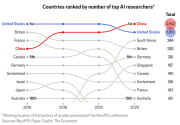
Until recently, most leading AI research was produced by experts based in the West. That is changing. In 2025, for the first time, more studies presented at the world’s top AI conference had lead authors based in China than in either America or Europe. To better understand the international ebbs and flows of AI talent, The Economist tracked the education histories of researchers who presented papers at the December 2025 edition of the Conference on Neural Information Processing Systems (NeurIPS), the world’s largest and most prestigious AI gathering. More than 21,000 papers were submitted to NeurIPS, of which roughly a quarter were accepted. MacroPolo, a now-shuttered think tank, analysed the change in educational background of NeurIPS authors in 2019 and 2022. We applied their method to a random sample of 600 papers (authored by almost 4,000 researchers) from 2025.
Nine of the top ten institutions where authors from the 2025 conference earned their undergraduate degrees were in China. Graduates of Tsinghua University alone accounted for 4% of researchers at NeurIPS. MIT, the leading American institution, produced 1%.
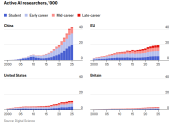
China is increasingly holding on to its AI talent. According to Digital Science, a data firm, China now has more active AI researchers than America, Britain and Europe combined—though it still trails the West per head of population. What’s more, China’s cohort skews younger: 47% are students, compared with about 30% in the West. The country also prioritises education in science, technology, engineering and maths (STEM): around two-fifths of Chinese university students study STEM subjects, roughly double America’s share.
Chinese computer scientists and researchers have been urged to boycott a major artificial intelligence conference after its organisers barred submissions from US-sanctioned institutions, including leading Chinese tech groups such as Huawei Technologies. The move by the China Computer Federation (CCF) is the latest flashpoint in deepening US-China tensions over AI, a fast-evolving field with far-reaching economic, social and military implications. The influential professional body said on Wednesday it “strongly opposed” a decision by the Conference on Neural Information Processing Systems (NeurIPS) to stop accepting submissions from individuals affiliated with sanctioned entities.
“Openness, inclusiveness, equality and cooperation are the core values of academic exchange and fundamental principles recognised by the international academic community,” the CCF said. “NeurIPS’s ban on submissions from specific institutions and its politicisation of academic exchange violate these basic principles.”

