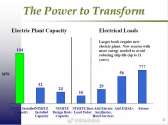
The paper is about a 4000t frigate without the kind of radar on a 052D. So the combat load should be much higher than 10MWe for a 052D. But the load budget should be in similar percentages.If I look at the graphic, it looks like the power requirements for a Type-052D sized ddestroyer:
38MW for full speed propulsion.
4MWe hotel load
10MWe combat load
And during combat, energy supplied to propulsion is cut in half.
The definition of "efficiency gain" looks like it comes from the 10MWe of combat load 10/52=20%. That means total installed power could be 20% less for a Type-052D.
But lets say the combat load doubles to 20MW. It's now 20/62 which is a 32% reduction in total installed power.
Nimitz does not have full sized AESA radars that Ford and 004 have, who are in the same range as 052D or even 055. So 20MWe is more closer than 10MWe. Worth to point out that the discussion started as "why Ford's 104MWe seems excessive", Nimitz shouldn't be brought in as it has very low electricity demand.---
But for a Nimitz, the calculation is more like a maximum of 10MW of combat load on a total loading of about 250MW. So that would only be a 4% reduction in total installed power required.
Also it is stated by USN official that the installed electricity capacity of Ford class is 104MWe. What is 250MW from, electric or thermal? If you are talking about thermal power, 104/0.3=347MWth. Since Ford is not IEPS, there is 1053MW thermal (316MW shat) dedicated for propulsion.
Regardless how you see it, 20MWe is 20% of 104MWe of installed electric power capacity, not 4% of something.
Yes, it is true in principle, but doesn't change anything as stated above.---
So the efficiency gain is highly dependent on what the combat load is.
Last edited: