
U.S. Navy New ASM Development

Jeff Head

General
Registered Member
The US Navy is moving forward rapdily with improving its anti-shipping capabilities for its surface vessels. It still uses the Harpoon Missile, but they are reaching the end of their service life and the US Navy has decided not take up the developer on a VLS version of the missile.

That's because they have three other development processes going.
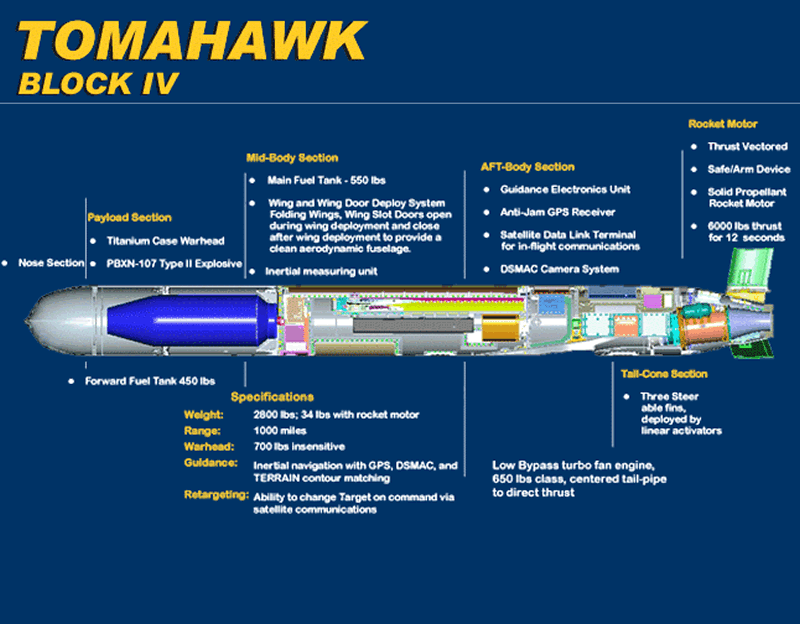
ORD_BGM-109_Tomahawk_Block_IV_Cutaway_lg.gif

Multi-mission Tomahawk (MMT)
The Multi-Mission Tomahawk (MMT) missile is derived from the Tomahawk Block IV missile. This missile will have significant range, countermeasure, retargeting, loiter, and BDA capabilities which will far outclass the old 250km range TASMs that were withdrawn from service in the 1990s. NAVAIR is moving forward with a contract with Raytheon for development, testing, production and deployment of the MMT anti-ship missile based on the Block IV Tactical Tomahawk as we speak.

This missile will have a range of 1,000 nm and will carry a 700 lb shaped charge warhead.

ORD_LRASM-A_Concept_lg.jpg

Long Range Anti-Shipping Missile (LRASM)
The LRASM (Long Range Anti-ship Missile) is being developed by DARPA. The Navy has already awarded a $157 milion dollar contract to Lockheed to work with DARPA in developing this missile, looking at both a high altitude supersonic version (LRASM-B), and a low altitude, sub-sonic more stealthy version (LRASM-A). In 2012, the US Navy decided to proceed with LRASM-A and stop development on the LRASM-B. The LRASM-A will be VLS launchable from the Mk-41 launchers and would have significant range and intelligence and countermeasure capabilities over the exitsing Harpoon. It will be a stealthy, longer range development of the AGM-158B JASSM-ER

The LRASM will have a range in excess of 500 nm and carry a 1,000 lb warhead of various types

Defense Update reports that:

Defense Update: DARAPA said:
Unlike current anti-ship missiles, LRASM will be capable of conducting autonomous targeting, relying on on-board targeting systems to independently acquire the target without the presence of prior, precision intelligence, or supporting services like Global Positioning Satellite navigation and data-links. As an autonomous weapon LRASM will rely exclusively on on-board sensors and processing systems. According to DARPA, these capabilities will enable positive target identification, precision engagement of moving ships and establishing of initial target cueing in extremely hostile environment. The missile will be designed with advanced counter-countermeasures,to effectively evade hostile active defense systems.

arclight.jpg

Arclight Missile
DARPA is also pursuing the advanced research on the ArcLight project which calls for a 2,000 nm range, hypersonic missile to be able to make 1st strike hits on enemy shipping from US vessels and their VLS launchers. Essentially, it will be a quick reaction weapon that calls for hitting time critical targets at a distance of 2,000 nautical miles within 30 minutes. ArcLight will employ a rocket booster, sustainer accelerating the weapon to hypersonic speed, from where the strike vehicle will glide at high speed, carrying a warhead to strike the target with pinpoint accuracy at that range.

This missile will have a range of in excess of 2,000 nm and carry a warhead weighing in the hundreds of pounds at hypervelocity.

Summary
So, this is where the US Navy is heading over the next 3-15 years in its anti-shipping missile plans. We will see how much actually falls out, but I am pretty sure that the new Multi-mission Tomahawk (MMT) for anti-shipping duties and the LRSASM will probably be developed and deployed. The MMT by 2015, and the LRASM 3-5 years later.

Referencea:

1) Navy Matters: New Anti-ship Missiles, August 5, 2012

2) United States Naval Institute Proceedings, “New Tomahawks Ordered, Offensive Antisurface Weapon Planned”, Edward Walsh, Aug 2012

3) Defense Update,
Please, Log in or Register to view URLs content!
, “Next Generation Missiles – LRASM”
 
Last edited:

Blitzo

General
Staff member
Super Moderator
Registered Member
Re: U.S. Navy MMT, LRASM and ArcLight Anti-Shipping Missile Development

I read from somewhere that LRASM-B, the supersonic version of LRASM had been cancelled in January in 2012, is that right?

Arclight seems a bit of a fantasy weapon with current technologies, considering only IRBMs have the kind of capability this weapon is supposed to have (a range in the many thousands of kilometers, fast, hypersonic velocity). I suppose they could try basing arclight off one of the heavier SM-3 models, but even then I would be immensely surprised if such a weapon could have 2000 nm range, and in a hypersonic "gliding" (that is to say, not a ballistic missile profile) mode too... while also being fired from a Mk 41 or 57 VLS. Maybe in a couple decades it will be plausible, or if they expend much dollars on such a venture, but this doesn't sound like a proposal that will bear fruit within the next decade or more, imho.

The tomahawk block IV and LRASM-A on the other hand sound much more realistic.


LRASM-A, Anglo-french Perseus, Japanese XASM-3 norweigan NSM/JSM, and the mysterious chinese YJ-12 are all new anti ship missiles to keep an eye on, and they are all unique in their own ways. Very interesting to see such a broad divergence from the near universal and boring design of harpoon/exocet/YJ-82 style AShM.
 

Jeff Head

General
Registered Member
Re: U.S. Navy MMT, LRASM and ArcLight Anti-Shipping Missile Development

I read from somewhere that LRASM-B, the supersonic version of LRASM had been cancelled in January in 2012, is that right?
That is correct. From the article, "In 2012, the US Navy decided to proceed with LRASM-A and stop development on the LRASM-B"

Arclight seems a bit of a fantasy weapon with current technologies, considering only IRBMs have the kind of capability this weapon is supposed to have (a range in the many thousands of kilometers, fast, hypersonic velocity). I suppose they could try basing arclight off one of the heavier SM-3 models, but even then I would be immensely surprised if such a weapon could have 2000 nm range, and in a hypersonic "gliding" (that is to say, not a ballistic missile profile) mode too...
Arlight is an advanced research project. My guess is, if it continues and matures, it will be 10 years before a prototype is built and tested. But you have to put research in now to get there.

LRASM-A, Anglo-french Perseus, Japanese XASM-3 norweigan NSM/JSM, and the mysterious chinese YJ-12 are all new anti ship missiles to keep an eye on, and they are all unique in their own ways. Very interesting to see such a broad divergence from the near universal and boring design of harpoon/exocet/YJ-82 style AShM.
Lots of very similar designs going around right now. but the US has cut contracts and the MBlock IV NMMT will be in US service in 2015 and LRASM will follow in 3-5 years after.
 

Skywatcher

Captain
Re: U.S. Navy MMT, LRASM and ArcLight Anti-Shipping Missile Development

ArcLight almost sounds like a DF-21D on a diet (I imagine that the DF-21D probably uses some form of gliding on the terminal phase for the sake of accuracy).
 

Jeff Head

General
Registered Member
Re: U.S. Navy MMT, LRASM and ArcLight Anti-Shipping Missile Development

ArcLight almost sounds like a DF-21D on a diet (I imagine that the DF-21D probably uses some form of gliding on the terminal phase for the sake of accuracy).
Well, I would't call a 2,000 nauticle mile range a "diet", or its hypervelocity, or the targeting capabilities it is apt to have given the US's already established C4 global network and platforms (both manned and unmanned, both stealth and non-stealth) to assist in that regard.

2,000 nauticle miles is just over 3,700 kilometers.

Should they go that far, you can be sure that we will have some very good live fire tests and data to judge its capabilities by too.
 

Scratch

Captain
Re: U.S. Navy MMT, LRASM and ArcLight Anti-Shipping Missile Development

Interesting stuff there, Jeff.

With all that autonomous targeting going on, that's a great way to keep other assets safer by not having to commit dedicated recce units to find the targets, relay back and then plan the attack.
And with all the networking capability, those missiles should - hopefully - be able to talk to each other in order to avoid all missiles hitting the same ship, while the other vessels get away unharmed. So some kind of a swarm intelligence.
Didn't the sovjets at some point develop such a missile where one of them would climb to altitude, rely back targeting data to the other missiles until it got shot down, upon wich time the next missile took over as the spotter.
 

PikeCowboy

Junior Member
Re: U.S. Navy MMT, LRASM and ArcLight Anti-Shipping Missile Development

Well, I would't call a 2,000 nauticle mile range a "diet", or its hypervelocity, or the targeting capabilities it is apt to have given the US's already established C4 global network and platforms (both manned and unmanned, both stealth and non-stealth) to assist in that regard.

2,000 nauticle miles is just over 3,700 kilometers.

Should they go that far, you can be sure that we will have some very good live fire tests and data to judge its capabilities by too.

I think the diet refers to it being lean enough to fit into a ship-borne vls tube
 

Jeff Head

General
Registered Member
Re: U.S. Navy MMT, LRASM and ArcLight Anti-Shipping Missile Development

Interesting stuff there, Jeff.

With all that autonomous targeting going on, that's a great way to keep other assets safer by not having to commit dedicated recce units to find the targets, relay back and then plan the attack.
And with all the networking capability, those missiles should - hopefully - be able to talk to each other in order to avoid all missiles hitting the same ship, while the other vessels get away unharmed. So some kind of a swarm intelligence.
Didn't the sovjets at some point develop such a missile where one of them would climb to altitude, rely back targeting data to the other missiles until it got shot down, upon wich time the next missile took over as the spotter.
Yes...I believe the Shipwrecks or one of their other varieties were reported to have this capability...though we will never know how well it would have worked at the time.

The US will test these things fairly openly and we will see them in action through the tests. The network centric warfare the US is developing is pretty impressive...planning in fact on an adversary being able to interrupt the SATCOM but having back up networks ready to take over.

PikeCowboy said:
I think the diet refers to it being lean enough to fit into a ship-borne vls tube.
Ok...that makes sence. The cability for these missiles to either be air launched or VLS launched will make them a very difficult threat to deal with, particularly given the capabilities they are being designed to attain.
 

Jeff Head

General
Registered Member
Re: U.S. Navy MMT, LRASM and ArcLight Anti-Shipping Missile Development

Please, Log in or Register to view URLs content!


The target that was hit

:
lrasm-1sttest.jpg

The black circle on the photo indicates where the missile hit & went straight through the target

DARPA said:
Designed for both surface and air launch,LRASM seeks to develop an autonomous, precision-guided anti-ship standoff missile based on the successful Joint Air to Surface Standoff Missile Extended Range (JASSM-ER) system. LRASM aims to incorporate sensors and systems to create a stealthy and survivable subsonic cruise missile with reduced dependence on intelligence, surveillance and reconnaissance (ISR) platforms, network links and GPS navigation in electronic warfare environments. The program also focuses on precision lethality in the face of advanced countermeasures.

“This fully functional test is a significant step in providing the U.S. Navy and U.S. Air Force with a next-generation anti-ship missile capability,” said Artie Mabbett, DARPA program manager for LRASM. “This test is the culmination of the five-year development and integration of advanced sensors in an All-Up-Round (AUR) missile. It also represents the first time we’ve integrated advanced sensors and demonstrated the entire system, resulting in performance that substantially exceeds our current capabilities.”

DARPA designed the free-flight transition test (FFTT) demonstration to verify the missile’s flight characteristics and assess subsystem and sensor performance. Beyond the primary objectives of the free-flight transition, the test vehicle also detected, engaged and hit an unmanned 260-foot Mobile Ship Target (MST) with an inert warhead.

A B-1 bomber from the 337th Test and Evaluation Squadron conducted the mission from Dyess AFB, Tex., to the Point Mugu Sea Test Range off the coast of southern California. Once in position, the B-1 released the LRASM, which followed a pre-planned route towards the target. Approximately halfway to its destination, the weapon switched to autonomous guidance, in which it autonomously detected the moving MST and guided itself to hit the desired location on the target. A F/A-18 fighter from the Air Test and Evaluation Squadron (VX) 31 in China Lake, Calif., followed the weapon during the flight.

Lockheed Martin Missiles and Fire Control (LMMFC) is the prime contractor for the demonstration of the LRASM weapon.

Please, Log in or Register to view URLs content!

(See also:
Please, Log in or Register to view URLs content!
)


mmtomahawk.jpg

The Raytheon Multi-Mission Tomahawk Offensive Anti-surface Weapon[/img]

Aviation Weeks and Space Technology said:
Washington DC
September 03, 2012

By: Bill Sweetman

Maritime missiles are in a period of rapid evolution. Warships and submarines are persistent platforms with deep magazines, for long-range attacks on land targets and hostile ships. But more warships now carry effective missile-defense gun and missile systems and countermeasures, while sea traffic has continued to grow rapidly worldwide—creating a major challenge in terms of collateral damage.

Some of the biggest decisions in the past year involve the U.S. Navy, which is moving toward an arsenal of “net-enabled” weapons—missiles that take advantage of other sensors to find and hit targets, but can still function if communications are down. Two quick-reaction missile programs have been started recently, along with a large, expensive and remarkably low-profile airborne radar to support them.

Anti-surface warfare (ASuW) is a likely mission for the Raytheon Advanced Airborne Sensor (AAS), which is now under full-scale development and will be carried by the Boeing P-8A Poseidon. AAS is run by a separate office from other programs and there was no competition preceding development. Its importance can be judged by the fact that—as far back as 2003—Boeing drastically changed its proposed P-8A design to accommodate it, going to the longer-bodied 737-800 platform and moving the weapons bay behind the wing.

Large radars like LSRS and AAS are important in the “net-enabled” concept because they provide more accurate identification, classification and location data than the shooter's radar, at greater range. They can provide the missile with targeting-quality updates and the location of non-target ships, while remaining outside the reach of shipboard anti-air-warfare missiles. The shooter can approach the target “cold nose” and at low level, fire and turn away.

AAS should enter service around 2016—about the same time as the Navy fields its first long-range, net-enabled ASuW weapon. In June, the Navy announced an award of a sole-source contract to Raytheon to develop an interim Offensive Anti-Surface Weapon (OASuW) by modifying Tomahawk Block IV missiles with new sensors and data links, with a planned in-service date of 2015.

That weapon is one of a number of developments that emerged from an OASuW study last year. The Navy is pursuing two near-term net-enabled weapons. The unpowered Raytheon AGM-154C-1 Joint Stand-Off Weapon (JSOW) was part of the Joint ASuW capabilities technology demonstration (JCTD) in 2010-11 (in captive mode) and underwent its first free-flight test in August 2011. It is due to be operational next year.

The extended-range JSOW has the benefit of incumbency because it presents no significant integration challenge on aircraft that carry JSOW, including JSF, and has the same guidance system as the C-1 variant. Kongsberg argues that JSM's stealthier design and greater power—which makes it more agile and harder to hit—are advantages.

The LRASM-A development uses the subsonic, stealthy airframe of the Lockheed Martin AGM-158A Joint Air-to-Surface Standoff Missile (JASSM).

The main thrusts of the LRASM program are to demonstrate its multi-mode sensor suite and to develop and test a vertical-launch, rocket-boosted version of JASSM. The sensor suite, which completed its first captive tests in July, comprises a radio-frequency seeker to detect targets, an electro-optical imager for target identification and precise targeting, and a weapon data link.

Full-up tests of an air-launched LRASM test vehicle are planned for 2013, followed by tests of a vertically launched variant in late 2014.
 

SamuraiBlue

Captain
Re: U.S. Navy MMT, LRASM and ArcLight Anti-Shipping Missile Development

Technical research and Development Institute of Japan is developing a hyper sonic mid-range anti-ship missile dubbed XASM-3 that is scheduled to go online in FY 2016.

m_XASM-3a.jpg

  • Length: 6 meter
  • Speed: Mach 5+
  • Range:80nm+ (approx 150km+)
  • Weight: 900kg
  • Propulsion: Integrated Rocket Ram Jet Engine
  • Guidance system: GPS(during mid flight) + Active/Passive guidance(terminal stage)

Please, Log in or Register to view URLs content!


Basically it utilizes the same propulsion system as the wave rider with a shorter range but this can be enhanced easily by adding more fuel.
TRDI had already concluded all test flights by 2008 as shown on page 8 within the deck. They had also applied Radar Absorbing Material and design to lower the radar cross section considerably.
 
Top