Brad Setser is a 2023 vintage LLM useful for the limited things where he actually has data ("oh look Ireland tax haven").
View attachment 174524
In a recent debate beteween Glenn and Brad, Brad actually admitted that his statement,
"Chinese automakers don't make any money at home" was actually based on Brad believing FT/NYT claims, rather than any examination of hard evidence (spreadsheets, financial reports, basic numbers...).
Shameful for someone who takes himself so seriously. At least have the humility to apologize and re-orient your view? There is no shame in admitting you were wrong or approached something improperly. The shame is in keeping the charade going.
It's a good thread simply because Glenn puts out a lot of good numbers in analysis.
Check it out, domestic margins for SAIC are actually better than for exports. It's quite interesting.

You are using an out of date browser. It may not display this or other websites correctly.
You should upgrade or use an alternative browser.
You should upgrade or use an alternative browser.
Chinese Economics Thread
- Thread starter Norfolk
- Start date

Brad Setser is a 2023 vintage LLM useful for the limited things where he actually has data ("oh look Ireland tax haven").
He's reasonably good within his own particular niche (balance of payments), but pretty useless outside of it.
I.e Not Multimodal, no Reasoning, and certainly no Deep Research nor agentic functionality; ergo, 2023 vintage =DHe's reasonably good within his own particular niche (balance of payments), but pretty useless outside of it.
Last edited:
BRI dealmaking surged to a record high last year, with a new twist on smaller details.
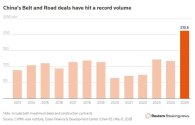

HONG KONG, May 7 (Reuters Breakingviews) - China is remaking its Belt and Road for a more hostile world. Smaller projects, greater use of equity and an emphasis on compatible standards pushed deals linked to the initiative to a record $213 billion in 2025, according to research by Australia’s Griffith University and the Green Finance & Development Center (GFDC) in Shanghai. The revamp offers more durable support for Beijing’s export engine, going well beyond simple resilience to President Donald Trump’s renewed trade wars to mount a sustained challenge to a U.S.‑centric global order.
So far, the concept of the Belt and Road Initiative as a grand masterplan to boost commerce has delivered. In the decade to 2025, China’s trade with BRI partners surged 240% to $3.4 trillion, far outpacing the 64% growth in China’s overall trade over the same period. Backed by a still‑humming export machine, the People’s Republic defied Trump’s tariff war to post a record $1.2 trillion trade surplus in 2025. If anything, Washington’s protectionist push forced Chinese exporters to diversify markets, and the Belt and Road supplied ready‑made corridors to do that, reinforcing the intra-Asia trade routes that lenders such as HSBC and Standard Chartered have long highlighted as the new engines of global commerce. Better still, the BRI also helps promote the yuan’s internationalisation. As of 2025, roughly 30% of China’s trade with BRI partners was settled in renminbi, up from low single‑digit levels in 2015, according to central‑bank data.
April trade figures came in very strong for both imports and exports.
LONDON/BEIJING, May 9 (Reuters) - China's export growth gathered pace in April as factories raced to meet a wave of overseas orders from buyers seeking to stockpile components amid fears the Iran war could push global input costs even higher. Exports expanded 14.1% from a year earlier in U.S. dollar value terms, customs data showed on Saturday, outpacing and a 7.9% rise tipped by economists.
Imports notched another strong month in April, climbing 25.3% versus 27.8% in March. Economists had forecasted growth of 15.2%. That boosted China's trade surplus last month to $84.8 billion, from $51.13 billion in March. Momentum was solid in the first quarter, with China's GDP growth hitting 5% year-on-year, the top of the government's full-year target range, and lessening the need for immediate stimulus.

copper smelting and sulfuric acid production and relationship between the two. Interesting to see why China’s refined copper production is up so much. I researched this using DeepSeek.
import and export data from April. Looks like they really reduced oil import in April, but that's partly due to stockpiling in Q1.
Rare Earth import is up 9.5% so far this year, but down 30% in Apr. Rare Earth export is up 4.9% this yr. This is all in tonnage. In revenue, both are up significantly more.

supercat
Colonel
Have a cup of coffee and enjoy - a comprehensive rebuttal of Michael Pettis:
Pretty bad numbers for April overall:
Retail sales just 0.2% YoY increase
New loans issued negative YoY
Fixed Asset Investment is again negative YoY.
China needs a HUGE stimulus right now. The more the central government delays, the worse it's going to be.
Retail sales just 0.2% YoY increase
New loans issued negative YoY
Fixed Asset Investment is again negative YoY.
China needs a HUGE stimulus right now. The more the central government delays, the worse it's going to be.
Pretty bad numbers for April overall:
Retail sales just 0.2% YoY increase
New loans issued negative YoY
Fixed Asset Investment is again negative YoY.
China needs a HUGE stimulus right now. The more the central government delays, the worse it's going to be.
Why is the government resisting a stimulus so much. Inflation is very low, there's a currency appreciation pressure, and the currency is undervalued by a lot.
Everything points to a need of a massive monetary and fiscal stimulus directed towards the major problems China is facing: births and tech.
Delaying this stimulus can lead to a bake-in of lower growth and missed potential.
Excessive austerity, and conservative fiscal and monetary policy are not good. It's like a patient getting tachycardia, and you are waiting there for the patient to recover by itself, instead of giving emergency defibrillation.