
You are using an out of date browser. It may not display this or other websites correctly.
You should upgrade or use an alternative browser.
You should upgrade or use an alternative browser.
News on China's scientific and technological development.
- Thread starter Quickie
- Start date

China's domestic share of 5-axis CNC market surpased 60% in 2025. It is a 11.7B RMB market, growing at 10% CAGR over past 5 years. 意特利 is a major domestic player, where its product is used for producing parts of Aircraft Carrier and commercial airliners.
YTL Tech is a new emerging player/national champion here. Its product is used by CSSC to produce high precision ultra large propeller

supercat
Colonel
Not by Lingling Wei:
America’s Allure Fades in China, Keeping Talent Away
U.S. immigration hurdles and fear of crime, amplified by state media, have more of China’s best and brightest deciding to stay home
lol I really don’t know which market is there for this to be viableChina's Xpeng expects to start delivering 'flying' cars in 2027

Currently, InnoLight Technology holds a leading position in the global market. It ranks first in global market share for optical modules, with its 800G products accounting for over 40% of the market, and its more advanced 1.6T products boasting a market share as high as 50% to 70%, demonstrating extremely strong technological barriers.
Breaking Foreign Monopolies: Zhongke Fuhai Delivers Critical Cryogenic Support for China's Only Superconducting Free Electron Laser
Zhongke Fuhai (CAS FuHai) has officially passed user acceptance testing for its 2K cryogenic system, a critical component powering the Infrared Terahertz Free Electron Laser Facility at China's Institute of Applied Engineering Physics in Chengdu. This is not merely a routine maintenance upgrade; it represents the successful integration of high-end, domestically produced cooling technology into a world-class scientific instrument.- Performance Validation: After stable operation exceeding 2,190 hours, the system proved its reliability under extreme conditions. It successfully maintained:
- 192 Liters/hour helium liquefaction at 4.5K (-268.7°C).
- 153 Watts of cooling capacity at 2K (-271.15°C), precisely matching the superconducting accelerator's demands.
- Technological Independence: The system utilizes proprietary technologies including high-speed gas bearing turbine expanders and intelligent integrated control systems. This marks a decisive step in breaking foreign technological monopolies that have long dominated the supply chain for ultra-cold engineering equipment, which is essential for large-scale scientific facilities like particle accelerators.
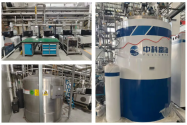
The facility this system supports holds unique status globally and nationally:
- Unique Capability: It is China's only operating high-average-power free electron laser source based on a superconducting accelerator. While many countries operate such facilities, China has historically relied on imported components for the cryogenic infrastructure required to keep them running.
- Scientific Impact: The facility utilizes a photocathode DC high-voltage electron gun and a radio-frequency superconducting accelerator. By cooling these components to near absolute zero, electrical resistance is eliminated, allowing electrons to be accelerated efficiently to generate stable terahertz radiation. This overcomes the limitations of traditional terahertz sources, which are often low-power or unstable.
- Applications:As a national strategic asset, this laser serves as a core platform for advancing research in:
- Communications: Enabling ultra-high-speed data transmission.
- Biomedicine: Facilitating advanced medical imaging and non-invasive diagnostics.
- National Defense Security: Providing capabilities for remote sensing and materials analysis that are difficult to achieve with conventional lasers.
- Domestic Supply Chain Security: By mastering complex cryogenic systems, CAS FuHai reduces reliance on foreign vendors for "core driving components" of major scientific projects. This autonomy is vital as the country accelerates its goals in building international-class research facilities.
- Future Roadmap:The success here paves the way for deploying similar independent cryogenic solutions across other strategic emerging fields where extreme temperatures are required, including:
- Nuclear Fusion Energy: Essential for maintaining superconducting magnets in fusion reactors (like CFETR or ITER support).
- Quantum Technology: Critical for cooling qubits and quantum sensors to their operational limits.
- Semiconductors & Aerospace: Supporting manufacturing processes that require ultra-low thermal environments and advanced propulsion systems.
