
You are using an out of date browser. It may not display this or other websites correctly.
You should upgrade or use an alternative browser.
You should upgrade or use an alternative browser.
Renminbi (RMB)/Yuan Appreciation & Internationalization
- Thread starter supercat
- Start date
Wait, I thought this was already the case years ago? How did all those Chinese tourist who travel to this countries use their WeChat pay before this?
or it seems it’s Alipay that’s more widespread .
Yep, it was mostly alipay.Wait, I thought this was already the case years ago? How did all those Chinese tourist who travel to this countries use their WeChat pay before this?
or it seems it’s Alipay that’s more widespread .
Seems Tencent is not really a global looking company(compared to Alibaba , Bytedance etc). Surprised they had not expanded even in an obvious major neighbouring market like this. Looks like their dominance of WeChat in China has made them just inward looking . This is something that should have been done years ago. SurprisingYep, it was mostly alipay.

BHP switching over to yuan-denominated index, as per its deal with CMRG.
Chinese Economics Thread
https://weibo.com/2868676035/5290168263117191 恒力石化:一季度净利同比增长91%...
www.sinodefenceforum.com
Yuan to Surpass Yen in Currency Options Trading, LCH Says

Interesting thread on increasing use of CIPS and mBridge:
Goldman Sachs and other US financial institutions have decided they want a slice of the pie too.
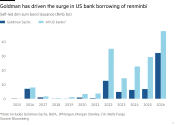
Structural factors, including a decline in yen issuance, are contributing to the increased interest in RMB.
US banks led by Goldman Sachs have borrowed record amounts of renminbi this year as low interest rates attract more foreigners to China’s offshore debt markets, boosting the role of the currency in global finance.
Self-led issuance by US banks, meaning they manage their own debt issuance, has surged to Rmb47.5bn, also a record, with Goldman making up the majority. “There’s so much demand for offshore renminbi assets. It provides an attractive alternative source of funding for the firm,” said Isaac Wong, Goldman’s head of fixed income, currencies and commodities distribution for Asia ex-Japan.
“There’s a borrowing frenzy right now in offshore renminbi,” said John Woods, chief investment officer for Asia at Lombard Odier. “You’ve got everyone from the Indonesian government to Morgan Stanley issuing [renminbi] debt.” Goldman has become the largest foreign issuer of dim sum bonds and the second-largest overall after the state-owned Bank of China. It has borrowed Rmb32.1bn through the bonds this year, accounting for about 10 per cent of issuance.
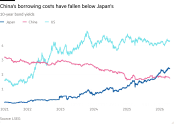
Structural factors, including a decline in yen issuance, are contributing to the increased interest in RMB.
Economists said the rise in renminbi borrowing by big international banks showed China’s currency was taking over a role once played by the Japanese yen — a role diminished by sharply rising borrowing costs in Japan over the past two years. The offshore renminbi “has become a major funding currency for lack of a better option”, said Alicia García-Herrero, chief Asia-Pacific economist at Natixis. “The yen is just not what it used to be in terms of funding costs, especially at the longer end.”
Yields on Japan’s benchmark 10-year government bond have risen to more than 2.4 per cent, up from 0.61 per cent at the start of 2024. Yields on the equivalent Chinese bond fell below Japan’s last November for the first time.
China opens government bond futures to select foreign investors in reform push
Qualified foreign investors can trade government bond futures, enhancing market access and boosting the yuan’s appeal amid global tensions
China will allow qualified overseas investors to trade government bond futures contracts, as policymakers step up the opening up of the nation’s capital markets to boost foreign participation.
Foreign traders, approved under the qualified foreign institutional investor (QFII) programme by the financial regulators, could buy and sell government-bond futures starting on Friday, the China Securities Regulatory Commission (CSRC) said in a statement on its website. The trading could only be carried out for hedging purposes, it said.
“The move is intended to widen the investment scope for QFIIs and enrich their rate-risk management tools,” the CSRC said. “It will also boost the appeal of yuan-denominated bonds, stabilise foreign institutions’ investment behaviour and promote the high-quality development of the bond spot and futures markets.”
The loosening of restrictions for foreign investors to trade on China’s financial derivative markets comes as demand for yuan-linked assets has jumped after the start of the US-Iran war.
Yen is japans currency right?
I don’t think that is a surprise. I actually thought the yuan was ahead for some time actually.