You are using an out of date browser. It may not display this or other websites correctly.
You should upgrade or use an alternative browser.
You should upgrade or use an alternative browser.
COMAC C919
- Thread starter Deino
- Start date
I think B-658W is MSN00026, the 20th production aircraft, and the 24th delivered [all net of the 6 flight test aircraft)Southern Airlines C919 registration number B-658W has just opened a new route from Guangzhou to Wenzhou. B-658W is the 23rd production aircraft delivered on 2025 October 30th. It made its first post-delivery flight on 2025 November 03rd.

EU regulators are now conducting regular tests in Shanghai after the first one last November.
China’s aviation authorities have mobilised a range of resources to support European certification of the C919, the home-grown airliner aiming to take on Boeing and Airbus, with steady progress made in recent months, multiple sources said. Technicians and pilots from the European Union Aviation Safety Agency (EASA) have set up shop in Shanghai for more checks and in-flight tests in recent months, according to a source who took part in some technological exchanges with the agency. “They now stay in Shanghai, like almost permanently, for tests and flights,” the source said.
Not sure political considerations will allow this to happen anytime soon. So I expect them to drag it well into the 2030s.EU regulators are now conducting regular tests in Shanghai after the first one last November.
C919 is already certified in China, and its first priority is domestic market which would take years for C919 to fullfill. EU can drag but so can China begin to cut A320's share in China already now. Does delaying C919's future (very far) oversea sales benifit Airbus better than speeding up the death of A320 in one of its largest market if not the largest already? Airbus is one of the very few things from EU that it still can make a fat profit, if EU want to die faster, so be it.Not sure political considerations will allow this to happen anytime soon. So I expect them to drag it well into the 2030s.
I dare to say that China offered a sum of A320 purchase or market share on the condition of date of EASA certification of C919. And that purchase or purcheses only happens on milestones of certification progress. Any delay of the progress will lead to promised A320 order being replaced by C919.
Last edited:
Come on dude. Let be practical ans real here. In this sector China is far behind the US/Europe. C919 is nowhere closed to competing with A320. Plus there's zero competition in the world against being and airbus . So china has no choice anyway than to keep buying airbus or even worse boeing(im sure Beijing prefers dealing with EUROPE far more than the US). So even if Europe delays C919 (which i believ they will) china will keep buying airbus planes because china needs them and there's basically no other alternatives . Even C919 is made up of a significant percentage of western (US/Europe) critical parts , this was also done for easy certifications and proven designs/systems . China will need years or even decades to substitute and operationalise most of this crucial parts. However , the good news is that China will eventually get there, its just a matter of time . But it will take quite some time .C919 is already certified in China, and its first priority is domestic market which would take years for C919 to fullfill. EU can drag but so can China begin to cut A320's share in China already now. Does delaying C919's future (very far) oversea sales benifit Airbus better than speeding up the death of A320 in one of its largest market if not the largest already? Airbus is one of the very few things from EU that it still can make a fat profit, if EU want to die faster, so be it.
I dare to say that China offered a sum of A320 purchase or market share on the condition of date of EASA certification of C919. And that purchase or purcheses only happens on milestones of certification progress. Any delay of the progress will lead to promised A320 order being replaced by C919.

Realistically, *If* COMAC do actually replace domestic orders with fully domestic version of C919, the soonest it'll come will probably be 2030. If not, production will likely still be bottlenecked for the foreseeable future, it'll be difficult if not impossible to fill up domestic needs for the next decade hence there really isn't anything Chinese airlines could do but to continue to buy majority Airbus for the near to medium future.
Not to mention A320NEO has overall lifetime cost advantage currently due to mature production lines while also being more economic to operate compared to C919 in its current form.
Not to mention A320NEO has overall lifetime cost advantage currently due to mature production lines while also being more economic to operate compared to C919 in its current form.

lcloo
Major
A realistic view on COMAC and China's domestic civil aviation market - 8,700 new airliners.
Reports from Boeing and Airbus estimated that China will need 8,700 new passenger aircraft by 2040. This beyond COMAC's production capability for period from 2026 to 2040. If COMAC is able to roll out average of 100 aircraft per year for the next 15 years, they will produce 1,500 aircraft, far short of the 8,700 forecasted.
Thus there will be a slot of 7,100 aircraft for foreign airplane makers.
OR, if COMAC is able to ramp up their average production to 150 aircraft per year in aggressive expansion, they could make 2,250 planes, and leave a slot of 6,450 airplanes to Airbus/Boeing/Embraer.
The market share available to Airbus/Boeing/Embraer is huge, and if their countries' administrations impose restrictions/bans/obstacles intending to slow down COMAC's development, China could shut them out of the Chinese lucrative market by various means.
Airbus is playing nicely along with China by investing heavily, setting up final assembly plants in Tianjin, and also have China friendly policies. They will be the largest winner against Boeing. And are expected to have a larger share on slots for foreign aircraft makers, due to hostile actions by US governments.
A very real means of controlling Chinese civil aviation's need for new aircraft is HSR. Already HSR is taking away a big portion of air traffics with distance of less than 1,000 km. The next generation 600km/hr high speed train is expected to enter service after or around 2030, this will expand HSR's competitiveness vs airliners to 2,000 km range travel distance.
Thus the forecast need of 8,700 new airliners could be cut down by expansion of new HSR services.
Any countries' attempt to restrict COMAC's development will result in self-damaging to their own aircraft making industry.
And lastly China's own airworthiness certificate is increasingly accepted by more foreign countries, spearheaded by South East Asian countries and Central Asian countries.
Reports from Boeing and Airbus estimated that China will need 8,700 new passenger aircraft by 2040. This beyond COMAC's production capability for period from 2026 to 2040. If COMAC is able to roll out average of 100 aircraft per year for the next 15 years, they will produce 1,500 aircraft, far short of the 8,700 forecasted.
Thus there will be a slot of 7,100 aircraft for foreign airplane makers.
OR, if COMAC is able to ramp up their average production to 150 aircraft per year in aggressive expansion, they could make 2,250 planes, and leave a slot of 6,450 airplanes to Airbus/Boeing/Embraer.
The market share available to Airbus/Boeing/Embraer is huge, and if their countries' administrations impose restrictions/bans/obstacles intending to slow down COMAC's development, China could shut them out of the Chinese lucrative market by various means.
Airbus is playing nicely along with China by investing heavily, setting up final assembly plants in Tianjin, and also have China friendly policies. They will be the largest winner against Boeing. And are expected to have a larger share on slots for foreign aircraft makers, due to hostile actions by US governments.
A very real means of controlling Chinese civil aviation's need for new aircraft is HSR. Already HSR is taking away a big portion of air traffics with distance of less than 1,000 km. The next generation 600km/hr high speed train is expected to enter service after or around 2030, this will expand HSR's competitiveness vs airliners to 2,000 km range travel distance.
Thus the forecast need of 8,700 new airliners could be cut down by expansion of new HSR services.
Any countries' attempt to restrict COMAC's development will result in self-damaging to their own aircraft making industry.
And lastly China's own airworthiness certificate is increasingly accepted by more foreign countries, spearheaded by South East Asian countries and Central Asian countries.
Last edited:

Existing C919 production line has 50 aircrafts capacity annually.A realistic view on COMAC and China's domestic civil aviation market - 8,700 new airliners.
Reports from Boeing and Airbus estimated that China will need 8,700 new passenger aircraft by 2040. This this beyond COMAC's production capability for period from 2026 to 2040. If COMAC is able to roll out average of 100 aircraft per year for the next 15 years, they will produce 1,500 aircraft, far short of the 8,700 forecasted.
Thus there will be a slot of 7,100 aircraft for foreign airplane makers.
OR, if COMAC is able to ramp up their average production to 150 aircraft per year in aggressive expansion, they could make 2,250 planes, and leave a slot of 6,450 airplanes to Airbus/Boeing/Embraer.
The market share available to Airbus/Boeing/Embraer is huge, and if their countries' administrations impose restrictions/bans/obstacles intending to slow down COMAC's development, China could shut them out of the Chinese lucrative market by various means.
Airbus is playing nicely along with China by investing heavily, setting up final assembly plants in Tianjin, and also have China friendly policies. They will be the largest winner against Boeing. And are expected to have a larger share on slots for foreign aircraft makers, due to hostile actions by US governments.
A very real means of controlling Chinese civil aviation's need for new aircraft is HSR. Already HSR is taking away a big portion of air traffics with distance of less than 1,000 km. The next generation of 600km/hr high speed train is expected to enter service after or around 2030, this will expand HSR's competitiveness vs airliners to 2,000 km range travel distance.
Thus the forecast need of 8,700 new airliners could be cut down by expansion of new HSR services.
Any countries' attempt to restrict COMAC's development will result in self-damaging to their own aircraft making industry.
And lastly China's own airworthiness certificate is increasingly accepted by more foreign countries, spearheaded by South East Asian countries and Central Asian countries.
2nd assembly line which is currently under construction has 100+ units capacity.
Airbus has two assembly lines in Tianjin with annual capacity of 144 narrow body airliners.
----------------------------------------------------------------------------------------------------------------
most of the people don't understand the fundamental problem of localized C919 mass production.. that is certification, certification and certification but not the core technology. each and every part has to go through thousands of hours testing and evaluation then report submit to respective authorities for final approval. you need civil aviation testing infrastructure in your country. that is long and brutal process.
we have a great example, CJ-1000A design has freeze last year but still can't use and minimum 2-3 years away from commercial service. even Chinese government cannot do anything. safety requirement is too high for commercial aviation. this is the reason COMAC goes with reliable and certified components from Europe/USA. back then our manufacturing wasn't mature and we didn't even have specialized wind tunnels for commercial aircraft.
----------------------------------------------------------------------------------------------------------------
COMAC is working on fully localized C919 for years and gradually replacing components with domestic ones. COMAC requirements are also very strict.
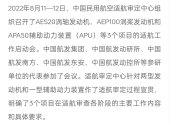
see this.. domestically developed APU for C919 certification process started back in 2022.
The APA50 Auxiliary Power Unit (APU) developed by AECC Zhuzhou Institute of Motion Research. APA50 is a 500KW auxiliary power unit. It is at the same level as the HGT750 currently provided by Honeywell.