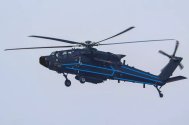
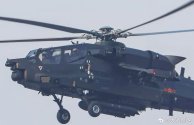
This still is not the clearest image, but it is already clear enough to show that the new auxiliary fuel tank is mounted under the fuselage, confirming the structure previously seen in the same position when the aircraft was in a clean configuration. It had actually appeared in several earlier sightings as well, but because the arrangement was so unconventional, people did not take it seriously and mostly assumed it was just AI-edited nonsense.
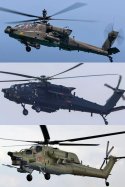
In theory, heavy attack helicopters such as the AH-64 and Mi-28 could also fit an auxiliary fuel tank under the belly, since there is physically enough space. But neither the Americans nor the Russians have done so, and earlier domestic models did not either. On those aircraft, if auxiliary fuel tanks are carried, the weapons load usually has to be cut drastically, which has a major impact on sustained firepower.
Only we have achieved this breakthrough. Doing so requires structural reinforcement at the relevant location, along with internal fuel lines connecting the tank to the engines. As a result, when the Z-21 carries a belly-mounted auxiliary fuel tank, it does not have to give up weapon hardpoints the way foreign models, or domestic models like the Z-10, Z-19, and Z-20, do.
This is an advance driven by the PLA helicopter force’s unique requirements for over-water and all-domain operations. Foreign heavy attack helicopters do not face a particularly pressing need for long-range strike missions, so their range requirements are generally not especially high. Our situation is different. In the near future, the operational scenarios being contemplated require greater range, but once the aircraft reaches the far side of the Strait, it must still face intense combat rather than fire off a few shots and withdraw in haste. So the Z-21 cannot sacrifice firepower for range, nor can it ignore range and simply pile on more weapons. Our requirements mean it has to do both: conduct long-range dash missions and still use a heavy weapons load to provide more sustained support for ground forces, blunt enemy counterattacks against the landing force, and push farther inland.
Of course, this does not mean the Z-21 can only carry auxiliary fuel tanks under the fuselage. The traditional stub-wing mounting method remains available, and it may be possible to carry as many as six auxiliary fuel tanks in total, depending on mission requirements. In scenarios where range matters more and exceptionally strong firepower is not required, such as sovereignty-protection missions involving close-in tracking and monitoring of foreign naval vessels and aircraft, this could offer a particularly strong advantage.
This is not a simple matter of hanging an existing auxiliary fuel tank design under the fuselage. The new mounting point has to preserve adequate ground clearance, so the new tank has a smaller diameter than the older model, with greater length used to maintain capacity. In addition, the new auxiliary fuel tank has a more refined aerodynamic design, with a sharper, smoother nose section that reduces drag in flight.