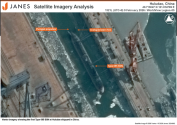
China has demonstrated a very clear and deliberate segregation of its tactical and nuclear strike missiles when it comes to land based ballistic missile regiments, that I think it would make zero sense for it to risk muddying the waters as it were, to introduce SSGNs that are effectively indistinguishable from SSBNs to enemy subs and sub hunting assets. The reasoning is simple, SSGNs are legitimate targets in a conventional war, but killing SSBNs would immediately risk crossing the nuclear threshold by presenting a use it or loose it dilemma.
From Norman Polmar & Edward Whitman's
Hunters and Killers Vol. 2: Anti-Submarine Warfare from 1943, p. 157:
In the early 1980s U.S. officials began to discuss publicly the Western anti-SSBN strategy. Probably the first official pronouncement of U.S. intentions was a 1985 statement by Secretary of the Navy John Lehman that U.S. submarines would attack Soviet ballistic missile submarines "in the first five minutes of the war." In January 1986, the Chief of Naval Operations, Admiral James Watkins, wrote that "we will wage an aggressive campaign against all Soviet submarines, including ballistic missile submarines." (Earlier, Watkins had observed that the shallow, ice-covered waters of the Soviet coastal seas were "a beautiful place to hide" for Soviet SSBNs.)
Some Americans-military and civilian- addressing U.S. anti-SSBN operations advocated the sinking of Soviet SSBNs during a crisis period, on the grounds that those missile submarines constituted a strategic reserve force." The semi-official Center for Naval Analyses concluded "that the Soviets planned to withhold their SLBM force during the conventional stages of a war with the North Atlantic Treaty Organization (NATO) and during initial nuclear strikes in order to provide either a second-strike capability or to retain a bargaining chip during [war-termination] negotiations." With the loss of those SSBNs, the argument went, the Soviet government would have to re-analyze its "correlation" of strategic forces. The loss of those missile submarines, with their "second strike" capability, could possibly deter the Soviets from escalating to an all-out nuclear conflict. On the other hand. some observers believed that rapidly sinking SSBNs would force the Soviet leadership to "use them or lose them," thus increasing the possibility of nuclear conflict.
But all Western theories and (presumably) plans for an anti-SSBN campaign soon encountered the realities of ASW: Would U.S. hunter-killer forces- air, surface, or submarine--be able to distinguish between Soviet SSBNs and SSNs? How would the Soviet leadership "know" that their SSBNs were being sunk and hence that it had to undertake the re-analysis of its remaining strategic forces? One U.S. naval officer. Commander David W. Hearding, asked, "How will the Soviets keep an accurate count of their surviving SSBN assets to evaluate the correlation of strategic forces? Viable SSBNs won't sacrifice covertness to report their status. Communications from [attacked] SSBNs would vary from unreliable to nonexistent, particularly under ice."
My understanding is that the Soviet "bastion" strategy for its SSBNs arose from the convergence of multiple factors:
(1) The development of truly intercontinental range missiles that could strike CONUS without entering the North Atlantic.
(2) Acoustic conditions under the ice that were favourable for hiding ballistic missile submarines.
(3) The ongoing technical inferiority of Soviet submarines, at least in the critical fields of signatures and sensing.
So the "bastion" strategy was a good idea, but it was fundamentally a defensive response grounded in Soviet inferiority. Further, the bastion strategy required a considerable portion of the Soviet SSN inventory to be devoted to protecting them, leaving fewer boats available for trailing American SSBNs, interdicting SLOCs, engaging NATO HVUs or other distant taskings. The American
Seawolf program was designed to restore advantages in sensing and particularly quieting that had been progressively eroded in the latter decades of the Cold War, but its broader strategic function, in threatening the Soviet bastions, was to draw a considerable portion of the Soviet SSN inventory to defending them, offering the American submarines a "target rich" environment while confronting Soviet submarines (and other ASW assets) with a high risk of red-on-red encounters.
One conclusion I draw from this is the importance of achieving technological parity and implementing it at scale. The extent to which 09V achieves this relative to
Virginia Block III and beyond, is therefore of fundamental significance. Without delving into the debates about the potential role of SSGNs against CONUS, I do believe that, even if the PLA's fundamental objectives remain more localised, they will need to move beyond even an expanded strategic framework of denial to embrace capabilities and doctrines that can fundamentally alter the American calculus closer to home. One example of this would be to develop the capabilities required to credibly (which is not to say reliably or consistently) tail American SSBNs. Despite considerable efforts, this is something that the Soviets apparently never really managed to do.
It should be noted that the American SSBN inventory is entering a period of relative vulnerability: the
Ohio-class SSBNs are now definitively
old, both in terms of their design characteristics and the mechanical wear-and-tear over decades of service that may well have degraded their "as-designed" signatures, while the
Columbia-class program will unfold only gradually throughout the 2030s. If 09V has indeed managed to converge with the global state of the art in the relevant fundamental aspects (signatures, sensing, tactical speed) and if it can be deployed at scale and in a timely fashion, there may be hitherto unprecedented possibilities in that regard.