

You are using an out of date browser. It may not display this or other websites correctly.
You should upgrade or use an alternative browser.
You should upgrade or use an alternative browser.
09V/09VI (095/096) Nuclear Submarine Thread
- Thread starter Hendrik_2000
- Start date

Wouldn’t it be easier to just procure a shorter missile?
What's the point?
SL-ICBMs are designed to have a certain amount of length because they need to have enough fuel to fly long enough distances to reach enemy countervalue or counterforce targets while carrying a sufficient amount of nuclear payload. For the case of SSBNs, their targets are typically located on (if not also deep within, such as the HQs of STRATCOM and SPACECOM) the enemy's home soil, which are more often than not well protected with integrated layers of BMD systems.
Shortening the SL-ICBM's missile length would result in any of these two:
- Reducing the effective strike ranges of the missile because the amount of fuel is reduced = The SSBN had to get closer to the enemy's home soil to launch the missiles = Higher chances for the SSBN to be discovered, and/or higher chances for the SL-ICBM to be intercepted at climb or midcourse stages instead of terminal stage; or
- Reducing the amount of nuclear payload + decoys that can be carried to be able to reach enemy home targets from farther away with a more limited amount of fuel.
Hence, if you've looked closely, all SSBNs in service today actually have their SL-ICBM launch tubes which protrude from the pressure hull of their respective submarines. This situation either necessitates having a significant turtleback (most SSBNs), or having the sail structures extended to the rear (North Korea's Sinpo and Israel's Dakar) to encase the launch tubes. SSNs (with VLS cells), on the other hand, do not face such issues as their missiles are often shorter than the submarine's hull diameter, which reduces the need for turtlebacks to a minimum if not zero.
Well, if that would be the case let's hope it won't be long until we'll get to see the boomer launched and react with the appropriate "big son of a b***!".even 094 has 12.5m diameter but with double hull so 096 14m is reasonable. hump don't count.
remember 095 has 12.5m diameter with single hull which is huge.
095/096 are the first set of submarines when China is not technological handicapped. so conservative design limit vanished.

plawolf
Lieutenant General
A couple of thoughts:
If the PLA's nuclear doctrine remains that of maintaining a credible, minimal deterrence, would its SSBNs need to get closer than 10k km, especially with ever improving SLBMs?
Granted having a highly stealthy SSBN means that has more options to hide in larger areas of the world's oceans, & that might mean closer to the target by default.
Another exciting thought is that if the 09VI ends up comparable in size to the Columbia, I wonder whether the PLAN could produce a SSGN variant that carries the CJ-1000 cruise missile? That would be a pretty potent combo, if feasible.
One thing to bear in mind is that the PLAN has displayed precisely zero interest in an SSGN design to date. While technical limitations would have played a big part in that decision (no one would seriously rate an 092 or even 094 hull based SSGN’s ability to get within cruise missile range of CONUS to make such a type worthwhile) , I think another key consideration would be strategic clarity.
China has demonstrated a very clear and deliberate segregation of its tactical and nuclear strike missiles when it comes to land based ballistic missile regiments, that I think it would make zero sense for it to risk muddying the waters as it were, to introduce SSGNs that are effectively indistinguishable from SSBNs to enemy subs and sub hunting assets. The reasoning is simple, SSGNs are legitimate targets in a conventional war, but killing SSBNs would immediately risk crossing the nuclear threshold by presenting a use it or loose it dilemma.
I think the PLAN may well decide to purposefully not pursue a traditional SSGN to remove all possibility of doubt, to both sides, that the second USN starts to take shots at PLAN boomers is the moment China concludes that America is seeking to escalate into the nuclear domain, and react accordingly immediately.
This may also be a secondary rationale for continued and ongoing mass production of late block 093s, that rather than use boomer hulls for its SSGNs, that China will instead use SSNs for that role.
Not only would this preserve strategic clarify with regards to nuclear strike capabilities, it will also mean that the PLAN’s long range cruise missile strike capabilities are more distributed across many more SSN hulls instead of concentrated on a much smaller number of boomer hulls, which adds much more redundancy and tactical flexibility in their use.
If this is the case, then it means we should not read too much into continued 093 parallel production to 095s, as they will then be for very different purposes and missions, as the 093 may well get the Virginia treatment with stretched hulls to accommodate more VLS in future blocks.
I wonder their restarted land reclaiming project here after 10 years of hiatus coincide with the new type of subs.
Subs go into circle body of water will be protected. In 2022 a US virginia sub was parking near Yulin sub base in Hainan for spying for chinese subs in/out. This is after the USN seawolf Connecticut crashed and surfaced near Paracel island. So there need to be more locations in SCS that can hide the subs.
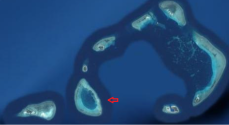
Subs go into circle body of water will be protected. In 2022 a US virginia sub was parking near Yulin sub base in Hainan for spying for chinese subs in/out. This is after the USN seawolf Connecticut crashed and surfaced near Paracel island. So there need to be more locations in SCS that can hide the subs.
Last edited:
I’m not suggesting they are for nuclear ICBM’s, simply that they use the whole tube as it is there, they can have the option to tri-pack or to not.What's the point?
SL-ICBMs are designed to have a certain amount of length because they need to have enough fuel to fly long enough distances to reach enemy countervalue or counterforce targets while carrying a sufficient amount of nuclear payload. For the case of SSBNs, their targets are typically located on (if not also deep within, such as the HQs of STRATCOM and SPACECOM) the enemy's home soil, which are more often than not well protected with integrated layers of BMD systems.
Shortening the SL-ICBM's missile length would result in any of these two:
- Reducing the effective strike ranges of the missile because the amount of fuel is reduced = The SSBN had to get closer to the enemy's home soil to launch the missiles = Higher chances for the SSBN to be discovered, and/or higher chances for the SL-ICBM to be intercepted at climb or midcourse stages instead of terminal stage; or
- Reducing the amount of nuclear payload + decoys that can be carried to be able to reach enemy home targets from farther away with a more limited amount of fuel.
Hence, if you've looked closely, all SSBNs in service today actually have their SL-ICBM launch tubes which protrude from the pressure hull of their respective submarines. This situation either necessitates having a significant turtleback (most SSBNs), or having the sail structures extended to the rear (North Korea's Sinpo and Israel's Dakar) to encase the launch tubes. SSNs (with VLS cells), on the other hand, do not face such issues as their missiles are often shorter than the submarine's hull diameter, which reduces the need for turtlebacks to a minimum if not zero.
In the case where they use the whole tube the missile will go much further than a much slimmer tri-packed one.
They could use it for something like a navalised DF-26.
Of course there is nothing stopping them putting a nuke on this missile, but it won’t be ICBM ranged, which is fine, because it’s not a SSBN.
But it would be a SSN with a 6000km range missile which is pretty awesome.
I think the best would be to have some large missiles and some tri-packed on the same boat.

I don't think PLAN actually has extensive sonar networks as people thought in the SCS, coastal regions and territorial waters maybe but not in the claimed seas. Wasn't there some report about a foreign SSK lurking near coastal waters found only after it was entangled in some fishing net or was I misremembering this one, but point is PLAN underwater surveillance network do not seem to be as advanced, layered and widespread as most people here expect.I wonder their restarted land reclaiming project here after 10 years of hiatus coincide with the new type of subs.
Subs go into circle body of water will be protected. In 2022 a US virginia sub was parking near Yulin sub base in Hainan for spying for chinese subs in/out. This is after the USN seawolf Connecticut crashed and surfaced near Paracel island. So there need to be more locations in SCS that can hide the subs.
View attachment 169760
Not everything you detect is worth going after. You’re not openly sharing everything you detect either since the point is you don’t want everyone to know what you did and didn’t see.I don't think PLAN actually has extensive sonar networks as people thought in the SCS, coastal regions and territorial waters maybe but not in the claimed seas. Wasn't there some report about a foreign SSK lurking near coastal waters found only after it was entangled in some fishing net or was I misremembering this one, but point is PLAN underwater surveillance network do not seem to be as advanced, layered and widespread as most people here expect.

I don't think PLAN actually has extensive sonar networks as people thought in the SCS, coastal regions and territorial waters maybe but not in the claimed seas. Wasn't there some report about a foreign SSK lurking near coastal waters found only after it was entangled in some fishing net or was I misremembering this one, but point is PLAN underwater surveillance network do not seem to be as advanced, layered and widespread as most people here expect.
But the last patrol in the series proved a dangerous failure, with HMAS Orion at grave risk of detection and capture.
On October 22, 1992, she left Sydney Harbour and headed for Shanghai to gather intelligence on the Chinese navy, especially its new submarines. Orion’s CO was commander Rick Shalders, who later commanded Australia’s Collins-class submarine fleet.
The Americans wanted better intelligence on the Chinese navy, but US nuclear submarines were too big to be sent into the shallow waters of the East China Sea. Australia’s smaller O-boats were ideal for the task.
Shanghai was China’s biggest mainland harbour at the wide mouth of the Yangtse river; the water was shallow and murky, and busy with non-military shipping, including the local fishing fleet and ferries. The shoreline was heavily urbanised.

That’s literally over three decades ago. I don’t think the information is up to date.
But the last patrol in the series proved a dangerous failure, with HMAS Orion at grave risk of detection and capture.
On October 22, 1992, she left Sydney Harbour and headed for Shanghai to gather intelligence on the Chinese navy, especially its new submarines. Orion’s CO was commander Rick Shalders, who later commanded Australia’s Collins-class submarine fleet.
The Americans wanted better intelligence on the Chinese navy, but US nuclear submarines were too big to be sent into the shallow waters of the East China Sea. Australia’s smaller O-boats were ideal for the task.
Shanghai was China’s biggest mainland harbour at the wide mouth of the Yangtse river; the water was shallow and murky, and busy with non-military shipping, including the local fishing fleet and ferries. The shoreline was heavily urbanised.