US Military News, Reports, Data, etc.

manqiangrexue

Brigadier
There‘s spme truth to it though,
I think you have truth and imagination mixed up.
especially looking at Chinede destroyer ramming into a coast guard ship. China has a steep learning curve and it hasn‘t even properly started.
OK which navy would you consider one that is further along in this than China? I would assume that if you think that one collision means China hasn't even started then if another prominant navy such as the USN has several, they'd be going backwards at a significant pace so I'm very curious which navy you think is worthy of envy. Let's pull up that navy's record and see how many accidents vs how many Chinese naval accidents. You know, let some statistics do the talking. I will bet that you will either find navies that have many more collisions and accidents than China, or navies that are laughably small and irrelevent.
 

uguduwa

Junior Member
Registered Member
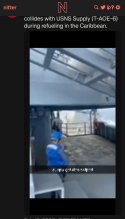
I don’t see how the two incidents are comparable. In PLAN’s case two Chinese warships collided while maneuvering against a smaller, much more agile target whereas here you don’t have any hostile target, the sea is calm with great visibility, and two friendly ships just started playing bumper ships with one another for no good reason. This is not to
Mention that instead of taking any remedial measures or self protection measures some of the sailors started recording the thing on their own phones… If this is not a sign of bad discipline I don’t know what is…
I wasn’t taking potshots. What I meant was that mistakes happen and China not having any experience of having a blue-warer navy has a steep learning curve ahead. In that sense the Youtube comment is not wrong. It just said that even the most experienced blue water navy makes dumb mistakes.
 

siegecrossbow

Field Marshall
Staff member
Super Moderator
I wasn’t taking potshots. What I meant was that mistakes happen and China not having any experience of having a blue-warer navy has a steep learning curve ahead. In that sense the Youtube comment is not wrong. It just said that even the most experienced blue water navy makes dumb mistakes.
The video is implying that China has more accidents than the U.S. but hasn’t released them due to secrecy, which is patently untrue.
 

siegecrossbow

Field Marshall
Staff member
Super Moderator
They must have taken his drinks away after the DOD gave CBP an energy based weapon for border guarding activities, and then have the CBP use said weapon against a balloon without notifying the FAA (and potentially NORTHCOM and the Pentagon if journalist Michael Weiss is to be believed), which caused the whole no fly zone curfuffle this morning.
Please, Log in or Register to view URLs content!

Spec wise pretty similar to Shennongdong currently used in Russia.
 

Blitzo

General
Staff member
Super Moderator
Registered Member
On the prospect of future 09III-size SSN to complement 095V.

If we assume that 09V represents a highly optimised alignment between new-generation reactor configuration and output, hull diameter enabling desired rafting and other silencing measures, and hydrodynamic form and performance (tactical speed, top speed, acceleration), it follows that, even if it is possible to fit that same reactor in a smaller SSN, doing so is going to shift away from that multi-axis optimised configuration, probably in several dimensions simultaneously. That is to say, a smaller SSN likely calls for a different reactor (and associated machinery).

One can get away with putting a large SSN reactor in an SSBN hull (as with e.g. Russian or British practice) in large part owing to the different performance targets that those roles entail. Performance requirements for two SSNs are likely to be more similar than between an SSN and SSBN.

Of course it is entirely possible to design and build that different reactor (and supporting machinery) and create another training and sustainment pipeline to support it. It is the economics of doing so that are in question. That depends in part on the number of hulls that would be expected to use that reactor, and any other applications to which it could be put (not obvious that there are any).

Did you mean to post this in the 09V thread?
 

Lethe

Captain
I wasn’t taking potshots. What I meant was that mistakes happen and China not having any experience of having a blue-warer navy has a steep learning curve ahead. In that sense the Youtube comment is not wrong. It just said that even the most experienced blue water navy makes dumb mistakes.

PLAN has been conducting blue water operations with underway replenishment since 1980. From David G. Muller's China as A Maritime Power 1945-1983, pp. 211-13.

China's Expedition to the South Pacific

After the first survey mission to the South Pacific in 1976, a series of follow- on deployments continued in 1977-1979. All involved research ships only, but Chinese sources continued to make it clear that naval personnel were involved in the operations. Due to the lack of underway replenishment ships--the first Fuqing-class AOR was not operational until 1980--Chinese warships were unable to accompany the research ships. They continued to provide escort within the China Seas, however. In many ways, the Chinese navy came of age in May 1980. An 18-ship task group--including six Luda-class destroyers--was formed and sailed thousands of miles to the South Pacific. The purpose of the previous research surveys in the Fiji Islands region had become clear: China announced its intention to launch a series of new intercontinental ballistic missiles--the CSS-4 ICBM-- on test flights over the Pacific Ocean. The Fiji area was evidently selected because the missiles would not have to fly over foreign territory to reach the impact zone. Instrumentation ships were required at the splashdown site to monitor the accuracy of the missiles, and the warships provided an escort.

In April 1980, the task group assembled off Wusong, near Shanghai, and there were ceremonies at which the top naval command, joined by Vice Premier Geng Biao and various PLA figures, saw the ships off. Apparently commanded by Gao Xiceng (Kao Hsi-ts'eng), deputy commander of the East Sea Fleet, the task group consisted of six Luda-class guided missile destroyers drawn from each of China's three fleets, two new Fuqing-class underway replenishment ships, two new Yuanwang-class missile range instrumentation ships, two new oceangoing salvage-and-rescue general auxiliary ships, the research and command ships Xiang Yang Hong 5 and 10, plus four oceangoing tugboats. The latter were evidently sent along in case one or more of the ships embarking on the adventure broke down and had to be ignominiously towed home.

The task group sailed across the East China Sea, through the Ryukyu Island chain, and into waters never before seen in 1,000 years of Chinese naval history. The group arrived in the projected impact zone during the second week of May 1980. Two Australian naval ships joined the Chinese in the zone to conduct surveillance of this high-interest event--a routine international practice--and after initial Chinese ship-to-ship warnings to the Australians to keep clear of the upcoming operations, officers from one of the Royal Australian Navy ships were invited aboard a Luda, coming away with a case of prized Qingdao-brand beer.

On 18 May, the task group arrayed itself in the proper formation to monitor the splashdown of the test warhead. A CSS-4 was launched from the missile test center at Shuangchengzi in North Central China and flew a perfect flight some 8,000 kilometers (4,300 nautical miles), the instrumentation package splashing down on target amid the naval task group. Navy helicopters (Super Frelons imported from France-- some of the few items of naval hardware purchased in the latter 1970s) lowered divers who attached the payload to a cable, accomplishing a smooth recovery. The success of the mission was marred somewhat when a second CSS-4 failed in flight on 21 May, splashing down some 1,300 kilometers (700 nautical miles) short of the impact zone. The task group started back to China shortly thereafter, arriving in Shanghai to great celebrations in early June.

The navy quite rightly interpreted the extended mission as a victory for modernization. The deployment "showed that the modernization of China's navy has reached a new level." But the long-term goal of a truly modern naval force had not yet been attained: "Today's victory is only a beginning. The development and strengthening of the navy... will be pursued continuously, with untiring efforts and struggle."

While simply travelling to a distant ocean area and returning without mishap was a signal accomplishment for the PRC Navy, there was more significance to the event. The navy had demonstrated its ability to maintain an effective force of combatant ships with logistic support for weeks at a time in waters no less distant than those of Southeast Asia, the Indian Ocean, or the Soviet Far East. The success of the ICBM test was incidental as far as the navy was concerned--indeed. a naval escort force for the instrumentation ships was unnecessary in the first place.

 
Last edited:

leonzzzz

Junior Member
Registered Member
I wasn’t taking potshots. What I meant was that mistakes happen and China not having any experience of having a blue-warer navy has a steep learning curve ahead. In that sense the Youtube comment is not wrong. It just said that even the most experienced blue water navy makes dumb mistakes."
"PLAN DoeSN't HaVE eXPeRiEncE"

The fighting experience:
1000008604.jpg
 

another505

Junior Member
Registered Member
What do you guys think of Longshot?
It seems decent on globemasters as they can increase the number of drones flying with limited runways.
 
Top