09V/09VI (095/096) Nuclear Submarine Thread

tamsen_ikard

Captain
Registered Member
09VI will be the first non-Western SSBN that can get through USN containment and get close to intended target to fire off ballistic missile vs firing from 10000 km away.
Just cause 096 is going to be slightly quieter than 094, I doubt it can simply go through first island Chain chokepoints without detection when there will be significant sensor network setup by the US and its allies. Chokepoints are the easiest places to detect submarines.

I believe China still faces the same strategic dilemma with 096 regardless of how good it is, which is that it is completely hemmed in by chokepoints on all sides.

The only good choice China has is through Russian islands in the north in Kurils. There they can pass through without US sensor network. But this depends on Russia being friendly and allowing such passages. Cause they will likely have their own detection methods.

What 096 can do is have a much bigger submarine to hold significantly bigger SLBM missiles which can fire from SCS and reach all of US from there. Current 094 lacks SLBMs that can reach all of US from SCS.

Overall, SSBNs will always have less strategic utility for China as long as they don't control Taiwan and break the first island chain chokepoint.
 

Blitzo

General
Staff member
Super Moderator
Registered Member
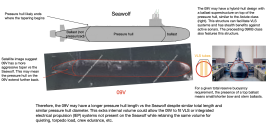
One thing that I noticed from the satellite image of the 09V is that the stern taper looks very prominent vs the taper on the Seawolf. This may mean a longer pressure hull despite similar total length. This may explain how the 09V can fit features like VLS tubes or IEP. Just a guess.View attachment 169688

Agree with that part about the stern tapering and relative pressure hull length, which could be possible but pending better pictures of course.

I don't fully agree with the comparison with Astute.
A top side hydrodynamic "shell" atop the dorsal pressure hull, imo is not really what we consider to be "hybrid hull".

Instead, "hybrid hull" tends to mean a submarine having a single hull section (usually amidships which has a wide/maximal beam pressure hull section) and a genuine double hull section (on the stern, bow or both, which is narrower than the single hull section and has the external hull fully enclosing around it).
Soryu and Yasen class as examples below:
YsjXjlb.png

usG8u6y.png


The hydrodynamic shell portion on the dorsal side of Astute is more in keeping with how SSBNs often have a hydrodynamic shell over their VLS tubes that protrude slightly out from the pressure hull (Ohio class for example below, but it's also the case for other single hull SSBNs like Vanguard class, Columbia class etc), however they are still very much considered single hull designs rather than "hybrid".
9VKZNvv.jpeg


In the case of 09IIIB, it does have that continuous hydrodynamic shell feature over its VLS tubes and dorsal hull in a relatively smooth way but in context of the overall submarine being still a (presumed) double hull design wholesale.
 

tphuang

General
Staff member
Super Moderator
VIP Professional
Registered Member
It's Block 5 Virginia (not 4) which has the 14:1 ratio (i.e.: much greater length due to addition of the VPM hull plug in section).

I remember some 4-5 years ago recalling that the hydrodynamic profile of 09V will be more akin to baseline Seawolf specifically for the purposes of higher end underwater performance, with its VLS complement being only "moderate" rather than too extensive like Block V VA or Yasen.

Part of the rationale is because the bigger gap in PLAN SSN capability was the ability to do higher end underwater warfare (against other submarines, as long distance escort for surface taskforces, and carrying out independent long distance hunter killer missions in general), whereas they had quite an extensive and still increasing anti-surface capability for the western pacific that could be fulfilled with other platforms/domains.


Still, possessing a degree of anti-surface capability for the baseline 09V makes sense, but for the initial boats it probably isn't the priority. We will see if they choose to pursue a variant of 09V (or indeed, a variant of 09VI) that is more "SSGN" oriented, as it goes without saying that once they are more comfortable with having a higher end SSN capability at scale, it would make sense to leverage the same platform type for enabling more comprehensive long distance conventional anti surface strike missions beyond the western pacific.
thanks for correcting me on that. I got the F-35 and Virginia block mixed up.

a sub fleet of 09V down the road that's stretched would make sense.

A couple of thoughts:

If the PLA's nuclear doctrine remains that of maintaining a credible, minimal deterrence, would its SSBNs need to get closer than 10k km, especially with ever improving SLBMs?

Granted having a highly stealthy SSBN means that has more options to hide in larger areas of the world's oceans, & that might mean closer to the target by default.

Another exciting thought is that if the 09VI ends up comparable in size to the Columbia, I wonder whether the PLAN could produce a SSGN variant that carries the CJ-1000 cruise missile? That would be a pretty potent combo, if feasible.
I think a 24 tube 09VI could work if PLAN is comfortable with larger hulls, it would be quite expensive.
They wouldn't need a SSGN variant of that if they can just stretch 09V and take the hydrodynamic penalty.

Just cause 096 is going to be slightly quieter than 094, I doubt it can simply go through first island Chain chokepoints without detection when there will be significant sensor network setup by the US and its allies. Chokepoints are the easiest places to detect submarines.

I believe China still faces the same strategic dilemma with 096 regardless of how good it is, which is that it is completely hemmed in by chokepoints on all sides.

The only good choice China has is through Russian islands in the north in Kurils. There they can pass through without US sensor network. But this depends on Russia being friendly and allowing such passages. Cause they will likely have their own detection methods.

What 096 can do is have a much bigger submarine to hold significantly bigger SLBM missiles which can fire from SCS and reach all of US from there. Current 094 lacks SLBMs that can reach all of US from SCS.

Overall, SSBNs will always have less strategic utility for China as long as they don't control Taiwan and break the first island chain chokepoint.
SOSUS along 1IC works if you have MPAs that can triangulate and SSNs that can tail them afterward.

If you have enough traffic going through 1IC or if you have fleet or air force that can chase away the MPAs, then just how exactly are the USN SSNs going to chase you down.

Let's go by the likely scenario that 09V and 09VI use 200MWt reactor that generates 60MWe electricity. Even without IEPS, a 09V in its current optimal hydrodynamic configuration can probably go at high 20 knots without making that much noise (iirc, Seawolf at 25 knots is quieter than LA class when it's not moving). Similarly, a 09VI using IEPS (in my mind, it would use that) could equally sustain 25 knots while being pretty quiet. So, just what exactly is going to chase it down if MPAs chased away? Something has to be reasonably close and able to sustain higher speed than the target sub in order to keep track of i.
 

ACuriousPLAFan

Lieutenant General
Registered Member
@BoraTas and I recorded an episode on Type 09V just this afternoon and you can find it here.

Please, Log in or Register to view URLs content!

We did raise one point that I think is worth watching out for, which is when will Type 09VI come out and what it will look like. 09VI will be the first non-Western SSBN that can get through USN containment and get close to intended target to fire off ballistic missile vs firing from 10000 km away. As such, it will be a really big deal whenever it gets produced. And we will see if it's a clean sheet like Columbia class with 13m+ beam.

Other thing that Bora raised is that the length to beam ratio of Type 09V as we see it now is quite ideal in terms of hydrodynamics (between 8 and 9 to 1) whereas the block 5 Virginia class is like 14:1 iirc, which is not ideal at all.
A couple of thoughts:

If the PLA's nuclear doctrine remains that of maintaining a credible, minimal deterrence, would its SSBNs need to get closer than 10k km, especially with ever improving SLBMs?

Granted having a highly stealthy SSBN means that has more options to hide in larger areas of the world's oceans, & that might mean closer to the target by default.

I'd like to add some on the 096 SSBN.

We do know that the JL-3 SL-ICBM on the 094/A SSBNs is already capable of reaching CONUS from within the 1IC. With this in mind, I suppose it is reasonable to expect that the JL-4 SL-ICBM on the 096 SSBNs would largely maintain the overall range from the JL-3 while increasing its payload capacity.

On the other hand, even if the JL-4 has a reduced range of ~10000 kilometers, I would deduce that the reduction could come from pushing the carried payload on the SL-ICBM to its maximum limit. In addition to what you guys have mentioned, using the most advanced silencing technologies that China has today would enable the 096 SSBNs to venture deeper across the world's oceans and to locations where they had never been before.

Let's just say that it'd be a pretty nasty surprise once the 096 SSBNs are discovered patrolling in the Atlantic or somewhere in the Eastern Pacific.

Moreover, we could also consider the potential avenues of having the SL-ICBMs tipped with HGVs instead of the conventional conical RVs that we have today. HGVs (especially the waverider design) would require greater volume (and therefore, mass) for the same amount of nuclear payload as conventional conical RVs, so having greater potential payload capacity could also mean having the same number of warheads that can be carried per SL-ICBM for both JL-3 and JL-4, but with more of the warheads of the JL-4 having better chances at evading and penetrating the enemy's integrated ABM/AHM systems to reach their targets than the warheads of the JL-3.

Another exciting thought is that if the 09VI ends up comparable in size to the Columbia, I wonder whether the PLAN could produce a SSGN variant that carries the CJ-1000 cruise missile? That would be a pretty potent combo, if feasible.

I'd go one step further and say that if the rumored 1100-1200mm LVLS cells for the next-gen DDGs/CGs are actually true, then they can definitely employ the sub-launch variants on the 096 in the SSGN configuration. This could theoretically be done by utilizing the purported 2.4-2.6 meter-diameter individual SL-ICBM tube spaces meant for the JL-4 to carry dual-pack VLS tubes for the larger strike missiles.

Such settings shouldn't be limited to the (navalized variant of) CJ-1000 - Something like a navalized DF-17 or DF-16B is also possible.

Sometime ago, I did some rough extrapolation in the PLAN Next-gen Surface Combatant thread - The rumored LVLS cells could actually reach a depth of 12-13 meters. This would be sufficient for something the size of the 096 SSBNs, supposing that the sub has a diameter of ~14-15 meters plus the additional ~1-2 meters of turtleback to better (and is originally meant to) fit the JL-4.

And similar to the 096s in SSBN configuration - The impact of having 096s in SSGN configuration constantly patrolling off Hawaii and the western seaboard of CONUS is certainly something to say at least. Plus, honestly, this sounds like a much better idea should the PLAN decide to procure "true SSGNs" in the future, rather than actually lengthen the 095 SSNs into "Block 5+ Virginia" levels of absurdity.

Of course, this part is purely theoretical at present.

 
Last edited:

Andy1974

Senior Member
Registered Member
Just cause 096 is going to be slightly quieter than 094, I doubt it can simply go through first island Chain chokepoints without detection when there will be significant sensor network setup by the US and its allies. Chokepoints are the easiest places to detect submarines.

I believe China still faces the same strategic dilemma with 096 regardless of how good it is, which is that it is completely hemmed in by chokepoints on all sides.

The only good choice China has is through Russian islands in the north in Kurils. There they can pass through without US sensor network. But this depends on Russia being friendly and allowing such passages. Cause they will likely have their own detection methods.

What 096 can do is have a much bigger submarine to hold significantly bigger SLBM missiles which can fire from SCS and reach all of US from there. Current 094 lacks SLBMs that can reach all of US from SCS.

Overall, SSBNs will always have less strategic utility for China as long as they don't control Taiwan and break the first island chain chokepoint.
Type 09VI could be escorted out into the western pacific by a carrier group, every time a carrier traverses the gap one or more 09VI’s could accompany it and once in deep water it could slip away.
 

ACuriousPLAFan

Lieutenant General
Registered Member
True, but if they are going to triple pack regular VLS in bigger tubes it stands to reason they could also fit one big missile in those tubes instead, right?

And that still wouldn't make any SSNs into SSBNs, as there isn't enough hull diameter to fit SL-ICBMs that are almost always as long as the hull diameter is tall without having a significant turtleback protruding out of the submarine's hull.

China's JL-3 and JL-4 are about 12-14 meters long, given their immense range requirements. It'd be impossible to fit them on the 095s without significant modifications to the sub's hull (i.e. turtleback etc), such that the PLAN might as well procure a different submarine design altogether.
 
Last edited:

mister unknown

New Member
Registered Member
I have a process & timeline question regarding 09V mass production. Again, this is another a layman's question as I am an amateur enthusiast at best:

What type of exploratory process is typically covered in the sea trials phase of a "first of its kind" SSN? How much can we find out about what works well & what doesn't during this process? How much of the "testing & debugging" can we get out of the way during a sea trial, & what types of problems can we typically discover only after the SSN has entered service?

The reason I'm asking is because this relates to how quickly we can reach the high volume production phase. If we can find out enough about what we want to modify on the follow up models of the 09V after a 2-year trial period (EoQ Q4'28 or Q1'29), then perhaps we can do 09IIIB-style mass production as early as Q1'29?

If we can meet that schedule, we could have 5 09Vs per year going into (shorter) sea trials by 1H'30?

Is this feasible or too ambitious?
 
  • Like
Reactions: jwt

Blitzo

General
Staff member
Super Moderator
Registered Member
I have a process & timeline question regarding 09V mass production. Again, this is another a layman's question as I am an amateur enthusiast at best:

What type of exploratory process is typically covered in the sea trials phase of a "first of its kind" SSN? How much can we find out about what works well & what doesn't during this process? How much of the "testing & debugging" can we get out of the way during a sea trial, & what types of problems can we typically discover only after the SSN has entered service?

We in the public won't get to know any of that.


The reason I'm asking is because this relates to how quickly we can reach the high volume production phase. If we can find out enough about what we want to modify on the follow up models of the 09V after a 2-year trial period (EoQ Q4'28 or Q1'29), then perhaps we can do 09IIIB-style mass production as early as Q1'29?

If we can meet that schedule, we could have 5 09Vs per year going into (shorter) sea trials by 1H'30?

Is this feasible or too ambitious?

I wouldn't try thinking this far ahead lol, better to expect nothing and just see how many 09Vs we observe getting launched.

The difference between a theoretical launch rate based on XYZ going right and based on production capacity, vs what they actually fund and choose to procure is different.


Why are the tail fins designed so large on 095?

We don't know if they're actually that large or if it's an image artefact (picture angle, shadows etc).

The real question should be "are the tail fins actually as big as it looks" and the correct answer is "we don't know yet, because the quality of the images so far means the tail size is something which might be slightly misrepresented"
 
Top