I agree. But there is a risk, that is if Japan tries to pursue nuclear weapons. China must absolutely step up espionage to ensure this doesn't happen.Japan's real problem lies in its stagnant domestic development. What good will the LDP's constitutional revision do? What good will provoking China do? These are merely tools to divert attention from the nation's own developmental failures.
Does the LDP's policy offer any solutions to Japan's developmental challenges? Can currency devaluation, exploding debt, radical stimulus measures, and domestic tax cuts truly resolve these issues? As long as Japan's economy remains this mess, even if Japan kicks up a fuss, it'll just be a lame duck. Japan's militarization has actually given China an opportunity to step on the gas for Japan's downhill slide. Just wait and see the fireworks of Japan's economy.

You are using an out of date browser. It may not display this or other websites correctly.
You should upgrade or use an alternative browser.
You should upgrade or use an alternative browser.
Miscellaneous News
- Thread starter bd popeye
- Start date

For your first question, nuke as warheads are essentially useless without some type of delivery vechicles.I have mixed feelings about this. I know Chinese nationalists will feel that China should push harder, but when has China ever done that? Never.
China is too pragmatic. I feel this will allow Japan to make some fundamental and irreversible change that will have long term consequence.
Mainly two things come to mind. Any attempt by Japan to go for nukes.
Japanese military arms donations to Taiwan.
Let's see if China can take some real tough action to stop any Japanese movement towards these places.
It is impractical for Japan to go for nuke in short terms, especially considering this topic has been discussed in high level JSDF decades ago, the result was "An incomplete nuclear arsenal would make its possessor want to use it before it is destroyed, making it more likely to invite a preemptive attack." This is even more evident if Japan's lack of strategic depth is taken into consideration.
Japan does not have a reliable method of nuclear delivering in the nuclear triads. Nuclear sharing, however, with USA would have more uncertainty though. Shinzo Abe mentioned this option in 2022, in reality it really should be limited on the extent to which Trump is willing to disregard decency for profit; and how much trust are there between Ministry of Defense and the Pentagon.
In another term of total mobilization preparedness, at least Japan does not have a good grade.
(2025, n=400)
(2023, n=1000)
Last edited:

Japan's goal of loosening nuclear restrictions is to obtain permission to build nuclear submarines and potentially host U.S. nuclear warheads; nuclear weapons remain a long-term (but not impossible) objective.I have mixed feelings about this. I know Chinese nationalists will feel that China should push harder, but when has China ever done that? Never.
China is too pragmatic. I feel this will allow Japan to make some fundamental and irreversible change that will have long term consequence.
Mainly two things come to mind. Any attempt by Japan to go for nukes.
Japanese military arms donations to Taiwan.
Let's see if China can take some real tough action to stop any Japanese movement towards these places.
Japanese youth not only lack a concept of the lost 30 years, but also of nuclear weapons. They grew up in an era where most of the survivors were dead, and the memory of nuclear bombings existed only in superficial moralizing (even distorted into anti-defeat rhetoric). They don't actually have much moral burden regarding it. 20 years later, the next generation will be even less resistant.
Last edited:
I saw some Chinese expats in Japan posting on X:
The administration will inject massive liquidity into the market, trading Japanese wallets and futures for asset appreciation.
Bullish on assets and short on the yen. Carry trading will intensify further, making the Nikkei, US stocks, and cryptocurrencies even hotter, but the economy will even rely more on stock prices than on real profitability, until a deleveraging stock market crash surpassing 1990-1997 occurs.
Enduring some xenophobic pressure from Japan is a price to pay for reaping.
Once asset gains accumulate enough, leave Japan in line with public sentiment.
Looking forward to continued acceleration, we all have a bright future ahead, except for those voting for the LDP
The administration will inject massive liquidity into the market, trading Japanese wallets and futures for asset appreciation.
Bullish on assets and short on the yen. Carry trading will intensify further, making the Nikkei, US stocks, and cryptocurrencies even hotter, but the economy will even rely more on stock prices than on real profitability, until a deleveraging stock market crash surpassing 1990-1997 occurs.
Enduring some xenophobic pressure from Japan is a price to pay for reaping.
Once asset gains accumulate enough, leave Japan in line with public sentiment.
Looking forward to continued acceleration, we all have a bright future ahead, except for those voting for the LDP
Last edited:

Lethe
Captain
Kaiser Kuo's essay makes for compelling reading:
It isn't clear what fruits the embryonic glimmers of recognition and accommodation that Kuo refers to will ultimately bear, but I welcome them all the same, because I do think that the prospects for peaceful coexistence rest, at least in part, upon our ability to recognise and accept the reality of China, which in turn implies a re-evaluation of the ideas we have long held about ourselves. That this is in large part a function of the pessimism and disorientation occasioned by the return of Donald Trump, rather than of any newfound insight into China is not so paradoxical as it first appears when one considers that the real blinders were always those we had imposed upon ourselves.
Change implies the end of the world as one has always known it, the loss of all that gave one an identity. And at such a moment, unable to see and not daring to imagine what the future will now bring forth, one clings to what one knew, or dreamed that one possessed. Yet, it is only when a man is able, without bitterness or self-pity, to surrender a dream he has long cherished or a privilege he has long possessed that he is set free. -- James Baldwin
The world feels unsettled, as if history itself were changing tempo. The familiar landmarks of the modern age are blurring, slipping away, and the stories we once told ourselves about progress and power no longer map cleanly onto the terrain before us. What we are living through seems, with each new day, less like a passing rearrangement of power, less like a momentary realignment of nations. We sense something deeper and more enduring: a transformation whose outlines we are only beginning to discern. History no longer feels like something unfolding behind us but something rushing toward us, urgent and impossible to ignore.
The economic historian Adam Tooze, reflecting on his recent, intense engagement with China, put it to me in July with characteristic directness: “China isn’t just an analytical problem,” he said. It is “the master key to understanding modernity.” Tooze called China “the biggest laboratory of organized modernizations there has ever been or ever will be at this level [of] organization.” It is a place where the industrial histories of the West now read like prefaces to something larger.
His observation cuts to the heart of what makes this moment so difficult to process. We have witnessed not merely the rise of another great power, but a fundamental challenge to assumptions long embedded in Western thought—about development, political systems, and civilizational achievement itself. We simply haven’t yet found the intellectual courage to face it.
This reckoning touches all of humanity, but it falls especially hard on the developed world and hardest on the United States, where assumptions about exceptionalism and hierarchy are most exposed and most fiercely denied. The familiar framing of China as “rising” or “catching up” no longer holds. China is now shaping the trajectory of development, setting the pace economically, technologically, and institutionally. For Americans especially, the deeper psychic shock lies in the recognition that modernity is no longer something they authored and others merely inherit. That story has outlived its usefulness.
[....]
Above all, some of us need to stop framing our approach to China in terms of why it can’t last, what must go wrong, or when the contradictions will finally catch up with it. The system has worked. It has delivered. Waiting for its collapse is not a strategy; it’s a coping mechanism.
It isn't clear what fruits the embryonic glimmers of recognition and accommodation that Kuo refers to will ultimately bear, but I welcome them all the same, because I do think that the prospects for peaceful coexistence rest, at least in part, upon our ability to recognise and accept the reality of China, which in turn implies a re-evaluation of the ideas we have long held about ourselves. That this is in large part a function of the pessimism and disorientation occasioned by the return of Donald Trump, rather than of any newfound insight into China is not so paradoxical as it first appears when one considers that the real blinders were always those we had imposed upon ourselves.
Change implies the end of the world as one has always known it, the loss of all that gave one an identity. And at such a moment, unable to see and not daring to imagine what the future will now bring forth, one clings to what one knew, or dreamed that one possessed. Yet, it is only when a man is able, without bitterness or self-pity, to surrender a dream he has long cherished or a privilege he has long possessed that he is set free. -- James Baldwin
Last edited:
For your first question, nuke as warheads are essentially useless without some type of delivery vechicles.
It is impractical for Japan to go for nuke in short terms, especially considering this topic has been discussed in high level JSDF decades ago, the result was "An incomplete nuclear arsenal would make its possessor want to use it before it is destroyed, making it more likely to invite a preemptive attack." This is even more evident if Japan's lack of strategic depth is taken into consideration.
Japan does not have a reliable method of nuclear delivering in the nuclear triads. Nuclear sharing, however, with USA would have more uncertainty though. Shinzo Abe mentioned this option in 2022, in reality it really should be limited on the extent to which Trump is willing to disregard decency for profit; and how much trust are there between Ministry of Defense and the Pentagon.
View attachment 169346
View attachment 169349
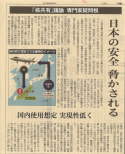
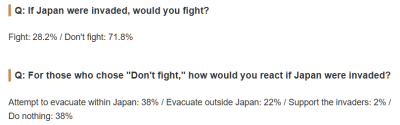
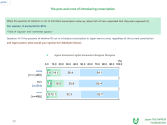
In another term of total mobilization preparedness, at least Japan does not have a good grade.
View attachment 169348
(2025, n=400)
View attachment 169347
(2023, n=1000)
Japan is already developing offensive missiles. Japan can launch rockets to space, they have enough technological sophistication to easily develop ICBMs and hypersonic IRBMs.
US and the west openly supports Japan developing and deploying massive number of offensive missiles. and I don't think Japan will have any problem getting a tech transfer either.
What this election win will do is allow the hawks in Japan actually execute the development and deployment of offensive missiles. Once that is developed and deployed then Japan will be able to blackmail China with missile attacks just like Iran is doing. They can essentially do the Iran strategy against China. Then they will go for nukes.
My feeling is that China can only subdue Japan with massive pressure campaign. It will be hugely costly for China's own economy. So, I don't think China will do that. They will do token actions and Japan will simply ignore it and keep going with their militarization.
Ultimately, China will have no choice but to fight this out. There is no other option.
The party composition of the Standing Committee of the NPC is less one-sided than the Japanese House of Representatives.

North Korea has loads of missiles and nukes. Yet they haven't really been able properly to "blackmail" Japan with it much less bigger players.Japan is already developing offensive missiles. Japan can launch rockets to space, they have enough technological sophistication to easily develop ICBMs and hypersonic IRBMs.
US and the west openly supports Japan developing and deploying massive number of offensive missiles. and I don't think Japan will have any problem getting a tech transfer either.
What this election win will do is allow the hawks in Japan actually execute the development and deployment of offensive missiles. Once that is developed and deployed then Japan will be able to blackmail China with missile attacks just like Iran is doing. They can essentially do the Iran strategy against China. Then they will go for nukes.
My feeling is that China can only subdue Japan with massive pressure campaign. It will be hugely costly for China's own economy. So, I don't think China will do that. They will do token actions and Japan will simply ignore it and keep going with their militarization.
Ultimately, China will have no choice but to fight this out. There is no other option.

Asset appreciation would collapse the carry trade. The Japanese carry trade has been a thing because Japan had a zero bond interest rate, almost no growth and flat markets. The Japanese rich had to move the money abroad to grow it. If they get an asset appreciation significantly above the currency depreciation they would stop the carry trade. Which is great for them. But not good for the USA or normal Japanese.I saw some Chinese expats in Japan posting on X:
The administration will inject massive liquidity into the market, trading Japanese wallets and futures for asset appreciation.
Bullish on assets and short on the yen. Carry trading will intensify further, making the Nikkei, US stocks, and cryptocurrencies even hotter, but the economy will even rely more on stock prices than on real profitability, until a deleveraging stock market crash surpassing 1990-1997 occurs.
Enduring some xenophobic pressure from Japan is a price to pay for reaping.
Once asset gains accumulate enough, leave Japan in line with public sentiment.
Looking forward to continued acceleration, we all have a bright future ahead, except for those voting for the LDP
My long standing opinion has been the Chinese being way too soft about Japan. That country hates China at a grassroots level. Their dislike ratio chart looks like GDP per capita graph of PRC. They like China only when it is poor. And their dislike ratio is like 95%. When you ask, they answer things like "Chinese immigrants are too loud". I don't know you but that does not sound like a valid reason for such an hatred to me. Over the last 20 years it always was China who was trying to keep the relationship functional. We are where the band aid needs to be ripped.Sanae Takaiichi is in course for a landslide victory. The Japanese people have given their message. So bring it on.
The Japanese people have now given China carte blanche to launch a full scale economic warfare on Japan. There should be no more mercy. It's time for Japan to feel some real economic pain. The majority of the Japanese voters have voted for this.
Ofcourse they did, they essentially blackmailed the US and others from "doing Iran style Bunker busting" on its nuke program by using its massive artillery capability against Seoul.North Korea has loads of missiles and nukes. Yet they haven't really been able properly to "blackmail" Japan with it.
If Japan tries to develop Nukes in the future and Japan already has thousands of hypersonic missiles deployed against China, then it is essentially blackmailing China from not trying to militarily stop Japan.
China will have to weigh the cost of thousands of Japanese missiles coming against Chinese cities and destroying valuable assets vs Going after Japanese nuke program.
China's military intervention against Japan will not be cost free, there will be huge destruction inside China as well. So, it will require enormous level of guts for whoever is Chinese leader at the time to pull the trigger against Japan.
I am afraid China will not be able to subdue Japan without going to a costly war and it cannot allow Japan to develop nukes which will be even more costly. Cause Japan is suicidal enough to launch Nukes against China even if it means its own destruction. They are the inventors of Kamikaze attacks.
I think China needs to prepare to go to war against Japan in the next 10 years.