China's Space Program Thread II

tankphobia

Senior Member
Registered Member
Imagine an object about 1.5 meters in size at a distance of 200 meters. Will it seem close to you?
In reality, the chance of a collision is very small anyway. But let me add, I personally am not at all enthusiastic about the Starlink systems. These systems incredibly pollute the space around the earth and are really not necessary. Progress is rapid and better technologies will certainly be available in a few years.
For orbit in which distances is measured in hundreds to thousands of km, 200 meter is an unacceptable level of risk.

Saying that, starlink esq LEO internet satellites only have a shelf life of 5-10 years before they run out of fuel and deorbit, so any issue with pollution is at least not permanent.
 

Jono

Junior Member
Registered Member
starlink esq LEO internet satellites only have a shelf life of 5-10 years before they run out of fuel and deorbit, so any issue with pollution is at least not permanent.
I wonder if this kind of "sympathetic" comment would still be made if a Chinese company instead of Starlink was involved??
I am not trying to accuse anybody of double standards, but China has almost always been painted in a bad light for whatever it does.
 

tankphobia

Senior Member
Registered Member
I wonder if this kind of "sympathetic" comment would still be made if a Chinese company instead of Starlink was involved??
I am not trying to accuse anybody of double standards, but China has almost always been painted in a bad light for whatever it does.
I'm not sure how you turned a fact about short lived LEO satellites into a East vs West pissing contest.
 

escobar

Brigadier
On July 3, 2025, the Long March 10B, a 5m reusable commercial launch vehicle was approved for development. This vehicle leverages and upgrades the market-oriented development model of the Jielong 3 and Long March 8 rockets, boasting high efficiency, high efficiency, and low cost. With a recovered first stage, it has a payload capacity of no less than 16 tons to low Earth orbit (200km LEO) and no less than 11 tons at a 900km, 50° orbital inclination.
View attachment 158906
The 5m diameter reusable rocket (likely CZ-10B) will maiden launch in first half year of 2026G8YL4oYbUAEgw1m.jpg
 

escobar

Brigadier
Brazil to get satellite internet from Chinese rival to Starlink in 2026
Chinese low Earth orbit satellite company SpaceSail will start providing internet access to remote areas in Brazil in the first half of 2026, President Luiz Inacio Lula da Silva's chief of staff, Rui Costa, said on Wednesday. SpaceSail and Brazil's state-owned telecom Telebras had signed a memorandum of understanding in late 2024 to offer satellite internet services for schools, hospitals and other essential services in the South American country.
 

Racek49

New Member
Registered Member
For orbit in which distances is measured in hundreds to thousands of km, 200 meter is an unacceptable level of risk.

Saying that, starlink esq LEO internet satellites only have a shelf life of 5-10 years before they run out of fuel and deorbit, so any issue with pollution is at least not permanent.
This is known. Two notes. If such a close flyby occurred, when there are several thousand of these satellites, what will it be like when there are 10 to 20 times more planned?
How many of them will fit into orbit, if they maintain a distance of 1000 km?
Just a note. Let's not discuss it further.
 

escobar

Brigadier
With the latest TLE data, it is confirmed Yaogan-40 is the third gen (1st Gen= YG-9ABC/16ABC/17ABC/20ABC/25ABC; 2nd Gen: YG-31 Group 1 to 4) Naval Ocean Surveillance System using tree satellites operating in a triangular formation separated from each other by about 120 km. 9 and 31 are in similar orbits, of around 1,100 by 1,050 km inclined by 63.4° but 40 at 851 by 854, 63.4° inclined, giving it a global view instead of just SCS & TW strait. 40 sats also bigger than the others, as launched by CZ-7A instead of LM-4C. As for 9&31, I'am expecting SSF to launch a new serie of optical sats (maybe also with a serie of SAR sats) to trail each 40 triplet for target confirmation.

NOSS give the ability not only to track warships on the open ocean, but also to directly target ships with weapons. I'am pretty sure SSF/PLAN also have adopted the “sensor-to-shooter” approach like USN has done decades ago. Instead of the NOSS satellites data being sent to the SSF/PLAN HQ and then to the ships, the information would be made automatically available to the weapons control stations in ships, subs, and aircraft; PLAN ships and aircraft exchanging tactical data in near realtime. This approach meant that more data could be delivered in useable form. This concept required that the satellite systems collect, process, and automatically report the information. I believe this is one of the key space system allowing PLAN anti-ship missiles to reach beyond the sensor range of their launching ships. And as PLA is shifting from a regional system to a global system, it means the era of anti-ship missile strike beyond 2IC is coming.

Note that, SSF also operate YG-32 (only 2 group launched) another NOS System using 2 sats instead of 3 in each group. Current US latest gen of NOSS (called Intruder) also used 2 sats for radar emissions triangulation.

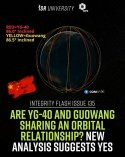
A new comparison of China’s YG-40 and Guowang launches reveals something:
  • YG-40 triplets: 851 km | 86.0° inclination
  • Guowang satellites: 1,168 km | 86.5° inclination
  • RAAN drift differences cause YG-40 to “twist” slowly beneath Guowang planes
The orbital comparison reveals the YG-40 satellites gradually drift to the west of the Guowang spacecraft as a result of differing RAAN precession rates. China had placed its YG-40 satellites into a near polar orbit in order to improve its RF detection/geolocation at the higher latitudes. Now it is possible YG-40’s orbit also allows it to use the Guowang satellite mesh network to quickly relay information to Chinese ground stations.
G8aa_4fWgAAV2UO.jpg
 
Top